Culture and the Gram Stain
Before molecular biology, diagnostic microbiology meant growing the organism and looking at it, and for a great many bacterial infections those two techniques — culture and the Gram stain — remain the reference standard. Culture is the only method that yields a live isolate, and a live isolate is what you need to test which antibiotics will actually work. That single capability keeps a 140-year-old technology at the center of modern clinical microbiology.
Culture: growing the organism#
A specimen (blood, urine, sputum, a swab) is spread onto or into a growth medium and incubated so that any viable organisms multiply into visible colonies. The medium is chosen to reveal what you are looking for.
- Enrichment media (e.g. blood agar) support fastidious organisms and reveal hemolysis patterns.
- Selective media contain agents that suppress unwanted flora so a target can grow — e.g. MacConkey agar selects for Gram-negative enterics.
- Differential media make different organisms look different, for instance by a color change when a particular sugar is fermented.
Blood culture — incubating blood in nutrient bottles until growth is detected — is the cornerstone test for sepsis, and the time-to-positivity itself carries information. Colony morphology, hemolysis, and growth requirements narrow the identification, which biochemical panels or MALDI-TOF then finalize.
The Gram stain#
The Gram stain, devised by Hans Christian Gram in 1884, sorts almost all bacteria into two groups based on their cell-wall structure.
- Crystal violet stains all cells purple.
- Iodine fixes the dye into a complex inside the cell.
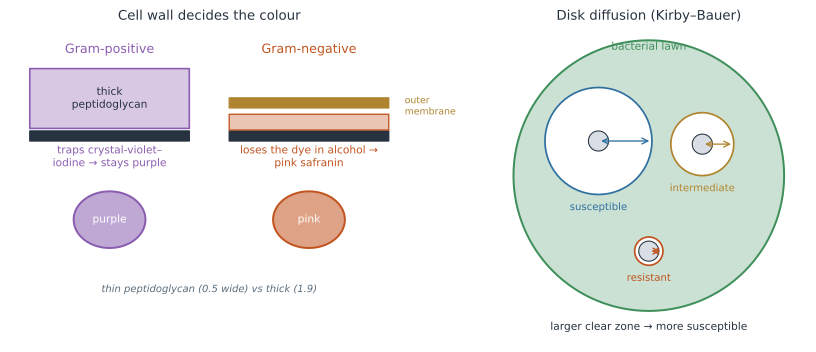
- Alcohol/acetone decolorizes — thick peptidoglycan walls retain the complex, thin ones do not.
- Safranin counterstains the decolorized cells pink.
Gram-positive bacteria (thick peptidoglycan) stay purple; Gram-negative bacteria (thin wall, outer membrane) turn pink (Figure 1). Combined with morphology — cocci vs rods, clusters vs chains — a Gram stain read in minutes gives an immediate, actionable first guess (Gram-positive cocci in clusters suggests Staphylococcus; Gram-negative rods in a urine sample suggest an enteric).
Antimicrobial susceptibility testing#
The reason a live isolate is so valuable is antimicrobial susceptibility testing (AST), which measures whether an antibiotic actually inhibits this organism.
- Disk diffusion (Kirby–Bauer) places antibiotic-impregnated disks on a lawn of the isolate; the diameter of the growth-free zone maps to susceptible/intermediate/resistant.
- Broth microdilution finds the minimum inhibitory concentration (MIC) — the lowest drug concentration that stops visible growth (see antimicrobial PK/PD).
Aggregated across many isolates, AST results build the antibiogram — the local map of resistance that guides empiric therapy and tracks the rise of resistant strains.
Trade-offs & resource considerations#
- Sensitivity & specificity. High for organisms that grow, and culture uniquely confirms viability. But fastidious, slow-growing, or unculturable organisms (many viruses, Mycobacterium tuberculosis over weeks, Treponema pallidum not at all) are missed, and prior antibiotics can sterilize a culture while the patient is still infected.
- Cost. Moderate — media, incubators, and consumables are inexpensive, but the labor of plating, reading, and identifying is substantial.
- Training & infrastructure. This is skill-intensive work: interpreting a Gram stain and colony morphology is a trained-eye task, and safe handling of live pathogens requires appropriate biosafety containment.
- Turnaround. The slow step — 1–2 days for common bacteria, longer for AST, and weeks for organisms like M. tuberculosis. This latency is culture’s central limitation and the main driver toward molecular and mass-spectrometry methods.
Why it matters#
Culture and the Gram stain are where diagnostic microbiology began and where much of it still lives. They deliver the live isolate that antimicrobial susceptibility testing needs, and the antibiogram those tests build is the frontline surveillance system for antimicrobial resistance — arguably the slowest-moving pandemic we face.
Related#
- Diagnostic Microscopy and Parasitology
- MALDI-TOF Mass Spectrometry — rapid ID from a colony
- Antimicrobial PK/PD — MIC and dosing
- Diagnostics & Surveillance