Electron Microscopy
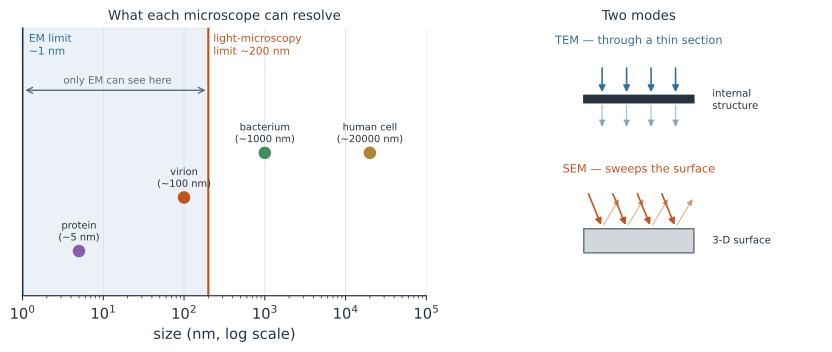
Light microscopy runs out of resolution at about 200 nanometers — far too coarse to see a virus. Electron microscopy (EM) replaces light with a beam of electrons, whose far shorter wavelength resolves structures down to the nanometer, bringing individual virions and cellular ultrastructure into view (Figure 1). It is not a high-throughput screening tool, but as a catch-all that can reveal a pathogen no one thought to test for, it holds a unique place in outbreak investigation and structural biology.
Two modes: TEM and SEM#
- Transmission EM (TEM) passes electrons through an ultrathin specimen; denser regions scatter more electrons, forming a high-resolution projection. TEM shows the internal structure and the shape of virus particles — the coronavirus corona, the bullet shape of rabies, the brick of a poxvirus.
- Scanning EM (SEM) sweeps a focused beam across a surface and collects scattered electrons to build a three-dimensional-looking image of the specimen’s exterior.
Negative staining: the diagnostic workhorse#
For rapid virus visualization, negative staining is the classic technique: the specimen is surrounded by a heavy-metal stain that is electron-dense, so the virus appears as a bright shape carved out of a dark background. In minutes it can reveal the morphology of any virus present, allowing family-level identification (is this a herpesvirus, a poxvirus, a coronavirus?) purely by shape — with no need for a pathogen-specific reagent. That reagent-free, hypothesis-free quality is EM’s diagnostic superpower: it can flag the completely unexpected.
Adding antibodies gives immuno-EM, which decorates specific targets with visible labels, and cryo-EM (flash-freezing specimens to image them near-native) has become a central tool of structural biology — solving the atomic structures of viral proteins that underpin vaccine and drug design, alongside X-ray crystallography.
Trade-offs & resource considerations#
- Sensitivity & specificity. Low sensitivity — a sample generally needs a high particle concentration (roughly a million particles per milliliter) to find anything — and only moderate specificity, since morphology usually identifies a virus family, not a species. Its value is breadth, not depth: it detects the unexpected rather than confirming the suspected.
- Cost. The highest of any method here: instruments run from hundreds of thousands to several million dollars, with demanding installation (vibration and electromagnetic isolation) and maintenance.
- Training & infrastructure. Requires a highly specialized operator and elaborate sample preparation (fixation, embedding, ultrathin sectioning, or cryo-preservation); it is concentrated in reference and research centers, not routine labs.
- Turnaround. Hours, including sample preparation — fast for negative-stain screening, slow for sectioned or cryo work.
- Where it fits. A specialist tool for novel or unculturable agents, outbreak triage when the cause is unknown, and structural research — not for routine, high-volume diagnosis.
Why it matters#
Electron microscopy has repeatedly been the method that named the unknown — it visualized the agents of outbreaks before molecular tests for them existed, and negative-stain EM remains a reference technique for characterizing emerging viruses. Its modern descendant, cryo-EM, now supplies the near-atomic structures that make structure-based vaccine and antiviral design possible, tying a classical diagnostic technique directly to countermeasure development.
Related#
- Diagnostic Microscopy and Parasitology — the light-microscopy counterpart
- MALDI-TOF Mass Spectrometry
- qPCR and RT-qPCR — the targeted method EM complements
- Diagnostics & Surveillance