One Health Surveillance
Most emerging infections in people begin somewhere else, in livestock, wildlife, or the environment, and reach humans only after circulating unseen. One Health surveillance watches those other compartments alongside human cases, so that a rise in animal or environmental signals can warn before the human curve turns up. It extends ordinary surveillance to the interface where spillover actually happens.
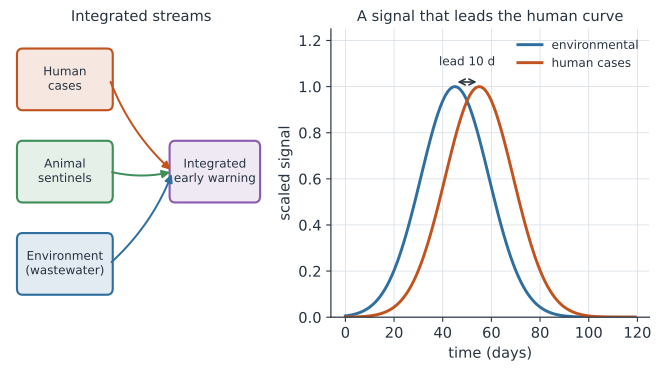
Three streams, one signal#
One Health surveillance draws on data that ordinary human-case reporting ignores.
- Human streams: clinical cases, syndromic reports, laboratory confirmations, the usual backbone of public-health surveillance.
- Animal streams: disease in domestic animals (dairy herds, poultry flocks) and in wildlife (bats, wild birds, rodents), plus sentinel animals deliberately monitored as early detectors, such as chickens watched for West Nile virus.
- Environmental streams: pathogen or its genetic material sampled from where it accumulates, most prominently wastewater, but also surface water, soil, and air.
The point is not three separate systems but one integrated signal. Read together, the streams cover the transmission cycle rather than only its human endpoint, and they can confirm each other: an environmental detection plus an animal cluster is far stronger evidence than either alone.
Why a cross-stream signal leads#
An animal or environmental stream can rise before human cases for a simple reason: it sits earlier in the causal chain.
Wastewater aggregates shedding from everyone in a sewershed, including pre-symptomatic and asymptomatic infections, so it does not wait for people to feel ill, seek care, get tested, and be reported. That removes the onset-to-report delays that hold back clinical surveillance. A sentinel or wildlife signal leads when the pathogen amplifies in an animal population before spilling over, as with avian influenza in wild birds and poultry ahead of human exposure.
The practical value is lead time: the number of days by which the leading stream anticipates the human curve. Even a week of warning changes what control can do, moving it from reactive to anticipatory.
Data linkage and governance#
The obstacle is rarely the biology; it is the institutions. Human health, agriculture, and environmental agencies keep separate data systems, mandates, and legal authorities, and animal or wildlife data may be commercially or politically sensitive. Linking streams means agreeing on shared case definitions, spatial and temporal resolution, and data-sharing rules across sectors that do not normally report to one another. One Health surveillance is as much a governance problem as a technical one, which is why sustained programs pair the data pipelines with formal cross-sector agreements.
A worked example#
Suppose an environmental (wastewater) stream and a human case curve both trace the same outbreak, but the wastewater signal peaks ten days earlier because it captures shedding before care-seeking and reporting. We recover that lead time from the two noisy series by sliding one against the other and taking the lag at which their cross-correlation peaks. The estimated lead, about ten days, is exactly the warning a One Health system buys over human-case reporting alone.
In code#
We simulate a leading environmental signal and a lagged human case curve, then estimate the lead time as the shift that maximizes the correlation between the two streams.
R#
set.seed(1834)
t <- 0:119
lead <- 10                                   # true environmental lead
wave <- function(peak) exp(-0.5 * ((t - peak) / 14)^2)

env   <- wave(45)        + rnorm(length(t), 0, 0.02)
human <- wave(45 + lead) + rnorm(length(t), 0, 0.02)

lags <- 0:30
corr <- sapply(lags, function(L) {
  h <- human[(L + 1):length(t)]
  cor(env[1:length(h)], h)
})
cat("estimated lead time (days):", lags[which.max(corr)], "\n")
Python#
import numpy as np

rng = np.random.default_rng(1834)
t = np.arange(0, 120)
lead = 10                                    # true environmental lead

def wave(peak):
    return np.exp(-0.5 * ((t - peak) / 14.0) ** 2)

env = wave(45) + rng.normal(0, 0.02, t.size)
human = wave(45 + lead) + rng.normal(0, 0.02, t.size)

# Slide the human curve earlier by L days; find the best-aligning lag.
lags = np.arange(0, 31)
ec = env - env.mean()
corr = np.array([
    np.corrcoef(ec[:t.size - L], human[L:] - human[L:].mean())[0, 1]
    for L in lags
])
best = int(lags[np.argmax(corr)])
print("estimated lead time (days):", best)
print("peak correlation:", round(float(corr.max()), 3))
estimated lead time (days): 10
peak correlation: 0.996
Julia#
using Random, Statistics
Random.seed!(1834)

t = 0:119
lead = 10
wave(peak) = exp.(-0.5 .* ((t .- peak) ./ 14).^2)

env   = wave(45)        .+ 0.02 .* randn(length(t))
human = wave(45 + lead) .+ 0.02 .* randn(length(t))

lags = 0:30
corr = [cor(env[1:length(t)-L], human[L+1:end]) for L in lags]
println("estimated lead time (days): ", lags[argmax(corr)])
Why it matters#
Spillover happens at the interface between people, animals, and the environment, and a surveillance system that only counts human cases sees it last. Integrating animal and environmental streams turns that interface into a warning system, buying lead time that reactive case reporting cannot. The gains are real but bounded by governance: the harder work is linking data across agencies that were never built to share it.