Copulas
Two questions hide inside every joint distribution: how is each variable distributed on its own, and how do the variables move together? A copula cleanly separates the second question from the first, so you can pair arbitrary marginal models — an exponential survival time, a heavy-tailed loss, a skewed rainfall total — with a dependence structure chosen independently of them. This decomposition is what lets you ask “these two risks each look fine alone, but how badly can they blow up together?” without committing to a joint normal you do not believe.
The probability integral transform#
The whole subject rests on one small fact about a single random variable. If is continuous with cumulative distribution function , then the transformed variable is . This is the probability integral transform: pushing a variable through its own CDF flattens whatever shape it had into a plain uniform, because . Running it backward, turns a uniform back into a variable with any marginal you want, which is exactly how the inverse-CDF sampling trick generates draws from an arbitrary distribution. A copula lives entirely on the uniform scale that this transform creates, so it never has to know or care what the original marginals were.
Sklar’s theorem#
The formal statement that dependence and marginals factor apart is Sklar’s theorem. For any joint CDF with marginals and , there exists a copula — a CDF on the unit square with uniform margins — such that When the marginals are continuous the copula is unique, and it is recovered by plugging the quantile functions back in, . Read the other direction, the theorem is a construction kit: choose any marginals and any copula , and is a valid joint distribution with exactly those margins and that dependence.
The copula itself has a clean interpretation. Because and are each uniform, is simply their joint CDF, Everything the copula encodes is dependence: the marginal information has been transformed away, leaving only how the two uniforms cling to or avoid each other.
Common families#
A copula family is a parametric shape for that dependence, and a few families cover most applied work.
Gaussian copula#
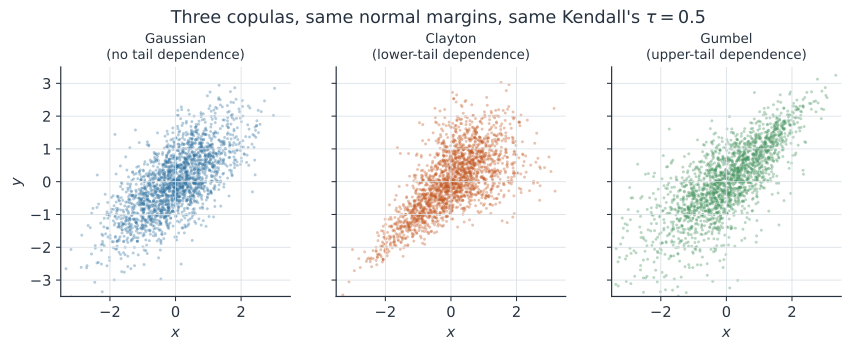
The Gaussian copula is the dependence structure you extract from a bivariate normal: correlate two standard normals with correlation , then push each through the standard normal CDF. Its single parameter tunes dependence from independence at to comonotone at . Its defining limitation is no tail dependence: no matter how high is (short of ), sufficiently extreme values of the two variables become asymptotically independent, so it systematically understates the chance of joint extremes.
t copula#
The t copula, taken from a multivariate Student- instead of a normal, keeps the elliptical shape but adds heavy joint tails. It has a degrees-of-freedom parameter alongside , and unlike the Gaussian it exhibits symmetric tail dependence that strengthens as shrinks — extreme lows cluster with extreme lows and extreme highs with extreme highs. This is why the t copula became the standard patch when Gaussian-copula models were blamed for underpricing simultaneous defaults.
Archimedean copulas#
Archimedean copulas are built from a generator function rather than an underlying multivariate distribution, and two of them give asymmetric tail dependence. The Clayton copula concentrates dependence in the lower tail — variables crash together but drift apart on the upside — which fits joint downside risk and correlated failures. The Gumbel copula does the mirror image, concentrating dependence in the upper tail, which fits joint extremes on the high side such as simultaneous flood peaks. Each has a single parameter controlling strength, and both reduce to independence at one end of their range.
Tail dependence#
The feature that separates these families, and the reason copula choice matters, is tail dependence: the probability that one variable is extreme given that the other is. Formally the lower-tail dependence coefficient is with an analogous at the upper tail. A positive means joint extremes do not vanish even in the limit: catastrophes co-occur. The Gaussian copula has , the t copula has , Clayton has with , and Gumbel has with . Two models can share the same overall correlation and still disagree wildly about how often the worst cases strike together, which is precisely where the figure’s three panels part ways.
Rank correlation#
Because a copula is invariant to the marginals, the natural way to summarize its strength is with rank correlations, which depend only on the ordering of the data and so are themselves margin-free. Kendall’s counts concordant minus discordant pairs, and Spearman’s is the ordinary correlation computed on the ranks. Unlike the Pearson correlation, neither changes if you apply any increasing transform to a margin, so they are functionals of the copula alone. This gives clean bridges between a copula’s parameter and its rank correlation: for the Gaussian copula , for Clayton , and for Gumbel . Those formulas let you calibrate a copula directly to an observed rank correlation, or read straight off a fitted parameter.
When to use copulas#
Copulas earn their keep whenever the marginals and the dependence want to be modeled separately. You reach for one to couple different marginal models — say a lognormal claim size with a Poisson-driven count — into a coherent joint law, to stress-test joint extremes by swapping a Gaussian coupling for a tail-dependent one and watching the simultaneous-disaster probability move, or to simulate correlated non-Gaussian data for which no convenient off-the-shelf multivariate distribution exists. The workflow is always the same: transform to uniforms, do the dependence work there, transform back out to whatever marginals you need.
A worked example#
Suppose we want samples with an Exponential(1) first margin and a Normal(10, 2) second margin, coupled by a Gaussian copula with correlation . We draw a correlated bivariate normal, apply the probability integral transform to get uniforms, then push those uniforms through the two target quantile functions. The margins come out exactly Exponential and Normal by construction, while the dependence is set by . The theory says Kendall’s should land near regardless of what marginals we chose, and the simulation confirms it.
In code#
R#
library(copula)                      # Gaussian copula, tau = 2/pi*asin(rho)
set.seed(1)
rho <- 0.7
cop <- normalCopula(rho, dim = 2)
# attach an Exponential(1) and a Normal(10, 2) margin
mv  <- mvdc(cop, c("exp", "norm"),
            list(list(rate = 1), list(mean = 10, sd = 2)))
xy  <- rMvdc(20000, mv)
c(kendall  = cor(xy[, 1], xy[, 2], method = "kendall"),
  spearman = cor(xy[, 1], xy[, 2], method = "spearman"),
  theory   = 2 / pi * asin(rho))
Python#
import numpy as np
from scipy.stats import norm, expon, kendalltau, spearmanr

rng = np.random.default_rng(0)
rho = 0.7                                  # Gaussian-copula correlation
z = rng.multivariate_normal([0, 0], [[1, rho], [rho, 1]], size=20_000)
u = norm.cdf(z)                            # probability integral transform -> uniforms
x = expon.ppf(u[:, 0])                     # Exponential(1) margin
y = norm.ppf(u[:, 1], loc=10, scale=2)     # Normal(10, 2) margin

print(f"target rho (copula)         = {rho:.3f}")
print(f"empirical Kendall tau       = {kendalltau(x, y).statistic:.3f}")
print(f"empirical Spearman rho      = {spearmanr(x, y).statistic:.3f}")
print(f"theory tau = 2/pi*asin(rho) = {2 / np.pi * np.arcsin(rho):.3f}")
print(f"margins: mean x = {x.mean():.2f}, mean y = {y.mean():.2f}")
target rho (copula)         = 0.700
empirical Kendall tau       = 0.494
empirical Spearman rho      = 0.684
theory tau = 2/pi*asin(rho) = 0.494
margins: mean x = 1.00, mean y = 9.99
Julia#
using Copulas, Distributions, StatsBase   # tau invariant to the margins
rho = 0.7
C  = GaussianCopula([1 rho; rho 1])
D  = SklarDist(C, (Exponential(1), Normal(10, 2)))   # attach the margins
xy = rand(D, 20_000)
x, y = xy[1, :], xy[2, :]
println("Kendall tau = ", corkendall(x, y))
println("Spearman    = ", corspearman(x, y))
println("theory tau  = ", 2 / pi * asin(rho))
Why it matters#
Copulas are the natural language for co-occurring risks, where the danger lives in the joint tail rather than in either margin. In infectious-disease work they let you couple correlated survival times — say time-to-recovery in paired or clustered subjects — while keeping realistic, possibly different, marginal hazards for each. They are the standard tool for joint environmental extremes, such as the chance that temperature and humidity, or two river gauges, spike together in a way a bivariate normal would badly underrate. And they are indispensable for simulating correlated non-normal data: pick the marginals your problem demands, pick a copula that captures the dependence and its tails, and generate synthetic data that no single named multivariate distribution could give you.