Diversity Indices
A diversity index compresses a whole community’s species composition into a single number that captures both how many species are present and how evenly the individuals are spread among them. This matters everywhere from gut microbiome surveys to host-parasite systems, because “which community is more diverse?” is really a question about the shape of the relative abundances .
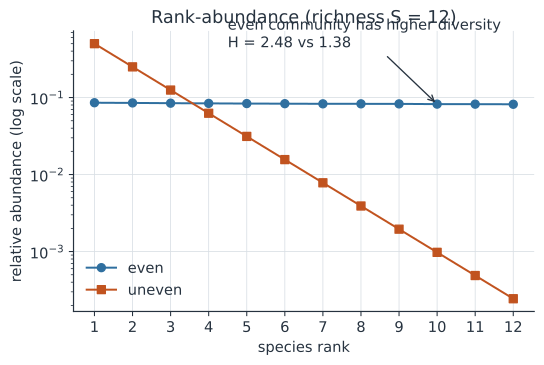
Relative abundances#
Start from counts of each species and convert them to relative abundances , the fraction of all individuals belonging to species . By construction they are non-negative and sum to one, so a is exactly the probability that a randomly drawn individual belongs to species . Every index below is a different summary of this abundance vector, which comes from the community’s underlying species-abundance distribution.
Species richness#
The simplest measure is species richness , the count of species with . Richness treats a species represented by a single individual exactly like a dominant one, so it ignores evenness entirely and is highly sensitive to sampling effort.
Shannon index#
The Shannon index borrows from information theory and measures the uncertainty in the species identity of a random individual: It is largest when all species are equally common and zero when one species holds everything. Because it uses the logarithm, is on a log scale; exponentiating it, returns an effective number of species — the number of equally-abundant species that would give the same . The Shannon index is also the expected value of over the community.
Simpson’s index#
Simpson’s index is the probability that two individuals drawn at random (with replacement) belong to the same species: Large means one or a few species dominate. Two common rescalings make it increase with diversity:
- Gini–Simpson index , the probability that two random individuals differ in species.
- Inverse Simpson index , again an effective number of species, but one that discounts rare species relative to .
Pielou’s evenness#
To separate evenness from richness, divide the Shannon index by its maximum possible value (attained when all species are equally abundant): Pielou’s evenness ranges from (one species dominates) to (perfectly even), and being a ratio it is comparable across communities with different .
Hill numbers unify them#
The Hill numbers express all of these as one family indexed by an order that tunes how much weight common species receive: Each is an effective number of species, measured in the same units as richness, which makes them directly comparable.
- : , plain richness — every species counts equally regardless of abundance.
- : the limit is , the exponential of Shannon — species weighted in proportion to abundance.
- : , the inverse Simpson number — common species weighted most.
As rises, rare species contribute less, so decreases: . Plotting against gives a diversity profile that summarizes a community at every weighting at once.
Worked example#
Take a community of four species with counts (total ), so Richness is .
Shannon index: So the effective number of species is .
Simpson’s index: Hence Gini–Simpson and inverse Simpson .
Evenness:
Collecting the Hill numbers: , , — a gentle decline, reflecting a fairly even community.
In code#
R#
p <- c(40, 30, 20, 10); p <- p / sum(p)     # relative abundances

# vegan
library(vegan)
diversity(p, index = "shannon")             # 1.279854
diversity(p, index = "simpson")             # 0.70  (Gini-Simpson, = 1 - D)
diversity(p, index = "invsimpson")          # 3.333333

# manual
S <- sum(p > 0)                             # richness = 4
H <- -sum(p * log(p))                       # 1.279854
J <- H / log(S)                             # 0.9231
D <- sum(p^2)                               # 0.30
hill <- function(p, q) if (q == 1) exp(-sum(p*log(p)))
                       else sum(p^q)^(1/(1-q))
c(hill(p,0), hill(p,1), hill(p,2))          # 4.000 3.596 3.333
Python#
import numpy as np
p = np.array([40, 30, 20, 10], float); p /= p.sum()

S = np.sum(p > 0)                    # 4
H = -np.sum(p * np.log(p))          # 1.2798542
J = H / np.log(S)                   # 0.92314
D = np.sum(p**2)                    # 0.30

def hill(p, q):
    return np.exp(-np.sum(p*np.log(p))) if q == 1 else np.sum(p**q)**(1/(1-q))

print(S, H, J, D)                   # 4 1.27985 0.92314 0.30
print([hill(p, q) for q in (0, 1, 2)])  # [4.0, 3.5955, 3.3333]
4 1.2798542258336674 0.9232196723355077 0.30000000000000004
[np.float64(4.0), np.float64(3.5961154666243216), np.float64(3.333333333333333)]
Julia#
p = [40, 30, 20, 10] ./ 100          # relative abundances

S = count(>(0), p)                   # 4
H = -sum(p .* log.(p))               # 1.2798542
J = H / log(S)                       # 0.92314
D = sum(p .^ 2)                      # 0.30

hill(p, q) = q == 1 ? exp(-sum(p .* log.(p))) : sum(p .^ q)^(1/(1 - q))
[hill(p, q) for q in (0, 1, 2)]      # [4.0, 3.5955, 3.3333]
Why it matters#
Because a single index can hide as much as it reveals, choosing an index is really choosing how much to care about rare species. Reporting richness, a Shannon- or Simpson-based number, and an evenness measure — or better, a whole Hill-number profile — lets a microbiome or community study compare samples on a common effective-species scale and state clearly whether a treatment changed the number of species, their evenness, or both.