The Exponential Distribution
The exponential distribution models the waiting time until the next event in a process where events occur at a constant average rate: the time between new infections, the length of an infectious period, the interval between radioactive decays, or the time until a component fails. It is the continuous companion of the Poisson distribution.
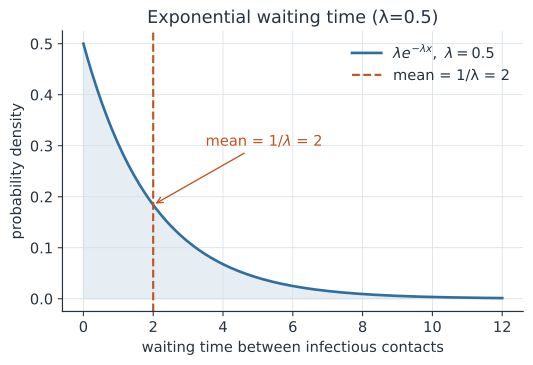
Definition#
Let be the waiting time with rate . Its probability density function is with cumulative distribution function .
- Support: .
- Parameter: rate (events per unit time). The reciprocal is the mean waiting time, sometimes called the scale.
- Mean: .
- Variance: .
Show the mean, variance, and memoryless property
Mean and variance. Integrate by parts with the density on :
A second integration by parts gives , so
Memorylessness. The survival function is , so
Having already waited a time tells you nothing about the remaining wait — the defining property of the exponential.
The memoryless property#
The exponential is the only continuous distribution that is memoryless: Having already waited units tells you nothing about how much longer you must wait — the process “forgets” the past. This is why it models the time to the next event in a constant-rate process, and why it is a common (if simplistic) model for infectious periods that end at a constant hazard.
Link to the Poisson#
If events occur according to a Poisson process with rate — so the count in any window is Poisson() — then the waiting times between consecutive events are independent Exponential() variables. Counting events and timing events are two views of the same underlying process.
When it arises#
The exponential arises for inter-event times at a constant rate: time between infections in early epidemic growth, duration of an infectious or latent period, survival times with constant hazard, and service or arrival times in queues.
In code#
Watch the parametrization carefully.
R uses the rate , SciPy uses a scale , and Julia’s Exponential(θ) also uses the scale .
R#
# R parametrizes by rate = lambda
dexp(1, rate = 0.5)    # density at x = 1
pexp(1, rate = 0.5)    # P(X <= 1) = 1 - exp(-0.5)
qexp(0.95, rate = 0.5) # 95% quantile

set.seed(123)
x <- rexp(10000, rate = 0.5)  # random sample, mean = 1/0.5 = 2
hist(x, breaks = 40, freq = FALSE)     # histogram
curve(dexp(x, rate = 0.5), add = TRUE) # overlay the density
Python#
import numpy as np
from scipy import stats

# scipy.stats.expon uses SCALE = 1/lambda (not the rate!)
lam = 0.5
stats.expon.pdf(1, scale=1/lam)    # density at 1
stats.expon.cdf(1, scale=1/lam)    # P(X <= 1)
stats.expon.ppf(0.95, scale=1/lam) # 95% quantile

rng = np.random.default_rng(123)
x = rng.exponential(scale=1/lam, size=10000)  # numpy also uses scale = 1/lambda
# plt.hist(x, bins=40, density=True); overlay stats.expon.pdf on a grid
Julia#
using Distributions, Random

# Julia's Exponential(theta) uses the SCALE theta = 1/lambda, NOT the rate.
lam = 0.5
d = Exponential(1 / lam)  # scale theta = 1/0.5 = 2  => rate lambda = 0.5
pdf(d, 1)                 # density at 1
cdf(d, 1)                 # P(X <= 1)
quantile(d, 0.95)         # 95% quantile

Random.seed!(123)
x = rand(d, 10_000)       # random sample, mean = theta = 2
# histogram(x, normalize=:pdf); plot!(t -> pdf(d, t)) to overlay the density
Simulation#
Many draws with rate have empirical mean near and variance near .
set.seed(7)
x <- rexp(1e6, rate = 0.5)
mean(x)  # ~ 2.0  (theoretical mean = 1/lambda)
var(x)   # ~ 4.0  (theoretical variance = 1/lambda^2)
Why it matters for statistics#
The exponential is the building block of survival analysis and reliability, the simplest hazard model, and the inter-arrival law of Poisson processes used throughout epidemiology and queueing theory. Understanding its rate-vs-scale parametrization prevents a common and costly software bug when moving between R, Python, and Julia.