Heritability and Variance Components
Heritability answers a deceptively simple question: how much of the variation in a trait across a population is due to genetic differences rather than environment? It is a variance ratio, not a statement about any individual, and it anchors the study of disease genetics, breeding, and polygenic scores.
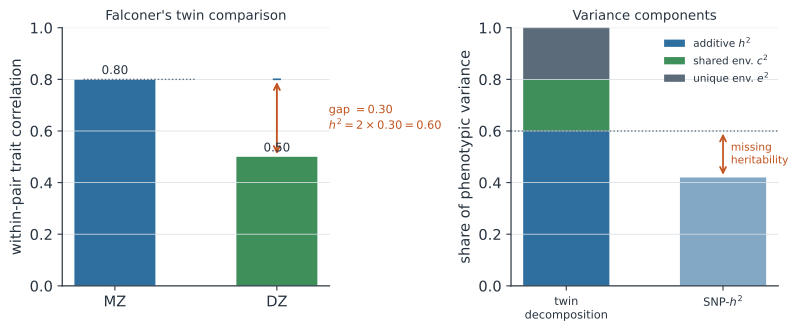
Decomposing phenotypic variance#
For a trait measured across a population, the total or phenotypic variance splits into genetic and environmental parts:
where is the variance attributable to genotype differences and to environment (this simple form assumes genotype and environment are uncorrelated and non-interacting). The genetic variance itself decomposes further:
into additive effects (the average per-allele contributions that parents pass on), dominance (interactions between alleles at one locus), and epistatic (interactions across loci).
Two heritabilities#
Broad-sense heritability is the fraction of phenotypic variance explained by all genetic differences:
Narrow-sense heritability uses only the additive part:
The narrow-sense is the more useful quantity in most of quantitative genetics because additive effects are what respond to selection and what a linear predictor built from allele dosages can capture. Both are ratios between and , and both are properties of a population in an environment, not fixed constants of a trait.
Estimating heritability#
Twin studies and Falconer’s formula#
Identical (monozygotic, MZ) twins share essentially all their DNA; fraternal (dizygotic, DZ) twins share on average half their segregating variants. If MZ pairs are more similar than DZ pairs, genetics is contributing. Comparing the trait correlation within MZ pairs, , to that within DZ pairs, , Falconer’s formula estimates
Show why the factor of two appears
Model each twin-pair correlation as the sum of the variance components the twins share. Identical (MZ) twins share all of their additive genetic variance and their common environment, while fraternal (DZ) twins share on average half the additive variance and the same common environment:
Subtracting eliminates the shared-environment term :
The same two equations recover the rest of the ACE decomposition, and . The “” is just the reciprocal of the difference in additive sharing between the two twin types.
The factor of two reflects that DZ twins share half the additive variance, so doubling the gap in correlations recovers the additive fraction. Broad-sense can be approximated as as well under simple assumptions, and estimates the shared-environment share.
SNP-heritability from genome-wide data#
Modern estimates use unrelated individuals and measured genotypes directly. Methods such as GREML fit a linear mixed model in which the phenotype has a random genetic effect whose covariance between individuals is their genetic relatedness matrix (GRM), computed from genome-wide SNPs:
with the GRM. The estimated is SNP-heritability, the additive variance tagged by common SNPs. It is typically lower than twin-based , and the gap (“missing heritability”) reflects rare variants and imperfect tagging.
Worked example#
A twin study of a quantitative trait reports and . Falconer’s formula gives
so about 60% of the trait variance is additively genetic (Figure 1). The shared-environment estimate is , and the remaining is unique environment plus measurement error.
In code#
R#
r_mz <- 0.80; r_dz <- 0.50
h2 <- 2 * (r_mz - r_dz)      # 0.60  narrow-sense heritability
c2 <- 2 * r_dz - r_mz        # 0.20  shared environment
e2 <- 1 - r_mz               # 0.20  unique environment

# Variance-component view: V_P = V_G + V_E
V_G <- 6; V_E <- 4; V_P <- V_G + V_E
H2  <- V_G / V_P             # 0.60  broad-sense
# SNP-heritability in practice: lme4/GCTA-style mixed model with a GRM
Python#
r_mz, r_dz = 0.80, 0.50
h2 = 2 * (r_mz - r_dz)       # 0.60
c2 = 2 * r_dz - r_mz         # 0.20
e2 = 1 - r_mz                # 0.20

V_G, V_E = 6.0, 4.0
V_P = V_G + V_E
H2 = V_G / V_P               # 0.60  broad-sense
# SNP-heritability: statsmodels MixedLM / GREML-style GRM model
Julia#
r_mz, r_dz = 0.80, 0.50
h2 = 2 * (r_mz - r_dz)       # 0.60
c2 = 2 * r_dz - r_mz         # 0.20
e2 = 1 - r_mz                # 0.20

V_G, V_E = 6.0, 4.0
V_P = V_G + V_E
H2 = V_G / V_P               # 0.60  broad-sense
# SNP-heritability: MixedModels.jl with a genetic relatedness matrix
Why it matters#
Heritability sets a ceiling on how well genetics can ever predict a trait, framing expectations for GWAS discovery and polygenic-score accuracy. It is also one of the most misunderstood numbers in science: a high does not mean a trait is unchangeable, nor does it explain differences between groups or within an individual — it describes the sources of variance in one population under its particular range of environments.