PK/PD Target Attainment
A dose that works in the average patient can still fail in many individuals, because clearance, volume, and the minimum inhibition concentration (MIC) all vary. Target attainment turns that variability into a probability: given a dose and an organism, what fraction of patients reach the pharmacodynamic target that predicts a good outcome? The calculation joins the concentration-time curve from pharmacokinetics to the PK/PD indices through a Monte Carlo simulation over between-patient differences.
Pharmacodynamic targets#
The feature of the concentration-time profile that predicts killing depends on the drug class, giving three targets measured against the MIC.
For beta-lactams killing is time-dependent, so the target is the fraction of the dosing interval that free drug spends above the MIC:
with goals typically around to of the interval. For fluoroquinolones and vancomycin total exposure matters, so the target is the free 24-hour area under the curve over the MIC, . For aminoglycosides a tall peak drives killing, so the target is the peak over the MIC, . Each target is a single number that a simulated profile either clears or misses.
Probability of target attainment#
A patient’s pharmacokinetics are not known in advance, so the target is met only with some probability. Let collect the patient-varying parameters (clearance, volume), drawn from a population distribution fit to a pharmacokinetic study. The probability of target attainment at a given dose and MIC is the chance a random patient clears the target:
where is the achieved index for that patient and is the target value. The integral rarely has a closed form, so it is estimated by Monte Carlo: draw many virtual patients, compute each one’s index, and take the fraction that succeed. A regimen is usually judged acceptable when .
From PTA to the cumulative fraction of response#
PTA is computed at a single MIC, but a real pathogen population presents a distribution of MICs. Weighting the PTA by how often each MIC occurs gives the cumulative fraction of response, the expected attainment across the organism population:
CFR answers the empirical-therapy question, where the MIC is unknown at the time of dosing, whereas PTA answers the targeted question once the MIC is measured.
Choosing doses and breakpoints#
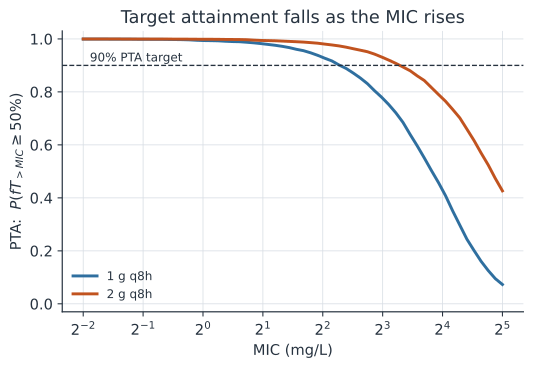
The PTA-versus-MIC curve is the tool for both decisions. Reading down from the line gives the highest MIC a dose reliably covers, which is the pharmacodynamic breakpoint separating susceptible from resistant. Reading across shows how a larger dose or a longer infusion shifts the whole curve rightward, extending coverage to less susceptible organisms. Regulators and committees use exactly these curves to set dosing and susceptibility breakpoints.
A worked example#
Take a beta-lactam given as a intravenous bolus every into a volume , with the target against an organism with . Clearance varies across patients lognormally with median and a coefficient of variation of , so each patient has elimination rate and a steady-state peak
The concentration decays as over the interval, so it stays above the MIC for a time , and the fraction above MIC is that time divided by (capped at one, or zero if the peak never reaches the MIC). Simulating many patients and counting those with gives a PTA near for the dose, short of the goal. Doubling to lifts the whole profile and pushes PTA above at the same MIC, which is exactly how a dose is selected.
In code#
We draw lognormal clearances, form each patient’s steady-state profile in closed form, compute , and report the attainment probability for two doses at a fixed MIC.
R#
set.seed(1834)
V <- 15; tau <- 8; target <- 0.50; mic <- 8
cl_med <- 6; cl_cv <- 0.40; n <- 5000

sigma <- sqrt(log(1 + cl_cv^2))
cl <- cl_med * exp(rnorm(n, 0, sigma))       # lognormal clearance
k  <- cl / V

ft_above <- function(dose) {
  cmax <- (dose / V) / (1 - exp(-k * tau))    # steady-state peak
  tcross <- ifelse(cmax > mic, log(cmax / mic) / k, 0)
  pmin(tcross, tau) / tau
}
c(g1 = mean(ft_above(1000) >= target),        # ~0.78
  g2 = mean(ft_above(2000) >= target))        # ~0.93
Python#
import numpy as np

rng = np.random.default_rng(1834)
V, tau, target, mic = 15.0, 8.0, 0.50, 8.0
cl_med, cl_cv, n = 6.0, 0.40, 5000

sigma = np.sqrt(np.log(1 + cl_cv**2))
cl = cl_med * np.exp(rng.normal(0.0, sigma, n))   # lognormal clearance
k = cl / V


def ft_above_mic(dose):
    cmax = (dose / V) / (1 - np.exp(-k * tau))     # steady-state peak
    t_cross = np.where(cmax > mic, np.log(cmax / mic) / k, 0.0)
    return np.minimum(t_cross, tau) / tau


for dose in (1000.0, 2000.0):
    pta = np.mean(ft_above_mic(dose) >= target)
    print(f"dose={dose/1000:.0f} g   PTA at MIC={mic:g} = {pta:.3f}")
dose=1 g   PTA at MIC=8 = 0.776
dose=2 g   PTA at MIC=8 = 0.930
Julia#
using Random, Statistics
Random.seed!(1834)
V, tau, target, mic = 15.0, 8.0, 0.50, 8.0
cl_med, cl_cv, n = 6.0, 0.40, 5000

sigma = sqrt(log(1 + cl_cv^2))
cl = cl_med .* exp.(sigma .* randn(n))          # lognormal clearance
k = cl ./ V

function ft_above(dose)
    cmax = (dose / V) ./ (1 .- exp.(-k .* tau))
    tcross = ifelse.(cmax .> mic, log.(cmax ./ mic) ./ k, 0.0)
    min.(tcross, tau) ./ tau
end
(mean(ft_above(1000.0) .>= target),            # ~0.78
 mean(ft_above(2000.0) .>= target))            # ~0.93
Why it matters#
Target attainment is how dosing decisions carry their uncertainty honestly, reporting the probability a regimen works rather than a single point estimate that hides the patients it fails. The same PTA curves that pick a dose also set the susceptibility breakpoints laboratories use to call an organism resistant, linking bedside pharmacology to surveillance. Keeping attainment high at the individual scale is also what suppresses the population spread of resistance, since regimens that clear infections reliably give resistant strains fewer openings.
Related#
- Pharmacokinetics: Compartment Models — the concentration-time curve behind each patient
- Pharmacodynamics: Dose–Response — where the targets come from
- Antimicrobial PK/PD — the indices scored against the MIC
- Population Dynamics of Resistance — the sibling population view
- Quantitative Methods