Response Surface Methodology
Response Surface Methodology (RSM) is a sequential strategy for optimizing a process or output over continuous factors — think maximizing yield or minimizing defects by tuning temperature and pressure. You first move quickly toward the optimum with a simple model, then map the curvature near it with a richer one.
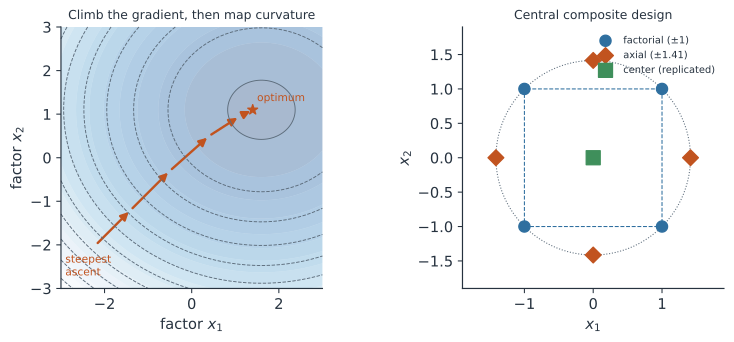
The two-phase strategy#
Phase 1: first-order model and steepest ascent#
Far from the optimum, the surface is locally well approximated by a plane:
Fit it with a two-level factorial plus center points. The gradient points in the direction of steepest ascent; take experimental steps along it until the response stops improving, signaling you are near a peak (where first-order terms flatten and curvature dominates) (Figure 1).
Phase 2: second-order model and curvature#
Near the optimum, add quadratic and cross-product terms:
This quadratic can bend, so it can represent a maximum, minimum, or saddle.
Central composite designs (CCD)#
Fitting the second-order model requires at least three levels per factor. A central composite design builds this economically from three pieces:
- Factorial points — the (or fractional) corners, .
- Axial (star) points — points at , etc., extending each axis beyond the cube. Choosing gives a rotatable design (equal prediction variance at equal distance from the center).
- Center points — several replicates at the origin, giving a pure-error estimate and information on curvature.
Canonical / stationary-point analysis#
Write the fitted second-order model in matrix form:
where is the vector of linear coefficients and is the symmetric matrix with on the diagonal and off-diagonal. Setting the gradient to zero, , gives the stationary point:
The eigenvalues of classify it: all negative → maximum, all positive → minimum, mixed signs → saddle point (a ridge to explore further).
Worked example#
Fit a one-factor quadratic . With scalar and , the stationary point is
Suppose . Then , and since it is a maximum, with predicted optimum . In two factors the same formula locates the peak of the fitted surface.
In code#
R#
library(rsm)
set.seed(1)
# Central composite design in 2 coded factors
d <- ccd(2, n0 = c(3, 3), alpha = "rotatable", randomize = FALSE)
# Simulate a quadratic response with a maximum
d$y <- 80 + 6 * d$x1 + 4 * d$x2 - 3 * d$x1^2 - 2 * d$x2^2 -
       d$x1 * d$x2 + rnorm(nrow(d), 0, 0.5)

fit <- rsm(y ~ SO(x1, x2), data = d)   # SO = second order
summary(fit)                            # includes stationary point + eigenvalues
Python#
import numpy as np
import pandas as pd
import statsmodels.formula.api as smf
from pyDOE3 import ccdesign

np.random.seed(1)
pts = ccdesign(2, center=(3, 3), alpha="r", face="ccc")  # rotatable CCD
d = pd.DataFrame(pts, columns=["x1", "x2"])
d["y"] = (80 + 6*d.x1 + 4*d.x2 - 3*d.x1**2 - 2*d.x2**2
          - d.x1*d.x2 + np.random.normal(0, 0.5, len(d)))

fit = smf.ols("y ~ x1 + x2 + I(x1**2) + I(x2**2) + x1:x2", data=d).fit()
c = fit.params
b = np.array([c["x1"], c["x2"]])
B = np.array([[c["I(x1 ** 2)"], c["x1:x2"] / 2],
              [c["x1:x2"] / 2,  c["I(x2 ** 2)"]]])
x_s = -0.5 * np.linalg.solve(B, b)
print(x_s)                 # stationary point ~ (0.9, 0.8)
print(np.linalg.eigvals(B))  # both negative -> maximum
Julia#
using LinearAlgebra, Random
Random.seed!(1)

# Manual CCD in 2 factors: factorial corners, axial points, center reps
α = 2.0^(1/4)                         # rotatable
factorial_pts = [(-1,-1), (1,-1), (-1,1), (1,1)]
axial_pts     = [(-α,0), (α,0), (0,-α), (0,α)]
center_pts    = fill((0.0, 0.0), 3)
pts = vcat(collect.(factorial_pts), collect.(axial_pts), collect.(center_pts))
X1 = [p[1] for p in pts]; X2 = [p[2] for p in pts]

y = 80 .+ 6 .*X1 .+ 4 .*X2 .- 3 .*X1.^2 .- 2 .*X2.^2 .- X1.*X2 .+ 0.5 .*randn(length(pts))

# Design matrix: 1, x1, x2, x1^2, x2^2, x1*x2 ; least squares
X = hcat(ones(length(pts)), X1, X2, X1.^2, X2.^2, X1.*X2)
β = X \ y
b = [β[2], β[3]]
B = [β[4]      β[6]/2;
     β[6]/2    β[5]]
x_s = -0.5 * (B \ b)      # stationary point
eigvals(B)                 # both negative -> maximum
Why it matters for statistics#
RSM turns optimization into a sequence of small, informative experiments rather than a blind search. By pairing efficient designs (factorials, then CCDs) with regression models and calculus (gradients for ascent, the stationary-point formula for the peak), it finds and characterizes optima with minimal runs. It is central to process improvement in chemistry, manufacturing, and formulation science, and it connects experimental design directly to continuous optimization.