Spatial Diffusion and the Heat Equation
Drop a bit of dye into still water, release a puff of spores into calm air, or track an animal wandering without a destination, and the same thing happens: the material spreads out, smoothing from a sharp concentration into an ever-broader blur. Diffusion is that spreading — the macroscopic consequence of countless particles each moving at random, with no growth, no source, and no preferred direction. This page is about pure spreading; when local growth is added on top, the dynamics change qualitatively into the constant-speed fronts of reaction–diffusion.
The diffusion (heat) equation#
Let be the concentration of some substance at position and time . Pure diffusion obeys the diffusion equation, also called the heat equation, where is the diffusion coefficient (units of area per time) and is the Laplacian. In one dimension is just the curvature of the concentration profile, so the equation reads . The partial derivative is the rate of change at a fixed point in space, and its sign is set entirely by the local curvature. Where the profile dips below its neighbors the curvature is positive and rises to fill the dip; where the profile peaks the curvature is negative and the peak erodes. Diffusion therefore does nothing but flatten gradients: it conserves the total amount of substance while relentlessly smoothing it toward uniformity.
Fick’s law: the constitutive assumption#
The equation follows from one physical idea, Fick’s law, which says that the flux of substance points down the concentration gradient and is proportional to its steepness, Particles do not “want” to move anywhere, but because there are more of them on the high side of a gradient than the low side, random motion carries a net flow from high to low concentration. Combining Fick’s law with conservation of mass — the continuity statement , that concentration changes only as flux accumulates — gives when is constant. The minus sign is the whole story: flux runs against the gradient, which is why diffusion always erases differences rather than amplifying them.
The microscopic picture: a random walk#
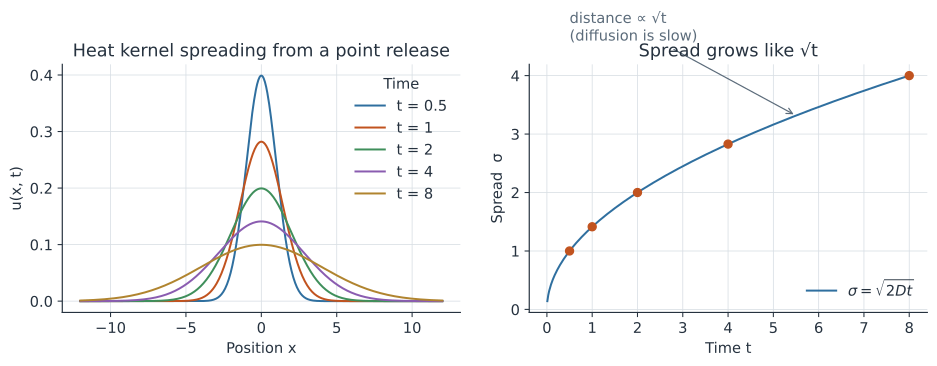
Underneath the smooth equation is a jittering particle. Consider a walker on a line that every time step takes a step of size , each direction equally likely, independent of the past — a random walk, the discrete cousin of Brownian motion. After steps its position is a sum of independent increments, so its mean displacement is zero (the walk drifts nowhere) but its variance grows: each step adds to the variance, giving . Writing and , the mean-squared displacement is and in dimensions, since each of the independent coordinates contributes . The characteristic distance the walker has wandered is the square root of this, This scaling is the signature of diffusion, and it makes diffusion slow: to spread twice as far takes four times as long, and to spread ten times as far takes a hundred times as long. A directed process covers distance ; a diffusing one covers distance , and the gap between them only widens with time.
The fundamental solution: a spreading Gaussian#
What does a point release actually look like as it spreads? Start with all the substance concentrated at the origin — a spike, formally a Dirac delta — and let it diffuse. The solution is the fundamental solution, or heat kernel, This is a normal distribution with mean and variance , and it is no coincidence: the central limit theorem guarantees that a sum of many small independent random steps is Gaussian, so the spatial profile of many diffusing walkers is a bell curve whose width grows like . As increases the Gaussian gets shorter and wider while the area under it stays fixed at , exactly as the figure shows. Because the diffusion equation is linear, the spreading of any initial profile is obtained by convolving it with this kernel — every release is a superposition of point releases, each blurring into its own broadening Gaussian.
Boundary conditions#
On a finite domain the equation needs conditions at the edges, and two kinds cover most cases. A Dirichlet condition fixes the concentration at a boundary, — appropriate for an absorbing edge held at a reservoir value, such as a lake shore that instantly dilutes any arriving pollutant. A Neumann condition fixes the flux, for a reflecting or zero-flux boundary, appropriate for an impermeable wall that nothing crosses, so the substance piles up rather than leaking out. The choice matters: absorbing (Dirichlet) boundaries drain substance and drive the interior toward zero, while zero-flux (Neumann) boundaries conserve it and let diffusion settle to a flat, uniform steady state.
How diffusion differs from advection and from reaction–diffusion#
It is worth separating three transport mechanisms that are easy to conflate. Advection is directed transport: a substance carried by a current or wind obeys , and its center of mass moves at speed , covering distance without spreading. Diffusion is undirected: the center of mass stays put and the substance spreads symmetrically, with width . Real plumes usually combine the two — the advection–diffusion equation describes a Gaussian blob that drifts downstream at speed while broadening like . Reaction–diffusion is different again: adding a growth term lets a locally multiplying population continually resupply its leading edge, and the result is a traveling wave that advances at a constant speed — distance , not . The contrast is the key lesson: random movement alone spreads a fixed amount of material ever more thinly and slowly, whereas movement plus growth invades new territory at a steady pace.
A worked example#
Suppose a pollutant is released at a point in groundwater with diffusion coefficient .
Spread after a given time. After one day, , the characteristic spread is So a day of pure diffusion smears the release over roughly ten metres — modest, because diffusion is slow.
Time to diffuse a given distance. To spread a characteristic distance we invert to get Reaching by diffusion alone would take times as long — about years — because the time scales with the square of the distance. This quadratic cost is why diffusion dominates only over short ranges (across a cell membrane, through a few metres of soil) and why long-range dispersal almost always relies on advection or active movement instead.
In code#
We simulate many independent one-dimensional random walkers and confirm that their mean-squared displacement grows linearly in time as .
R#
set.seed(1)
n_walkers <- 20000
n_steps   <- 400
ell <- 1; tau <- 1                 # step size and step time
D <- ell^2 / (2 * tau)             # diffusion coefficient = 0.5

steps <- matrix(sample(c(-ell, ell), n_walkers * n_steps, replace = TRUE),
                nrow = n_walkers)
pos <- t(apply(steps, 1, cumsum))  # position of each walker over time

for (t in c(100, 200, 400)) {
  msd <- mean(pos[, t]^2)
  cat(sprintf("t=%3d  MSD=%7.1f  2Dt=%7.1f\n", t, msd, 2 * D * t))
}
Python#
import numpy as np

rng = np.random.default_rng(1)
n_walkers, n_steps = 20000, 400
ell, tau = 1.0, 1.0                     # step size and step time
D = ell**2 / (2 * tau)                  # diffusion coefficient = 0.5

steps = rng.choice([-ell, ell], size=(n_walkers, n_steps))
pos = np.cumsum(steps, axis=1)          # position of each walker over time

for t in (100, 200, 400):
    msd = np.mean(pos[:, t - 1] ** 2)   # mean-squared displacement
    print(f"t={t:3d}  MSD={msd:7.1f}  2Dt={2 * D * t:7.1f}")
t=100  MSD=   99.8  2Dt=  100.0
t=200  MSD=  200.9  2Dt=  200.0
t=400  MSD=  402.1  2Dt=  400.0
Julia#
using Random, Statistics
Random.seed!(1)
n_walkers, n_steps = 20000, 400
ell, tau = 1.0, 1.0                     # step size and step time
D = ell^2 / (2 * tau)                   # diffusion coefficient = 0.5

steps = rand((-ell, ell), n_walkers, n_steps)
pos = cumsum(steps, dims = 2)           # position of each walker over time

for t in (100, 200, 400)
    msd = mean(pos[:, t] .^ 2)          # mean-squared displacement
    println("t=$t  MSD=$(round(msd, digits=1))  2Dt=$(2 * D * t)")
end
The measured mean-squared displacement tracks closely, confirming the linear-in-time growth that underlies the spread.
Why it matters#
Diffusion is the null model for spread: it is what happens when things move but nothing grows, and its slow crawl is the baseline against which faster mechanisms are measured. It sets the scale for how far pathogen particles, spores, or airborne droplets drift from a source, how a pollutant plume broadens as it seeps through soil or groundwater, and how far an individual animal wanders when foraging without a goal. The same mathematics explains why molecular signalling works only across microns — a signalling molecule takes milliseconds to cross a cell but centuries to cross a room — so life relies on diffusion for the short haul and bulk flow for the long haul. Crucially, pure diffusion does not by itself produce the sharp, constant-speed epidemic fronts seen when disease sweeps across a landscape; those require the growth term of reaction–diffusion, and comparing the two makes precise why an outbreak advances like a wall of fire () rather than a spreading stain ().