Parallelism & Concurrency
A modern laptop has 8 or more cores, and a cluster node has dozens. Running work on many cores at once — parallelism — is how a 1,000-replicate simulation study or a set of MCMC chains finishes in an hour instead of a day. But parallel code introduces failure modes that serial code simply does not have: results that come out wrong (race conditions), results that are slower than serial (oversubscription), and bugs that refuse to reproduce.
This page is about getting the speedup without the surprises — with particular attention to the thread-setting traps that bite users of Stan, data.table, and multithreaded math libraries.
Cores, Processes, and Threads#
Three words that are easy to blur but matter here:
- A core is a physical unit that executes instructions.
Ncores can doNthings at literally the same time. - A process is a running program with its own private memory. Two processes can’t accidentally corrupt each other’s data.
- A thread is a unit of execution inside a process; multiple threads share the same memory. That sharing is what makes threads fast to coordinate — and what makes them dangerous.
The one-line summary: processes are isolated and safe; threads are shared and fast but hazardous.
The Easy, Safe Kind: Embarrassingly Parallel#
Most parallelism in mathematical biology is the good kind: many independent tasks that don’t need to talk to each other — 1,000 simulation replicates, 4 MCMC chains, a grid of parameter values, a bootstrap. Each task runs on its own, and you just collect the results. This parallel-map pattern is safe because nothing is shared and mutated.
# R: run independent replicates across cores (furrr = purrr + future)
library(furrr)
plan(multisession, workers = 8)
results <- future_map(1:1000, run_one_replicate,
                      .options = furrr_options(seed = TRUE))  # per-worker RNG
# Python: a process pool sidesteps the GIL for CPU-bound work
from concurrent.futures import ProcessPoolExecutor
with ProcessPoolExecutor(max_workers=8) as pool:
    results = list(pool.map(run_one_replicate, range(1000)))
# Julia: independent tasks over threads
using Base.Threads
results = Vector{Float64}(undef, 1000)
@threads for i in 1:1000
    results[i] = run_one_replicate(i)     # each i writes its OWN slot -> safe
end
Prefer this pattern whenever you can. If tasks are independent, parallelism is almost free of danger.
Race Conditions: When Threads Share State#
The trouble starts when parallel workers read and write the same data.
Because an operation as innocent as count = count + 1 is really three steps — read, add, write — two threads can interleave so that one update is silently lost.
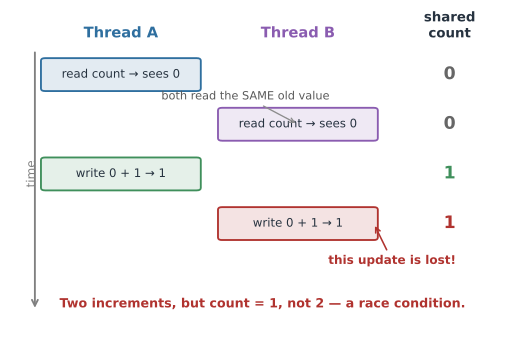
This is a race condition, and it has three nasty properties: the answer is wrong, it is nondeterministic (depends on timing, so it changes run to run), and it therefore often can’t be reproduced on demand — the worst kind of bug.
The defenses, in order of preference:
- Don’t share mutable state. Give each worker its own output slot or return value and combine at the end (the parallel-map pattern above). This is by far the best option.
- Use a reduction. Frameworks provide safe parallel
sum/+reductions that avoid the shared-counter trap. - Lock the shared resource (a mutex) only as a last resort — it is easy to get wrong and it serializes the very code you parallelized.
A subtler cousin: even a correct parallel sum can give slightly different low-order digits each run, because floating-point addition is not associative and threads finish in a different order. Round before testing for equality.
Amdahl’s Law: Why 64 Cores ≠ 64× Faster#
Parallelism only speeds up the part of your program that actually runs in parallel. If a fraction of the work is parallelizable and the rest is inherently serial, the best possible speedup on workers is
The serial remainder sets a hard ceiling, and the returns diminish fast:
def amdahl(p, n):
    return 1 / ((1 - p) + p / n)

print(f"{'workers':>7} | {'p=0.50':>7} | {'p=0.90':>7} | {'p=0.99':>7}")
print("-" * 38)
for n in [2, 4, 8, 16, 64, 256]:
    print(f"{n:>7} | {amdahl(0.50, n):>7.2f} | {amdahl(0.90, n):>7.2f} | {amdahl(0.99, n):>7.2f}")
workers |  p=0.50 |  p=0.90 |  p=0.99
--------------------------------------
      2 |    1.33 |    1.82 |    1.98
      4 |    1.60 |    3.08 |    3.88
      8 |    1.78 |    4.71 |    7.48
     16 |    1.88 |    6.40 |   13.91
     64 |    1.97 |    8.77 |   39.26
    256 |    1.99 |    9.66 |   72.11
Even code that is 90% parallel can never exceed a 10× speedup, no matter how many cores you throw at it. The practical lesson: profile to find the serial bottleneck (see vectorization & profiling) before scaling out, and don’t request 64 cores for a job that can’t use them.
The Oversubscription Trap (Stan, data.table, BLAS)#
This is the mistake that most often makes parallel scientific code slower than serial, and it is worth understanding concretely. Many libraries already multithread internally. When you then run them inside your own parallel loop, the thread counts multiply: with 8 workers each spawning 8 internal threads, you get 64 threads fighting over 8 cores, and they spend their time context-switching instead of computing.
The rule is to parallelize at exactly one level: either run N single-threaded workers, or one job with N internal threads — never N × N.
Stan (rstan / cmdstanr) runs one chain per core by default, which is the natural parallelism.
If you also turn on within-chain threading (reduce_sum, threads_per_chain), the total is chains × threads_per_chain, and you must keep that at or below your physical core count:
# cmdstanr: 4 chains in parallel, 2 threads each = 8 threads on an 8-core box
fit <- mod$sample(data = dat,
                  chains = 4, parallel_chains = 4,
                  threads_per_chain = 2)     # 4 x 2 = 8, matches the cores
data.table uses many threads by default (getDTthreads()).
Inside a parallel foreach/future_map, each worker then launches a full set of data.table threads — classic oversubscription.
Pin it to one thread inside workers:
library(data.table)
# inside each parallel worker:
setDTthreads(1)          # let the OUTER parallelism own the cores
BLAS / OpenMP (OpenBLAS, MKL) multithread matrix algebra automatically. Combined with a multiprocessing loop, you again oversubscribe. Cap the inner threads to one in each worker:
# set before launching R/Python workers, or per-worker
export OMP_NUM_THREADS=1
export OPENBLAS_NUM_THREADS=1
# R equivalent, inside a worker
RhpcBLASctl::blas_set_num_threads(1)
When you request cores from SLURM, match the library’s thread count to --cpus-per-task, and set the inner libraries to 1 thread when the outer loop is doing the parallelizing.
Threads, Reproducibility, and the GIL#
- Reproducibility needs per-worker seeds. Never let parallel workers share one generator or reuse one seed; derive an independent stream for each, as on the randomness page (
future’sseed = TRUE,SeedSequence.spawn, L’Ecuyer-CMRG). - Python’s GIL means threads do not speed up CPU-bound pure-Python code — only one thread runs Python bytecode at a time.
Use processes (
ProcessPoolExecutor,joblib) for CPU-bound work; threads help only for I/O or code that drops into compiled libraries (NumPy) that release the GIL. - Set the thread count explicitly (
OMP_NUM_THREADS,setDTthreads,JULIA_NUM_THREADS,torch.set_num_threads) rather than trusting defaults — the default is often “all cores,” which is exactly what oversubscribes.
A Short Checklist#
- Prefer embarrassingly-parallel maps over shared mutable state; give each worker its own output.
- Never share a mutable variable across threads without a reduction or lock — race conditions are silent and wrong.
- Parallelize at one level only. Set inner libraries (
data.table, BLAS, Stan threads) to 1 when an outer loop owns the cores. - Match total threads to physical cores (and to
--cpus-per-taskon a cluster). - Remember Amdahl’s law — the serial part caps the speedup; profile before scaling out.
- Seed every worker independently for reproducible parallel results.
Related#
- Running Jobs on an HPC Cluster (SLURM) — requesting cores and mapping them to threads
- Vectorization, Memory & Profiling — squeeze one core before reaching for many
- Randomness & Random Number Generation — independent RNG streams per worker
- Floating-Point Arithmetic & Numerical Stability — why parallel sums vary in the last digits
- A Simulation Toolkit — the replicate studies you’ll parallelize
- Programming & Computing