Rapid Antigen & Lateral-Flow Tests
A rapid antigen test (RAT) is the paper strip that made at-home testing a household routine. It detects a pathogen protein (antigen) directly from a swab or saliva, with no instrument, no power, and a result in about fifteen minutes. The underlying format — the lateral-flow immunoassay — is the same one used by pregnancy tests, and its speed and simplicity come with a defining limitation: it is far less sensitive than a molecular test.
How the strip works#
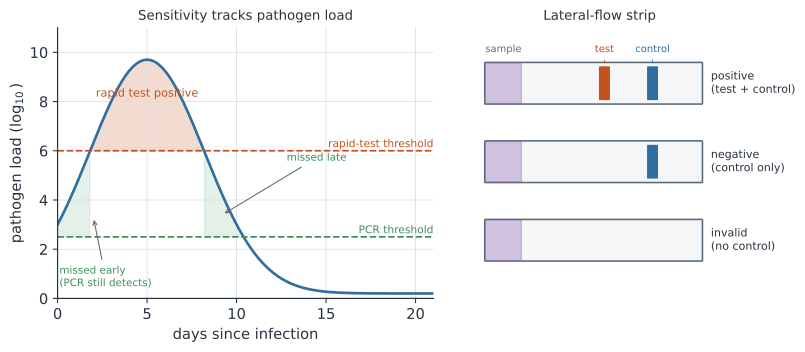
The specimen is mixed with a buffer and dripped onto a pad, and capillary action wicks it along a nitrocellulose strip past three zones.
- A conjugate pad holds antibodies against the target antigen, tagged with colored gold nanoparticles or latex. If the antigen is present, it binds these labeled antibodies and is carried along.
- The test line is coated with a second, immobilized antibody against the antigen. Antigen sandwiched between the mobile and fixed antibodies concentrates the colored label into a visible line.
- The control line captures excess labeled antibody regardless of antigen, confirming the test ran correctly.
Two lines means positive; one line (control only) means negative; no control line means the test is invalid.
Sensitivity tracks pathogen load#
The single most important fact about rapid antigen tests is that their sensitivity depends on how much antigen is present, which depends on when in the infection you test. A RAT needs a relatively high antigen concentration to cross its detection threshold, so it is most likely to be positive during the days of peak load — often around symptom onset — and misses early and late infection where a PCR would still detect nucleic acid (Figure 1).
The practical response is serial testing: repeating a rapid test every day or two dramatically raises the chance of catching the infection during its detectable window, partly compensating for the lower single-test sensitivity.
Positive predictive value and prevalence#
Rapid tests are usually built for high specificity, so a positive is generally trustworthy. But the value of a positive still depends on how common the disease is. The positive predictive value,
collapses when prevalence is very low — even a 99%-specific test throws mostly false positives when almost no one is infected — which is the core argument for confirming unexpected positives and for interpreting screening results in light of the tested population.
Trade-offs & resource considerations#
- Sensitivity & specificity. Low-to-moderate sensitivity (worst near the edges of the diagnostic window), but high specificity. Sensitivity is best expressed conditional on viral load, not as a single headline number.
- Cost. Very low per test, no instrument — the least resource-intensive option available.
- Training & infrastructure. Essentially none; designed for lay users and the bedside, with no cold chain for many formats.
- Turnaround. ~15 minutes, at the point of care — its entire reason for existing.
- Where it fits. Rapid tests trade analytical sensitivity for access and speed. For controlling transmission, a same-minute answer that someone acts on can outperform a more sensitive result that arrives after they have already spread the pathogen.
Why it matters#
Rapid antigen tests reframed testing from a laboratory service into a personal, repeatable behavior. Understanding why they miss early infection, why serial testing rescues much of that sensitivity, and why a positive’s meaning depends on prevalence is essential to using them well — and to reading the surveillance signals they generate.
Related#
- qPCR and RT-qPCR
- ELISA
- Diagnostic Testing and Screening — sensitivity, specificity, PPV
- Diagnostics & Surveillance