Climate and Disease Transmission
Pathogens do not circulate in a vacuum; they ride on mosquitoes that breed in warm standing water, on rodents that follow shifting rainfall, and on human contact with disturbed ecosystems. Climate and environment set the stage on which transmission plays out, tuning vector abundance, pathogen replication, and the chance of spillover. Yet climate rarely acts by temperature alone; it more often works through multi-step ecological chains in which one link cascades into the next. A warm, mast year of heavy acorn production, for instance, feeds a boom in white-footed mice and other small mammals, and that rodent surge later amplifies Lyme-disease risk by enlarging the reservoir on which infected ticks feed. Shifts in moisture and temperature can likewise favour fungal pathogens, driving disease in wildlife, in crops, and in people, so the climate signal often reaches health through the ecology it reshapes rather than through direct physiology alone. This page treats that environmental leg quantitatively, because it is the part of One Health surveillance and planetary health that data-focused programs most often leave thin.
Temperature shapes vector and pathogen traits#
Most vectors are ectotherms, so nearly every rate that matters for transmission depends on temperature. Biting and feeding rate, larval development, adult mortality, and the extrinsic incubation period (the days a pathogen needs to develop inside the vector before it can be transmitted) all respond to warming. Warmth speeds development and biting up to a point, but past that point mortality climbs and the vector dies before it can transmit. Because these traits push in opposite directions as temperature rises, their product, transmission intensity, is unimodal: it climbs, peaks at an intermediate thermal optimum, and falls off at both cold and hot extremes.
We can write relative vectorial capacity, or relative , as a product of temperature-dependent traits. Following the Ross–Macdonald form, transmission scales roughly as
where is the biting rate, vector competence, the adult mortality rate, and the extrinsic incubation rate. Each trait is itself a hump-shaped function of temperature, so their combination is sharply peaked.
A unimodal thermal response#
A convenient empirical form for a single thermal trait is the Briere function,
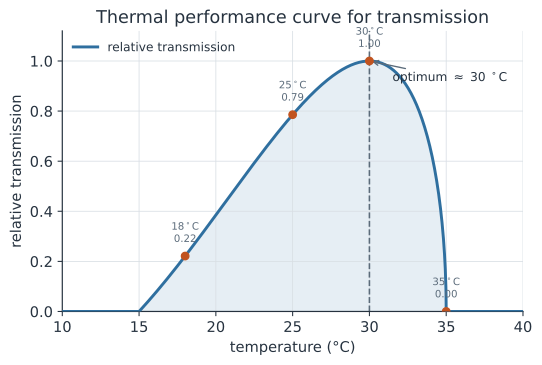
and outside . Here is the lower thermal limit, the upper thermal limit, and a scaling constant. The curve rises from zero at , peaks at an optimum skewed toward the warm end, and drops back to zero at .
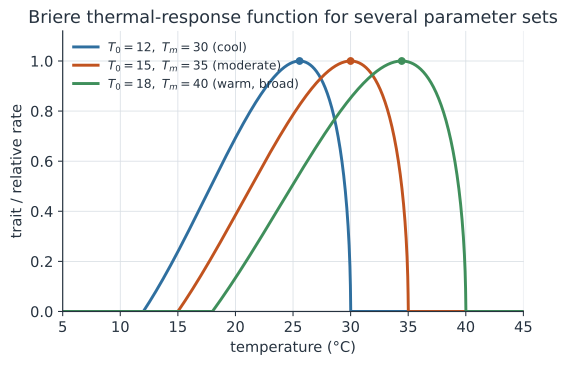
This is why the same disease can be limited by cold at high latitudes and by heat in the hottest seasons, with a transmission belt in between. Temperature never acts entirely on its own, though, because it interacts with water at the scale of the individual organism. Relative humidity and the vapour-pressure deficit set how fast a vector loses water, so dry air raises desiccation and depresses survival and abundance even when temperatures sit near the thermal optimum. Soil-borne pathogens show the same coupling from the other direction: many need a specific window of moisture and temperature for their spores to mature before wind can disperse them and hosts can take them up.
Precipitation, water, and climate variability#
Temperature is only one axis; water is the other. Rainfall creates the standing pools where Aedes and Anopheles mosquitoes lay eggs, so transmission often tracks the rainy season with a lag of a few weeks. Yet the relationship is not monotone: heavy rain can flush out breeding sites, and drought can concentrate people and vectors around the few remaining water sources. Climate variability adds a lower-frequency rhythm, and the El Niño–Southern Oscillation (ENSO) is the clearest example, with El Niño years reshaping temperature and rainfall enough to trigger malaria, dengue, and cholera anomalies across whole regions. Arthur and colleagues emphasize that these environmental forces act alongside social ones, so climate signals must be read against human context rather than in isolation (Arthur et al., 2017, Philosophical Transactions of the Royal Society B).
Range shifts, land use, and spillover#
As the climate warms, thermal envelopes move, and so do the diseases tied to them. Vectors and their pathogens expand into newly suitable altitudes and latitudes, exposing populations with no prior immunity and health systems with no prior experience. At the same time, land-use change, deforestation, agricultural expansion, and urban encroachment on wildlife habitat, brings people into novel contact with reservoir species. Biodiversity loss can concentrate transmission in the competent hosts that persist in degraded landscapes, raising spillover risk at the human–wildlife interface, the theme of reservoir ecology. One influential but still-debated idea, the dilution-effect hypothesis, frames this mechanism explicitly: higher host biodiversity may dilute transmission by adding poorly competent species that absorb infectious contacts, so that biodiversity loss would concentrate transmission and spillover among the competent reservoir and maintenance hosts that survive in disturbed habitat. The evidence for it is genuinely mixed and context-dependent, holding for some systems such as Lyme disease yet failing to generalize to others, so it is best carried as a working hypothesis rather than a settled rule. The planetary-health framing makes this explicit: ecosystem change is not a backdrop to human health but a direct driver of it, and warming is expanding the caseload that clinicians must handle (Öncü et al., 2025, Infection).
WASH, environmental pathways, and surveillance#
Not all environmental transmission runs through a vector. Water, sanitation, and hygiene (WASH) govern the fecal–oral pathogens, so a cholera or rotavirus outbreak is often an environmental-infrastructure failure as much as a biological event. Pathogens also persist in soil, surface water, and air, and monitoring those compartments is how the environment becomes a data stream rather than only a risk factor. Environmental surveillance, wastewater sampling for viral shedding and systematic vector trapping and identification, turns the environment into an early-warning sensor, feeding the integrated signal described in one-health surveillance.
Biosecurity in agricultural settings#
Where livestock production meets wildlife and people, biosecurity is the practical lever that keeps environmental exposure from becoming an outbreak. Pig farming is a clear worked example, because swine sit at the interface of zoonotic and reverse-zoonotic risk for pathogens such as influenza and African swine fever. On a well-run farm, controlled access with hygiene barriers, all-in/all-out batch management that empties and disinfects a barn between cohorts, and routine sanitation together cut the chance that a pathogen enters, establishes, and spreads. The same operation shrinks its environmental footprint by treating waste and manure before release, limiting the nutrient and pathogen load that would otherwise run off into soil and water. Read through a One Health and planetary-health lens, biosecurity is where reducing human and animal exposure and protecting the surrounding ecosystem become a single decision rather than competing goals.
A worked example#
Consider a mosquito-borne pathogen whose relative transmission follows a Briere thermal curve with lower limit T_0 = 15\,^\circ\text{C}, upper limit T_m = 34\,^\circ\text{C}, and scaling . We evaluate across a temperature grid, normalize by its peak, and read off the thermal optimum and the relative transmission at a few representative temperatures. The optimum sits at about 29\,^\circ\text{C}, transmission is only a fifth of its peak at a cool 18\,^\circ\text{C}, near-maximal at 30\,^\circ\text{C}, and collapses to zero at 35\,^\circ\text{C} once temperature exceeds the vector’s upper thermal limit. The lesson is that transmission peaks in the middle and fails at both extremes, so warming can either raise or lower risk depending on which side of the optimum a place starts.
In code#
The Python block evaluates the Briere thermal-performance curve, finds the optimum, and prints relative transmission at representative temperatures. The R and Julia snippets are illustrative sketches of the same calculation.
R#
c <- 2e-4; T0 <- 15; Tm <- 34
briere <- function(T) ifelse(T > T0 & T < Tm,
                             c * T * (T - T0) * sqrt(Tm - T), 0)
grid <- seq(10, 36, by = 0.01)
vals <- briere(grid)
opt  <- grid[which.max(vals)]
peak <- max(vals)
cat("thermal optimum (C):", round(opt, 2), "\n")
for (T in c(18, 25, 30, 35))
  cat(T, "C ->", round(briere(T) / peak, 3), "\n")
Python#
import numpy as np

c, T0, Tm = 2.0e-4, 15.0, 34.0

def briere(T):
    T = np.asarray(T, dtype=float)
    val = c * T * (T - T0) * np.sqrt(np.clip(Tm - T, 0, None))
    return np.where((T > T0) & (T < Tm), val, 0.0)

grid = np.linspace(10, 36, 2601)
vals = briere(grid)
opt = grid[np.argmax(vals)]
peak = vals.max()

print("thermal optimum (C):", round(float(opt), 2))
for T in (18, 25, 30, 35):
    rel = float(briere(T)) / peak
    print(f"{T} C -> relative transmission {rel:.3f}")
thermal optimum (C): 29.22
18 C -> relative transmission 0.238
25 C -> relative transmission 0.826
30 C -> relative transmission 0.991
35 C -> relative transmission 0.000
Julia#
c, T0, Tm = 2e-4, 15.0, 34.0
briere(T) = (T0 < T < Tm) ? c * T * (T - T0) * sqrt(Tm - T) : 0.0

grid = 10:0.01:36
vals = briere.(grid)
opt  = grid[argmax(vals)]
peak = maximum(vals)
println("thermal optimum (C): ", round(opt, digits = 2))
for T in (18, 25, 30, 35)
    println(T, " C -> ", round(briere(T) / peak, digits = 3))
end
Why it matters#
Treating the environment as a first-class driver, not a footnote, changes what a transmission model can explain and predict. The unimodal thermal response alone tells us that warming does not raise risk everywhere; it shifts risk poleward and upward while eventually suppressing transmission where it becomes too hot. This is the leg of One Health that postgraduate and quantitative training most neglects, with environment and conservation under-represented relative to human and animal health (Adeyemi et al., 2024, One Health Outlook). Building environmental drivers, temperature, water, land use, and surveillance streams, into our models is how planetary health becomes something we can measure and act on rather than merely invoke.