Fitting Delay Distributions: Truncation and Censoring
Characterizing the time between two events of interest is essential in epidemiology and infectious disease dynamics. These intervals including incubation periods, serial intervals, reporting delays — are things we have to estimate from data, usually while an outbreak is still unfolding and more importantly, are often things that we do not get the opportunity to directly observe. That data are imperfect in at least two systematic ways that a naïve fit ignores at its peril: events are recorded only to the nearest day (censoring), and, in real time, long delays have not had a chance to be observed yet (truncation). Get the likelihood right and you recover the true distribution; ignore these effects and you will confidently estimate a distribution that is too short and too narrow.
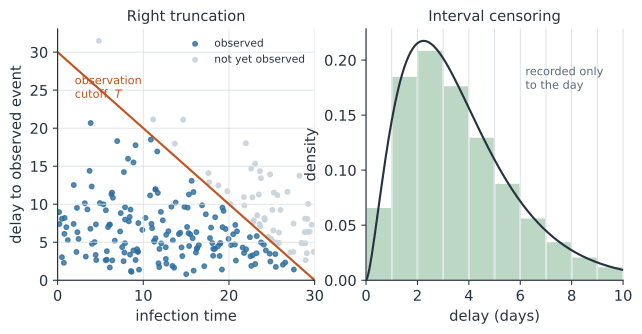
Interval censoring#
We almost never observe the exact instant of infection or symptom onset, and even more rarely are these events reported with a high degree of accuracy.
Most often we observe a day.
A delay computed as onset_day − infection_day is therefore an integer that could correspond to a range of true continuous delays — this is interval censoring.
When both the primary event (e.g. infection) and the secondary event (e.g. onset) are censored to the day, the delay is doubly interval censored. The standard fix is to treat the true time of the primary event as uniformly distributed within its observation window, and to integrate the delay density over every continuous delay compatible with the observed integer. For a one-day primary window and an observed integer delay , the probability contribution is
where is the CDF of the underlying continuous delay and is the unknown within-day offset of the primary event. Censoring matters most when the delay is short relative to the censoring window: a mean delay of a day or two is badly distorted by daily rounding, while a three-week delay is barely affected.
Right truncation#
Estimating a delay in real time introduces a subtler bias. At the data cutoff , you can only have observed an infector–infectee pair, or an infection–death pair, if the second event has already happened. Cases with long delays are disproportionately still “in the pipeline” and missing from your data — the distribution is right-truncated at .
Because recent infections can only appear in the data if they had short delays, the observed sample is biased toward short delays, and the bias is worse when incidence is growing, because the sample is dominated by recent infections. The correction is to condition each observation on having been observable at all: divide its likelihood by the probability that its delay was short enough to appear before , given the (observed) time of its primary event.
Left truncation is the mirror image — for example, only sampling cases whose secondary event occurred after surveillance began — and is corrected the same way, by renormalizing over the observable window.
Forward vs backward delays and epidemic phase#
A related, easily-missed bias: during an epidemic, the forward delay (measured looking forward from a cohort infected at the same time) and the backward delay (measured looking back from a cohort who had their secondary event at the same time) are different distributions whenever incidence is changing. When incidence grows, backward delays are compressed; when it falls, they are stretched. Any method that pools delays across calendar time without accounting for the epidemic phase inherits this dynamical bias. This is why modern nowcasting frameworks tie the delay estimation to the incidence curve rather than fitting the two separately.
The censoring- and truncation-aware likelihood#
Putting the pieces together, the contribution of an observation with observed integer delay , primary event on day , and data cutoff is the doubly-censored cell probability, truncated to the observable region:
The numerator is the censored probability of the delay, clipped so it cannot exceed what was observable; the denominator is the probability of being observed at all. Maximizing over the parameters of recovers the true delay distribution.
A worked example#
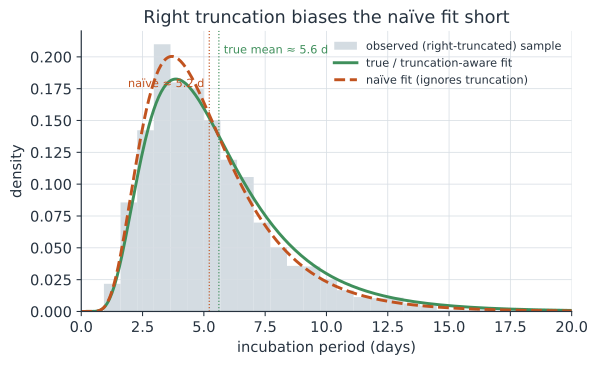
We simulate a growing epidemic, record infections and symptom onsets only to the day, and cut the data off at day . Fitting a lognormal that ignores these effects underestimates the mean incubation period; the censoring- and truncation-aware fit recovers the truth.
In code#
The Julia ecosystem’s CensoredDistributions.jl and the R primarycensored / epidist packages implement exactly this likelihood and plug into Stan/Turing for full Bayesian fits.
The Python example builds the likelihood from scratch with Polars and SciPy so the mechanism is fully visible.
R#
library(primarycensored)   # doubly-interval-censored + truncated delay fitting
library(fitdistrplus)

# `delays` records, per case, the primary-event window [prim_lwr, prim_upr),
# the secondary-event window [sec_lwr, sec_upr), and the observation time.
fit <- fitdistdoublecens(
  delays,
  distr = "lnorm",
  D     = obs_time,                 # right-truncation time (relative to primary event)
  start = list(meanlog = 1.5, sdlog = 0.5)
)
summary(fit)                        # meanlog / sdlog, corrected for censoring + truncation

# For a full Bayesian model that jointly handles the growth phase, use epidist:
#   library(epidist); epidist(data, ...)
Python#
We build the simulated data as a Polars frame, then fit both a naïve and a corrected lognormal.
import numpy as np
import polars as pl
from scipy.optimize import minimize
from scipy.stats import lognorm

rng = np.random.default_rng(42)

# --- truth: a lognormal incubation period, observed during a growing epidemic ---
mu_true, sigma_true = 1.6, 0.5
T, r, N = 30.0, 0.15, 6000                     # cutoff day, growth rate, cohort size

u = rng.uniform(0, 1, N)
t_inf = np.log(1 + u * (np.exp(r * T) - 1)) / r    # infections denser toward the present
D = lognorm.rvs(s=sigma_true, scale=np.exp(mu_true), size=N, random_state=rng)
onset = t_inf + D

c = np.floor(t_inf)                            # infection day (primary, censored to the day)
seen = onset <= T                              # right truncation: onset must occur by T
delays = pl.DataFrame({"c": c[seen], "n": (np.floor(onset) - c)[seen]})

print("observed", delays.height, "of", N, "infections")
mean_recorded = delays.select(pl.col("n").mean()).item()
print(f"mean recorded delay = {mean_recorded:.2f} days (before any correction)")
observed 2786 of 6000 infections
mean recorded delay = 4.58 days (before any correction)
n = delays["n"].to_numpy()
c = delays["c"].to_numpy()

# --- naive fit: pretend the day-delays are exact and the sample is complete ---
s0, _, scale0 = lognorm.fit(n + 0.5, floc=0)
naive = (np.log(scale0), s0)

# --- corrected fit: integrate over the within-day offset and divide out truncation ---
ps = (np.arange(20) + 0.5) / 20                # grid for the unknown primary-event offset
F = lambda x, mu, sig: lognorm.cdf(x, s=sig, scale=np.exp(mu))

def negloglik(theta):
    mu, sig = theta[0], np.exp(theta[1])
    lo = n[:, None] - ps
    hi = np.minimum(n[:, None] + 1 - ps, (T - c[:, None]) - ps)
    num = np.clip(F(hi, mu, sig) - F(lo, mu, sig), 1e-12, None).mean(1)
    den = np.clip(F((T - c[:, None]) - ps, mu, sig), 1e-12, None).mean(1)
    return -(np.log(num) - np.log(den)).sum()

fit = minimize(negloglik, [np.log(n.mean()), np.log(0.5)], method="Nelder-Mead")
corrected = (fit.x[0], np.exp(fit.x[1]))
lnmean = lambda mu, sig: np.exp(mu + sig**2 / 2)

for name, (mu, sig) in [("true", (mu_true, sigma_true)), ("naive", naive), ("corrected", corrected)]:
    print(f"{name:10s} meanlog={mu:.3f}  sdlog={sig:.3f}  mean={lnmean(mu, sig):.2f} d")
true       meanlog=1.600  sdlog=0.500  mean=5.61 d
naive      meanlog=1.534  sdlog=0.430  mean=5.09 d
corrected  meanlog=1.595  sdlog=0.506  mean=5.60 d
The naïve fit lands near 5.1 days; the censoring- and truncation-aware fit recovers the true mean of about 5.6 days. While this difference of around 12 hours seems small, this can lead to a misestimation of the , biasing it higher.
Julia#
using CensoredDistributions, Distributions, Turing

# Wrap a latent lognormal delay with a uniform (daily) primary-event window,
# then right-truncate at the per-observation cutoff D. See the package docs
# for the exact constructor names, which track the Distributions.jl interface.
latent   = LogNormal(1.6, 0.5)
censored = primarycensored(latent, Uniform(0, 1))     # doubly interval censored

@model function delay_model(n, D)
    meanlog ~ Normal(1.5, 0.5)
    sdlog   ~ truncated(Normal(0.5, 0.5); lower = 0)
    dist = primarycensored(LogNormal(meanlog, sdlog), Uniform(0, 1))
    for i in eachindex(n)
        n[i] ~ truncated(dist; upper = D[i])          # right truncation per case
    end
end
A Bayesian version with NumPyro#
Maximum likelihood gives a single best-fit distribution, but during an outbreak we usually want the full posterior — the uncertainty in the delay parameters, propagated into everything downstream.
The likelihood is exactly the same; we simply place priors on the parameters and let a sampler explore the posterior.
Because NumPyro has no built-in doubly-censored, truncated distribution, we hand it the log-likelihood directly with numpyro.factor, reusing the simulated n, c, and T from the Python example above.
import jax, jax.numpy as jnp
import numpyro, numpyro.distributions as dist
from numpyro.infer import MCMC, NUTS

ps = (jnp.arange(20) + 0.5) / 20

def lncdf(x, mu, sigma):                      # lognormal CDF, 0 for x <= 0
    z = (jnp.log(jnp.clip(x, 1e-12)) - mu) / sigma
    return jnp.where(x > 0, jax.scipy.stats.norm.cdf(z), 0.0)

def delay_model(n, c, T):
    meanlog = numpyro.sample("meanlog", dist.Normal(1.5, 0.5))   # weakly-informative priors
    sdlog   = numpyro.sample("sdlog", dist.HalfNormal(1.0))
    nn, cc = n[:, None], c[:, None]
    lo  = nn - ps
    hi  = jnp.minimum(nn + 1 - ps, (T - cc) - ps)                 # censoring, clipped by truncation
    num = jnp.clip(lncdf(hi, meanlog, sdlog) - lncdf(lo, meanlog, sdlog), 1e-12).mean(1)
    den = jnp.clip(lncdf((T - cc) - ps, meanlog, sdlog), 1e-12).mean(1)   # P(observed | c)
    numpyro.factor("loglik", (jnp.log(num) - jnp.log(den)).sum())

mcmc = MCMC(NUTS(delay_model), num_warmup=500, num_samples=500, progress_bar=False)
mcmc.run(jax.random.PRNGKey(0), n=jnp.asarray(n), c=jnp.asarray(c), T=T)
mcmc.print_summary()

post = mcmc.get_samples()
implied_mean = jnp.exp(post["meanlog"] + post["sdlog"] ** 2 / 2)
print(f"implied mean delay = {float(implied_mean.mean()):.2f} d")
                mean       std    median      5.0%     95.0%     n_eff     r_hat
   meanlog      1.60      0.01      1.60      1.58      1.62    310.82      1.00
     sdlog      0.51      0.01      0.51      0.49      0.52    253.60      1.00

Number of divergences: 0
implied mean delay = 5.62 d
The numerator and denominator are the same censoring-and-truncation-aware likelihood derived above; numpyro.factor just adds its log to the model’s log-density.
Running NUTS on the simulated data recovers the truth with tight credible intervals (r_hat near 1) — a posterior mean delay near 5.6 days — matching the MLE point estimate but now carrying full uncertainty that flows into any downstream or nowcast.
For production work the R and Julia packages above wrap this same model with pre-built censored distributions and run it in Stan or Turing.
Why it matters#
Delay distributions feed straight into the numbers decision-makers watch: the reproduction number depends on the generation interval, nowcasts of “how many cases really occurred last week” depend on the reporting delay, and estimates of severity depend on the onset-to-death delay.
A delay estimated without correcting for censoring and truncation is biased short and overconfident, and every downstream quantity inherits that bias.
The correction is not exotic — it is a few extra terms in the likelihood — and packages like CensoredDistributions.jl, primarycensored, and epidist now make it the default rather than the exception.