Direct, Indirect, Total, and Overall Vaccine Effects
Vaccines do something no ordinary drug does: protecting one person changes the risk faced by everyone around them. A vaccinated person who does not get infected also does not transmit, so unvaccinated bystanders are protected too. This dependent happening — one person’s outcome depends on others’ — means a single “vaccine effect” is not enough, and the test-negative estimate of individual protection captures only part of a program’s benefit. Halloran and Struchiner formalized the rest into four distinct effects, each answering a different question and each needing a different comparison.
Dependent happenings#
In non-infectious epidemiology, one person’s outcome is independent of another’s, and a single relative risk summarizes an intervention. Infection breaks that independence: whether you are infected depends on whether the people you contact are infected, which depends on whether they are vaccinated. Ronald Ross called these dependent happenings, and they are why a vaccine’s population benefit exceeds the sum of its individual protections — the extra piece is the transmission it prevents, the same herd effect that produces a herd immunity threshold. Measuring it requires comparing not just vaccinated to unvaccinated people, but populations with a program to populations without one.
The four effects#
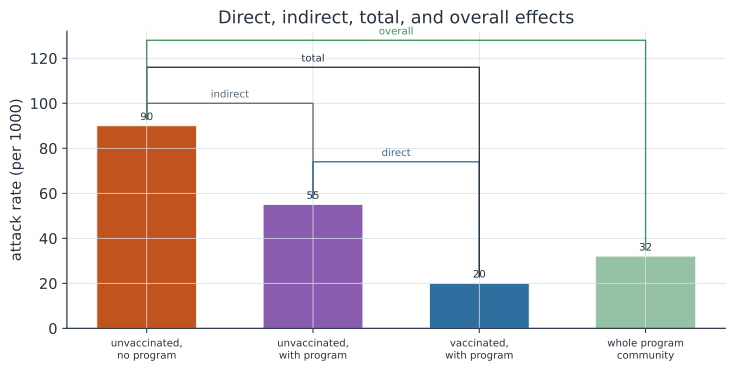
The Halloran-Struchiner framework (Halloran and Struchiner 1991) reads four effects off comparisons of attack rates across two kinds of contrast: individuals within a community, and whole communities against each other.
Direct effect — vaccinated versus unvaccinated within the same program community. This is individual protection holding the transmission environment fixed, and it is what a randomized efficacy trial or a test-negative study estimates.
Indirect effect — unvaccinated people in a program community versus unvaccinated people in a comparison community with no program. Both groups are unvaccinated, so any difference is pure herd protection: the benefit of living among vaccinated others.
Total effect — vaccinated people in a program community versus unvaccinated people in a no-program community. This combines direct and indirect protection and is the most relevant number for an individual deciding whether to be vaccinated in a setting where others are too.
Overall effect — the whole program community, vaccinated and unvaccinated together, versus the whole comparison community. This is the population-level effectiveness of the program as a policy, the quantity that matters for deciding whether to run the program at all.
The comparisons in the figure#
The figure lays out the attack rates the four effects are built from. Unvaccinated people with no program sit highest. Unvaccinated people inside a program are lower — that drop is the indirect effect. Vaccinated people inside a program are lower still; the step down from their unvaccinated neighbors is the direct effect, and the full drop from the no-program reference is the total effect. The whole program community’s average against the no-program reference is the overall effect. Because these effects can diverge — a program with modest direct efficacy can have a large overall effect if it interrupts transmission — reporting only one of them can badly misstate a vaccine’s value.
Study designs#
The effects dictate the design. Direct effects come from individually randomized trials or observational designs within one population. Indirect, total, and overall effects require variation in program coverage across communities, so they are estimated by cluster-randomized trials that randomize whole communities to a program or not, or by stepped-wedge and observational community comparisons. This is why vaccine programs are increasingly evaluated at the cluster level: only a design with unvaccinated-but-exposed and no-program comparison groups can see the herd effects that individual trials are blind to.
A worked example#
From attack rates in the four groups, we compute each effect as a relative reduction in risk.
In code#
R#
ar_unvax_noprog <- 90     # attack rate per 1000, unvaccinated, no program
ar_unvax_prog   <- 55     # unvaccinated, within program (indirectly protected)
ar_vax_prog     <- 20     # vaccinated, within program
ar_whole_prog   <- 32     # whole program community average

direct   <- 1 - ar_vax_prog   / ar_unvax_prog
indirect <- 1 - ar_unvax_prog / ar_unvax_noprog
total    <- 1 - ar_vax_prog   / ar_unvax_noprog
overall  <- 1 - ar_whole_prog / ar_unvax_noprog

round(c(direct = direct, indirect = indirect,
        total = total, overall = overall), 3)
Python#
ar_unvax_noprog = 90   # attack rate per 1000, unvaccinated, no program
ar_unvax_prog = 55     # unvaccinated, within program (indirectly protected)
ar_vax_prog = 20       # vaccinated, within program
ar_whole_prog = 32     # whole program community average

direct = 1 - ar_vax_prog / ar_unvax_prog
indirect = 1 - ar_unvax_prog / ar_unvax_noprog
total = 1 - ar_vax_prog / ar_unvax_noprog
overall = 1 - ar_whole_prog / ar_unvax_noprog

print(f"direct effect   = {direct:.1%}")
print(f"indirect effect = {indirect:.1%}")
print(f"total effect    = {total:.1%}")
print(f"overall effect  = {overall:.1%}")
direct effect   = 63.6%
indirect effect = 38.9%
total effect    = 77.8%
overall effect  = 64.4%
Julia#
ar_unvax_noprog = 90   # attack rate per 1000, unvaccinated, no program
ar_unvax_prog   = 55   # unvaccinated, within program (indirectly protected)
ar_vax_prog     = 20   # vaccinated, within program
ar_whole_prog   = 32   # whole program community average

direct   = 1 - ar_vax_prog   / ar_unvax_prog
indirect = 1 - ar_unvax_prog / ar_unvax_noprog
total    = 1 - ar_vax_prog   / ar_unvax_noprog
overall  = 1 - ar_whole_prog / ar_unvax_noprog

(direct = direct, indirect = indirect, total = total, overall = overall)
The direct effect understates the program: the total protection an individual gets, and the overall benefit to the community, are both larger because vaccination also suppresses transmission.
Why it matters#
Quoting a vaccine’s direct efficacy alone hides the part of its value that comes from interrupting transmission, which for a program is often the larger part. The four-effect decomposition keeps the questions separate — how well it protects the vaccinated, how much it shelters everyone else, and what the program does to a whole community — and makes clear that answering the herd-effect questions demands community-randomized designs, not individual ones. It is the study-design consequence of the same dependent happenings that give epidemics their threshold behavior.
Related#
- Vaccine Effectiveness and the Test-Negative Design — estimating the direct effect
- Epidemiologic Study Designs — cluster-randomized and community designs
- Measures of Association and Impact — attack rates and relative reductions
- Final Size, Herd Immunity, and Overshoot — the herd effect these designs measure
- Causal Inference — interference and dependent happenings