The Language of Mathematics
Welcome — if formulas make you nervous, start here. Mathematics is not a wall of symbols to memorize; it is a compact language for saying precise things about how quantities relate and change. This page is a friendly glossary of its basic vocabulary, so the rest of the site reads smoothly.
Think of it the way you first met a new scientific field: before the interesting results, you learned the words. Here the words are number systems, a few famous constants, and the names for the objects we manipulate — variables, functions, and equations. Once these feel familiar, the equations elsewhere on the site stop looking like code and start reading like sentences.
Number systems#
Numbers come in nested families, each larger than the last, and each family has a standard “blackboard bold” symbol. Reading these symbols aloud helps: means “is an element of” (as in “”, three is a natural number), and means “is a subset of” (one whole family sits inside another).
- Natural numbers — the counting numbers. You meet them whenever you count whole things: a population size, a number of cases, a litter of pups.
- Integers — the naturals together with their negatives, . You need these once counts can go down as well as up: the change in a population from one year to the next can be .
- Rational numbers — all ratios of integers, like or . You meet them as proportions and rates: a prevalence of , three deaths per thousand.
- Real numbers — the full continuous number line, filling in the gaps between the rationals with irrational numbers such as , , and . You meet them in measurements that vary continuously: a concentration, a body temperature, an elapsed time.
- Complex numbers — numbers with an “imaginary” part built on the imaginary unit , so that . A complex number looks like .
These families nest neatly inside one another:
Read left to right, this says: every natural number is an integer, every integer is rational, every rational is real, and every real is complex. So when you write for a population count, you are also entitled to treat as a real number when you do calculus with it.
Why biologists meet imaginary numbers#
Complex numbers can feel like a purely abstract detour, but they show up the moment a biological system oscillates — and that is often.
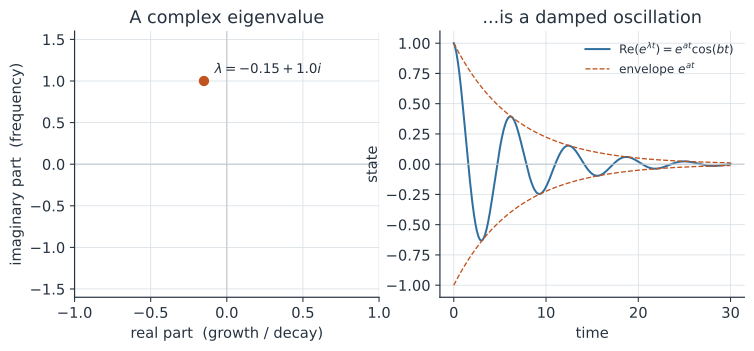
Here is the payoff. When you study the stability of a dynamical system, you linearize it near an equilibrium and look at the eigenvalues of its Jacobian matrix. Those eigenvalues can come out complex, , and the behavior near the equilibrium grows like . The real part of works out to , which is an oscillation wrapped in an exponential envelope. The real part sets growth or decay: if the wiggles die away, if they blow up. The imaginary part sets the oscillation frequency, giving a cycle with period . This is precisely the math behind predator–prey cycles and behind damped epidemic waves that ripple and settle. So the imaginary unit is not a curiosity — it is the algebra of anything that cycles.
Constants worth knowing#
A handful of numbers appear so often they earned their own names.
- — the ratio of a circle’s circumference to its diameter, and the constant that shows up wherever there are angles, rotations, or oscillations (note the above).
- Euler’s number — the base of natural growth and decay, and the anchor of the exponential and logarithm family that describes unchecked population growth, radioactive decay, and drug clearance.
- The imaginary unit — the building block of the complex numbers described above.
The words for the objects#
Once the numbers are in place, we need names for the things we do with them.
Variables, parameters, and constants#
A variable is a quantity that changes and that we are solving for or tracking. A parameter is a quantity we hold fixed for a given scenario but might tune between scenarios. A constant is a fixed number that never changes, like . For example, in the growth equation , the population size is a variable (it changes over time), while the per-capita growth rate is a parameter (fixed for a given species and setting).
Functions#
A function is a rule that takes an input and returns exactly one output. The input is called the argument; the set of allowed inputs is the domain; the set of possible outputs is the range. We write to mean “the function evaluated at the argument ”. See functions and graphs for the visual picture.
Equations, identities, and inequalities#
An equation asserts that two expressions are equal for particular values, like (true only when ). An identity is an equality that holds for all values, written with , as in . An inequality compares sizes using , , , , or (“not equal to”), as in for a population count.
Three symbols that look alike#
These are easy to confuse but mean different things.
- means “approximately equal to”, as in .
- means “proportional to”: says for some constant you may not care to name.
- means “is distributed as”, relating a random variable to its probability distribution, as in .
For the fuller symbol table — sums, products, set operations, and more — see mathematical notation.
How to read an equation#
An equation is a sentence; give yourself permission to read it slowly. Go left to right, name each symbol out loud, decide what varies and what is held fixed, and sanity-check the units on both sides.
Take the logistic growth law:
Read it piece by piece. The left side is the derivative of population size with respect to time — the instantaneous rate of change of , in individuals per unit time. On the right, is the variable, while (growth rate) and (carrying capacity) are parameters held fixed. The factor is exponential growth, and the bracket is a brake: it is near when is small (fast growth) and shrinks to as approaches (growth stalls). So in words the equation says: “the population grows in proportion to its size, but that growth is throttled as the population fills up its habitat.” The same reading habit unpacks the compartment models on the SIR and predator–prey pages.
Where to learn more#
These are genuinely useful starting points for biologists and public-health learners. Use them the same way: watch or skim first for the intuition, then go back and work a few examples by hand — the understanding sticks only once your own pencil moves.
- Otto & Day, A Biologist’s Guide to Mathematical Modeling in Ecology and Evolution (Princeton) — the ideal on-ramp written for biologists: press.princeton.edu.
- Strogatz, Nonlinear Dynamics and Chaos — a beloved, intuition-first tour of oscillations, stability, and bifurcations: stevenstrogatz.com.
- 3Blue1Brown, Essence of Calculus and Essence of Linear Algebra — short animated videos that build visual intuition before symbols: 3blue1brown.com.
- Khan Academy — free, self-paced courses in algebra, calculus, and statistics with practice problems: khanacademy.org/math.
- Project Jupyter — executable notebooks so you can try models and plots yourself: jupyter.org.