Lotka–Volterra Predator–Prey Dynamics
Predators and their prey are locked in a coupled feedback loop: more prey feeds more predators, and more predators eat down the prey. The Lotka–Volterra model is the simplest mathematical picture of this dance, and it explains why so many natural populations oscillate rather than settle down.
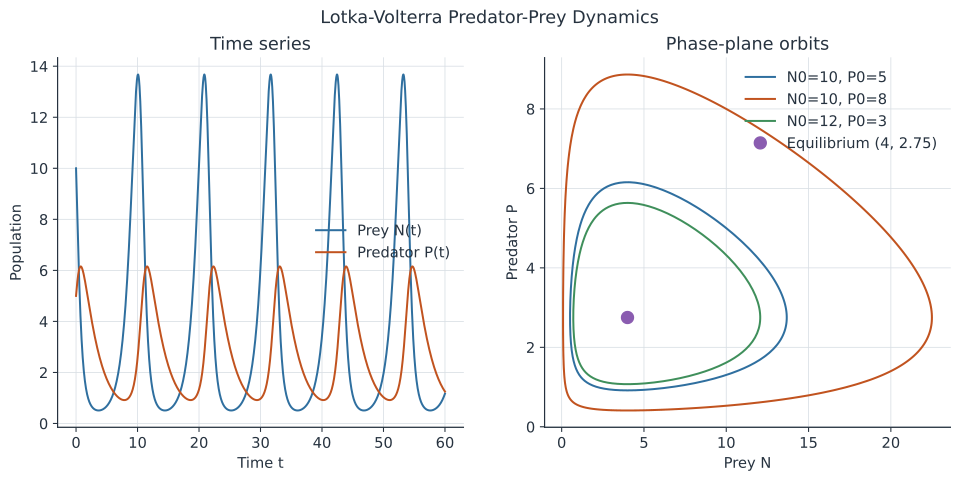
The basic model#
We track prey density and predator density through time. Prey grow exponentially in the absence of predators and are removed by predation; predators reproduce in proportion to the prey they consume and die at a constant rate.
Here is the intrinsic prey growth rate, is the attack (predation) rate, is the conversion efficiency of eaten prey into new predators, and is the predator mortality rate. The product is a mass-action term: encounters between predators and prey occur in proportion to the density of each.
Unlike logistic growth, the prey here have no carrying capacity of their own — the only thing holding them back is the predator.
Interior equilibrium#
An equilibrium is a state where both populations stop changing, so we set both derivatives to zero. Ignoring the trivial extinction point , we look for the interior (coexistence) equilibrium where and .
Setting with gives , so
Setting with gives , so
Notice the counterintuitive structure: the equilibrium prey density depends only on predator parameters, and the equilibrium predator density depends only on prey parameters. Enriching the prey (raising ) does not raise equilibrium prey — it raises predators.
Neutral cycles and structural instability#
Linearizing about gives a Jacobian whose eigenvalues are purely imaginary, .
Show that the eigenvalues are purely imaginary
Linearize the system about the coexistence equilibrium . The Jacobian of has entries , , , ; substituting the equilibrium values makes the diagonal entries vanish:
Its trace is and its determinant is , so the characteristic equation is , giving
Purely imaginary eigenvalues mark a center: trajectories are closed neutral cycles, circling the equilibrium with period rather than spiraling in or out.
Purely imaginary eigenvalues mean the equilibrium is a center: trajectories neither spiral in nor out but trace closed loops. The system conserves the quantity , so each initial condition sits on its own fixed orbit.
This makes the basic model structurally unstable: the cycles are neutral, and the smallest change to the equations — adding prey self-limitation, a saturating functional response, or noise — destroys the delicate closed orbits. Real predator–prey cycles are therefore better described by modified models.
Functional responses#
The term is the functional response: the per-predator prey consumption rate as a function of prey density. Holling classified three shapes.
- Type I — linear, ; consumption rises without bound (the basic model above).
- Type II — saturating, , where is the handling time per prey; a predator that must spend time subduing and digesting prey eventually saturates.
- Type III — sigmoid, ; low predation on rare prey (from switching or prey refuges) gives an S-shaped curve.
Replacing the linear term with a type II response changes the stability of the interior equilibrium. Because a saturating predator becomes less effective as prey become abundant, enriching the system (raising prey carrying capacity) can destabilize the equilibrium and drive ever-larger cycles toward extinction — the paradox of enrichment.
Worked example#
Let , , , and .
Interior prey equilibrium:
Interior predator equilibrium:
So the populations balance at . The cycle period near this center is approximately time units.
In code#
We integrate the ODEs and plot the population cycles and a phase-plane orbit.
R#
library(deSolve)

lv <- function(t, y, p) {
  with(as.list(c(y, p)), {
    dN <- r * N - a * N * P
    dP <- b * a * N * P - m * P
    list(c(dN, dP))
  })
}

p  <- c(r = 1.0, a = 0.02, b = 0.1, m = 0.4)
y0 <- c(N = 300, P = 40)
t  <- seq(0, 60, by = 0.05)
out <- ode(y = y0, times = t, func = lv, parms = p)

# Interior equilibrium: N* = m/(b a) = 200, P* = r/a = 50
matplot(out[, "time"], out[, c("N", "P")], type = "l",
        xlab = "time", ylab = "density")
plot(out[, "N"], out[, "P"], type = "l",
     xlab = "prey N", ylab = "predator P")  # closed orbit
Python#
import numpy as np
from scipy.integrate import solve_ivp
import matplotlib.pyplot as plt

r, a, b, m = 1.0, 0.02, 0.1, 0.4

def lv(t, y):
    N, P = y
    return [r*N - a*N*P, b*a*N*P - m*P]

sol = solve_ivp(lv, (0, 60), [300, 40], t_eval=np.linspace(0, 60, 1200))
N, P = sol.y

# Interior equilibrium: N* = m/(b*a) = 200.0, P* = r/a = 50.0
print(m/(b*a), r/a)          # -> 200.0 50.0

fig, (ax1, ax2) = plt.subplots(1, 2)
ax1.plot(sol.t, N, sol.t, P)          # cycles vs time
ax2.plot(N, P)                        # closed phase-plane orbit
plt.show()
200.0 50.0
Julia#
using DifferentialEquations, Plots

function lv!(du, u, p, t)
    N, P = u
    r, a, b, m = p
    du[1] = r*N - a*N*P
    du[2] = b*a*N*P - m*P
end

p   = (1.0, 0.02, 0.1, 0.4)
prob = ODEProblem(lv!, [300.0, 40.0], (0.0, 60.0), p)
sol  = solve(prob, Tsit5(); saveat = 0.05)

# Interior equilibrium: N* = m/(b*a) = 200, P* = r/a = 50
plot(sol)                              # cycles vs time
plot(sol[1, :], sol[2, :])             # closed orbit
Why it matters#
Predator–prey theory underpins how ecologists interpret coupled oscillations in the wild, from lynx and hare pelts to plankton blooms and the dynamics of hosts and their parasites, a structure shared with epidemic models such as the SIR model. It shows that regular cycles can arise from deterministic interactions alone, and that the stability of those cycles is fragile — a lesson that shapes biological control, conservation of exploited populations, and warnings like the paradox of enrichment.
Related#
- Competition and Coexistence
- The Community Matrix and Stability
- Equilibria and Stability
- Jacobians
- Logistic Growth
- Compartmental Models (SIR)
- Functional Responses and the Paradox of Enrichment — how Holling’s saturating responses reshape stability and drive enrichment-induced cycles
- Quantitative Methods