Quantitative Genetics and the Breeder’s Equation
Most traits that matter — height, body mass, pathogen virulence, drug resistance — vary continuously because they are shaped by many genes of small effect acting together with the environment. Quantitative genetics is the framework for such traits: it partitions their variation into heritable and non-heritable parts and predicts how a population responds when we select on them.
Partitioning phenotypic variance#
For a continuous trait, the phenotype of an individual is modelled as a genetic value plus an environmental deviation, . The genetic value itself splits into an additive part (the sum of average effects of the alleles carried) and non-additive parts from dominance and epistasis. Assuming these components are uncorrelated, the total phenotypic variance decomposes as where is the additive genetic variance, the dominance variance, and the environmental variance. Only reflects effects that are transmitted predictably from parent to offspring, because offspring inherit alleles, not genotypes — the specific pairing that creates dominance is reshuffled each generation.
Narrow-sense heritability#
The fraction of phenotypic variance that is additive is the narrow-sense heritability, It ranges from to and measures how faithfully phenotype predicts breeding value, so it is exactly the quantity that governs the response to selection. It is a property of a particular population in a particular environment, not a fixed constant of the trait.
The breeder’s equation#
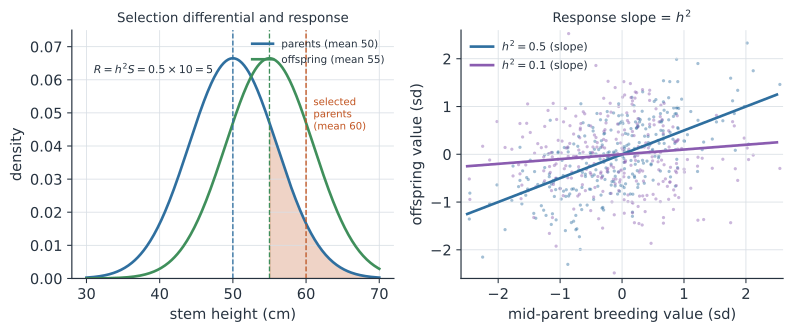
Truncation or differential selection lets only some individuals reproduce. The selection differential is the difference between the mean phenotype of the selected parents and the mean of the whole population before selection. The response is the shift in the mean phenotype of the offspring generation relative to the parental population. The breeder’s equation links them through heritability: The intuition is that selection acts on phenotypes but only the additive component is inherited, so the population moves a fraction of the way that the selected parents were displaced (Figure 1). Standardizing the selection differential by the phenotypic standard deviation defines the selection intensity , giving the equivalent form High heritability means selection is effective; when even strong selection produces almost no response, because the trait differences among parents are environmental and not passed on.
Worked example#
A population of plants has stem height with phenotypic mean cm and narrow-sense heritability . We select as parents only the tallest individuals, whose mean height is cm. The selection differential is The predicted response is so the offspring generation is expected to average cm. If the heritability were only , the same selection would yield cm — the same effort, one-fifth of the gain.
Simulation#
Build additive breeding values for parents, impose selection, generate offspring whose breeding value is the mid-parent value plus fresh Mendelian and environmental noise, and check that the realized response matches .
R#
set.seed(1)
n  <- 100000
VA <- 0.5; VE <- 0.5          # so VP = 1, h2 = 0.5
h2 <- VA / (VA + VE)

A <- rnorm(n, 0, sqrt(VA))    # additive breeding values
P <- A + rnorm(n, 0, sqrt(VE))

# select top 20% as parents
thr  <- quantile(P, 0.80)
sel  <- P >= thr
S    <- mean(P[sel]) - mean(P) # selection differential

# offspring: mid-parent breeding value + Mendelian sampling + environment
pa <- sample(which(sel)); ma <- sample(which(sel))
Aoff <- (A[pa] + A[ma]) / 2 + rnorm(length(pa), 0, sqrt(VA / 2))
Poff <- Aoff + rnorm(length(pa), 0, sqrt(VE))
R <- mean(Poff) - mean(P)

c(S = S, predicted = h2 * S, observed = R)  # observed ~ h2 * S
Python#
import numpy as np
rng = np.random.default_rng(1)

n = 100_000
VA, VE = 0.5, 0.5             # VP = 1, h2 = 0.5
h2 = VA / (VA + VE)

A = rng.normal(0, np.sqrt(VA), n)
P = A + rng.normal(0, np.sqrt(VE), n)

thr = np.quantile(P, 0.80)    # top 20% become parents
sel = np.where(P >= thr)[0]
S = P[sel].mean() - P.mean()

pa = rng.permutation(sel); ma = rng.permutation(sel)
Aoff = (A[pa] + A[ma]) / 2 + rng.normal(0, np.sqrt(VA / 2), len(pa))
Poff = Aoff + rng.normal(0, np.sqrt(VE), len(pa))
R = Poff.mean() - P.mean()

print(S, h2 * S, R)           # R ~ h2 * S
1.3984519049386284 0.6992259524693142 0.6990948334356657
Julia#
using Statistics, Random
Random.seed!(1)

n = 100_000
VA, VE = 0.5, 0.5             # VP = 1, h2 = 0.5
h2 = VA / (VA + VE)

A = randn(n) .* sqrt(VA)
P = A .+ randn(n) .* sqrt(VE)

thr = quantile(P, 0.80)       # top 20%
sel = findall(P .>= thr)
S = mean(P[sel]) - mean(P)

pa = shuffle(sel); ma = shuffle(sel)
Aoff = (A[pa] .+ A[ma]) ./ 2 .+ randn(length(pa)) .* sqrt(VA / 2)
Poff = Aoff .+ randn(length(pa)) .* sqrt(VE)
R = mean(Poff) - mean(P)

(S, h2 * S, R)                # R ~ h2 * S
Why it matters#
The breeder’s equation is the quantitative backbone of artificial selection in agriculture and of predicting evolution in the wild. It tells a plant breeder how fast a yield trait can be improved, warns an epidemiologist how quickly a pathogen population may evolve resistance, and — because the same additive-variance logic underlies the regression of offspring on parents — connects directly to how heritability is estimated from field and pedigree data.