Quasispecies and the Error Threshold
An RNA virus does not replicate as a single genome that occasionally throws off a mutant. Its polymerase is so error-prone — of order one mistake per genome per copy for many RNA viruses — that every infected host carries a swarm of closely related sequences, a mutant cloud centred on the fittest variant. Eigen’s quasispecies theory treats that whole cloud, not any one sequence, as the thing selection acts on, and it predicts a sharp limit: push the mutation rate past a critical error threshold and the cloud loses its centre entirely, an error catastrophe that erases the genetic information the population was built around. This is the theory behind lethal mutagenesis as an antiviral strategy and the reason RNA viruses seem to sit precariously close to the edge of viability.
Mutation and selection as one operator#
Label the possible genotypes and let be the fraction of the population carrying genotype , with . Genotype replicates with fitness , but replication is imperfect: a copy of comes out as with probability , the entries of a mutation matrix whose columns sum to one. The two forces combine into a single reproduction operator , and the quasispecies dynamics are the replicator equation where the outflow term is the mean fitness and simply keeps the frequencies normalised. In discrete generations the same model is the map Set (perfect copying) and this collapses to ordinary selection: the fittest genotype fixes. The mutation term is what couples the genotypes together, so the equilibrium is not a single winner but a stationary distribution — the quasispecies — and it is the leading eigenvector of .
The master sequence and its cloud#
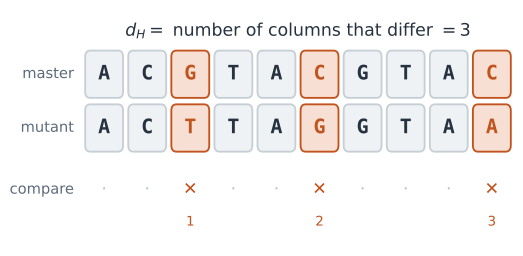
On a single-peak landscape one sequence, the master, replicates times faster than every mutant: and for . The equilibrium is a mutant cloud whose height falls off with Hamming distance from the master. The Hamming distance between two sequences of equal length is simply the number of positions at which they differ: line the two genomes up site by site, mark every mismatch, and count the marks. For binary sequences it is computed as — bitwise XOR the two strings and sum the ones — and for a four-letter nucleotide alphabet it is the same tally of disagreeing sites. Because each point mutation flips exactly one site, the Hamming distance from the master is precisely the number of mutations a genome carries, so grouping sequences into error classes by their distance from the master (as the simulation below does) is the natural coordinate for the whole model.
Selection concentrates weight on the peak; mutation smears it outward; the balance sets the shape. The subtle, important part is that selection does not maximise the fitness of the most common sequence — it maximises the mean fitness of the whole cloud. A slightly lower peak surrounded by fit neighbours (a flat part of the landscape) can outcompete a taller peak surrounded by lethal mutants — the “survival of the flattest” effect that has no analogue in mutation-free selection.
The error threshold#
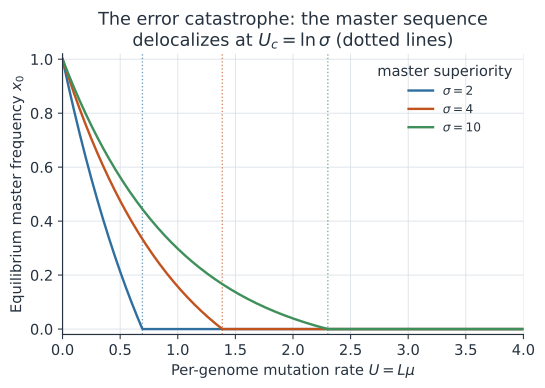
Whether the cloud even has a centre depends on how fast mutation erodes the master. Let each of the sites copy correctly with fidelity , so an error-free genome copy has probability writing for the per-site mutation rate and for the expected number of mutations per genome per replication. Neglecting the rare back-mutations that land exactly on the master, the master sequence is maintained at equilibrium only while its fitness advantage survives the fidelity loss, and its equilibrium frequency is The inequality rearranges, via , into a threshold on the genomic mutation rate: Below the cloud stays localised around the master; above it the master’s frequency drops to zero, the distribution spreads uniformly over sequence space, and heredity fails — this delocalisation is the error catastrophe. The threshold cuts both ways. Read as , it caps how long a genome can be at a given fidelity, which is why the most error-prone replicators are also the shortest, and why no known RNA virus carries a genome much beyond kb without evolving proofreading.
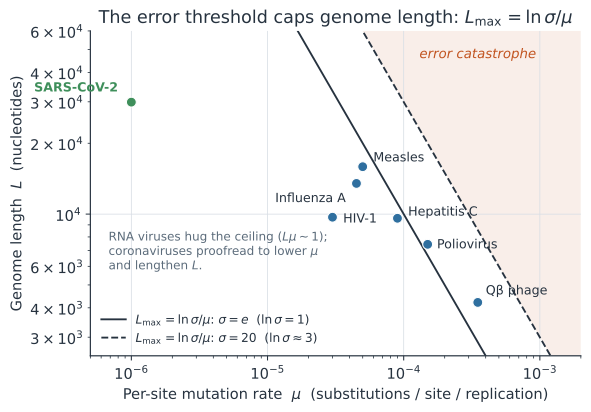
Plotting real viruses against this ceiling makes the constraint concrete. Fast-mutating RNA viruses — bacteriophage Qβ, poliovirus, hepatitis C, measles, influenza, HIV — all crowd into a diagonal band just beneath the threshold, with a genomic mutation rate of order one (roughly one mutation per genome per replication), exactly where the theory says a replicator can sit without losing its master sequence. The conspicuous outlier is the coronaviruses: their genomes reach kb, far longer than the ceiling would otherwise permit, because they alone among RNA viruses encode a proofreading exonuclease (nsp14) that lowers and lifts . Values here are approximate order-of-magnitude estimates drawn from viral mutation-rate reviews (Sanjuán et al. 2010; Drake & Holland 1999).
Worked example#
Take a genome of sites and a master that replicates times faster than its mutants. The threshold sits at mutations per genome, i.e. a per-site rate . At a comfortable the genome fidelity is , so and the master holds an equilibrium share Push the polymerase to and , giving : the master is gone, , and the population has fallen over the error threshold.
Simulation#
The closed form above ignores back-mutation. To see the real cloud, iterate the exact mutation–selection map over Hamming error classes: group all sequences by their number of mismatches from the master, give class fitness and the rest fitness , and move probability between classes with the binary mutation kernel (each of the wrong sites can revert, each of the right sites can mutate). Iterating to equilibrium recovers the localised cloud below threshold and its collapse above.
Python#
import numpy as np
from math import comb

def mutation_kernel(L, mu):
    # T[i, j] = P(class j -> class i) under independent per-site flips.
    T = np.zeros((L + 1, L + 1))
    for j in range(L + 1):          # start with j wrong sites
        for a in range(j + 1):      # a of them revert to the master
            for b in range(L - j + 1):  # b of the right sites mutate
                i = j - a + b
                T[i, j] += (comb(j, a) * mu**a * (1 - mu)**(j - a) *
                            comb(L - j, b) * mu**b * (1 - mu)**(L - j - b))
    return T

def equilibrium_master(L, mu, sigma, iters=2000):
    f = np.ones(L + 1); f[0] = sigma          # single-peak landscape
    T = mutation_kernel(L, mu)
    x = np.ones(L + 1) / (L + 1)              # start uniform
    for _ in range(iters):
        w = T @ (f * x)                        # select, then mutate
        x = w / w.sum()                        # renormalise
    return x[0]

L, sigma = 20, 4.0
for mu in (0.03, 0.069, 0.12):                # below, near, above U_c/L
    print(f"mu={mu:.3f}  U={L*mu:.2f}  x0={equilibrium_master(L, mu, sigma):.3f}")
print(f"error threshold U_c = ln(sigma) = {np.log(sigma):.3f}")
mu=0.030  U=0.60  x0=0.396
mu=0.069  U=1.38  x0=0.000
mu=0.120  U=2.40  x0=0.000
error threshold U_c = ln(sigma) = 1.386
R#
mutation_kernel <- function(L, mu) {
  T <- matrix(0, L + 1, L + 1)
  for (j in 0:L) for (a in 0:j) for (b in 0:(L - j)) {
    i <- j - a + b
    T[i + 1, j + 1] <- T[i + 1, j + 1] +
      choose(j, a) * mu^a * (1 - mu)^(j - a) *
      choose(L - j, b) * mu^b * (1 - mu)^(L - j - b)
  }
  T
}

equilibrium_master <- function(L, mu, sigma, iters = 2000) {
  f <- rep(1, L + 1); f[1] <- sigma
  T <- mutation_kernel(L, mu)
  x <- rep(1 / (L + 1), L + 1)
  for (i in seq_len(iters)) { w <- T %*% (f * x); x <- w / sum(w) }
  x[1]
}

for (mu in c(0.03, 0.069, 0.12))
  cat(sprintf("mu=%.3f  x0=%.3f\n", mu, equilibrium_master(20, mu, 4)))
Julia#
function mutation_kernel(L, mu)
    T = zeros(L + 1, L + 1)
    for j in 0:L, a in 0:j, b in 0:(L - j)
        i = j - a + b
        T[i + 1, j + 1] += binomial(j, a) * mu^a * (1 - mu)^(j - a) *
                           binomial(L - j, b) * mu^b * (1 - mu)^(L - j - b)
    end
    T
end

function equilibrium_master(L, mu, sigma; iters = 2000)
    f = ones(L + 1); f[1] = sigma
    T = mutation_kernel(L, mu)
    x = fill(1 / (L + 1), L + 1)
    for _ in 1:iters
        w = T * (f .* x); x = w ./ sum(w)
    end
    x[1]
end

for mu in (0.03, 0.069, 0.12)
    println("mu=$mu  x0=", round(equilibrium_master(20, mu, 4.0), digits = 3))
end
Why it matters#
Quasispecies thinking reframes a fast-evolving pathogen as a distribution rather than a sequence, which changes what you measure and what you can do about it. The mutant cloud is a reservoir of pre-existing drug-resistance and immune-escape variants, so therapy and immunity select from standing diversity rather than waiting for new mutations — one reason monotherapy fails so fast against HIV and hepatitis C. The error threshold turns the virus’s own mutation rate into a target: antivirals such as favipiravir and molnupiravir work by nudging replication over the threshold, driving the population to the error catastrophe instead of trying to stop it. And the survival-of-the-flattest effect means the fittest cloud is not always the one with the fittest peak, a warning against reading pathogen evolution off a single consensus genome.