Spatial Point Processes
Where a thing happens is often as informative as how often it happens. The nests of a bird, the trees of a species, the households reporting a new infection — each is a set of locations scattered across a map, and a spatial point process is the probability model for that scatter. Instead of predicting a value at every point (as a spatial field would), it treats the number and positions of the points themselves as random.
The intensity function#
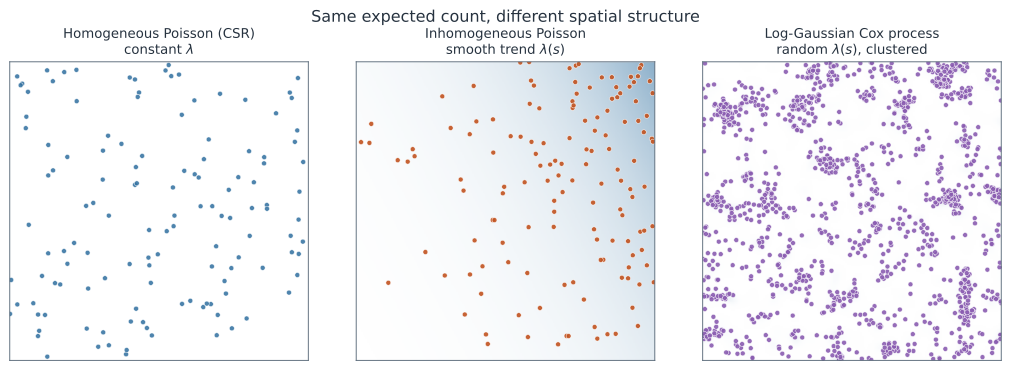
A point process on a region is described by its intensity function , the expected density of points per unit area at location . Over any sub-region the expected number of points is the integral of the intensity, where counts the points that fall in and is the integrated intensity. When is constant, this reduces to , intensity times area. The intensity is a first-order property: it tells you how many points to expect and where they concentrate, but not whether points attract or repel one another.
The homogeneous Poisson process#
The reference model — the spatial analogue of “nothing is going on” — is the homogeneous Poisson process, which encodes complete spatial randomness (CSR). It is defined by two properties.
- Poisson counts. For any region , the count follows a Poisson distribution with mean :
- Complete independence. For disjoint regions , the counts are mutually independent random variables.
A remarkable consequence follows: conditional on the total count , the points are independent and uniformly distributed over . So you can simulate CSR in two steps — draw how many points there are from a Poisson distribution, then throw each of them down uniformly at random, independently of the others. Because the mean equals the variance for a Poisson, CSR has , the benchmark against which real patterns are judged over- or under-dispersed.
The inhomogeneous Poisson process#
Real environments are not uniform: cases cluster where people live, nests concentrate where habitat is good. The inhomogeneous Poisson process keeps the independence but lets the intensity vary in space, . Counts are still Poisson and disjoint regions are still independent — only the mean changes, Given , the points are now independent draws from the density rather than the uniform, so they crowd into the high-intensity regions.
A clean way to build one is thinning. Start from a homogeneous process at the maximum rate , then keep each candidate point at independently with probability . The survivors form an inhomogeneous Poisson process with exactly the intensity , because independent thinning of a Poisson process by a probability yields a Poisson process with intensity . Thinning is the workhorse for simulation and also the natural model for imperfect detection, where is the probability an event that occurred at is actually observed.
Both Poisson models share complete independence: knowing where some points landed tells you nothing about where the others are. Any clustering an inhomogeneous Poisson process shows is entirely due to a varying , not to interaction between points.
Cox processes: when the intensity is itself random#
Often we do not know — it depends on unobserved environmental drivers, and it is more honest to treat it as random. A Cox process (a doubly-stochastic Poisson process) does exactly that: first draw a random intensity surface , then, conditional on it, generate an inhomogeneous Poisson process with that intensity. Randomness now enters twice — once in the surface, once in the points given the surface — which is why the counts are more variable than Poisson.
By the laws of total expectation and variance, the count in a region satisfies The variance strictly exceeds the mean whenever the intensity surface is genuinely random, so every Cox process is overdispersed relative to Poisson. That extra variance shows up spatially as clustering: regions where the surface happened to be high receive bursts of points, and the pattern looks patchy even though, conditionally, the points never “interact.”
The log-Gaussian Cox process#
To make a flexible, positive, spatially smooth random surface, the most popular choice puts a Gaussian process on its logarithm. A log-Gaussian Cox process (LGCP) takes where is a deterministic mean (often a regression on covariates) and is a zero-mean Gaussian process whose covariance function sets the correlation length of the clustering. Exponentiating keeps the intensity positive, and the smoothness of the field is inherited from the covariance kernel, the same machinery used for kriging a continuous surface. Because is Gaussian, the pointwise intensity is log-normal, so with , and a larger field variance means both a higher mean intensity and heavier clustering.
Neyman–Scott and Thomas processes cluster differently: scatter unseen “parent” points as a Poisson process, then place a random number of “offspring” around each parent (Gaussian-displaced offspring give the Thomas process). These are also Cox processes, and like the LGCP they generate overdispersion — but the mechanism is explicit parent-offspring aggregation rather than a smooth latent field, which fits seeds near a plant or secondary cases near an index case.
A worked example#
Homogeneous baseline. Suppose bird nests occur at a constant intensity per km across a km reserve. The nest count is , so and , giving a standard deviation of . The chance of finding an empty reserve is — effectively impossible under CSR.
An intensity trend. Now let the intensity rise toward better habitat, on the unit square with . The expected count integrates the trend, close to the baseline but with the points shifted toward the edge. To simulate it by thinning, note , so we generate CSR at rate and keep each point at with probability .
Overdispersion from a random intensity. Finally make the reserve-wide intensity random: with a positive multiplier satisfying and (a Gamma surface). Then as before, but a variance-to-mean ratio of instead of . This Gamma–Poisson mixture is exactly the negative binomial, the discrete signature of the clustering an LGCP produces continuously in space.
In code#
R#
library(spatstat)

# Complete spatial randomness: intensity 100 on the unit square
csr <- rpoispp(lambda = 100)

# Inhomogeneous Poisson: intensity varies smoothly in space
inh <- rpoispp(lambda = function(x, y) 100 * exp(2 * x))

# Log-Gaussian Cox process: log-intensity is a Gaussian field (exponential covariance)
lgcp <- rLGCP(model = "exp", mu = 4, var = 1.3, scale = 0.05)

# Neyman-Scott / Thomas cluster process: parents + Gaussian-scattered offspring
thom <- rThomas(kappa = 15, scale = 0.03, mu = 8)

# Test an observed pattern against CSR (Ripley's K, envelope from simulations)
plot(envelope(csr, Kest, nsim = 99))
Python#
import numpy as np

rng = np.random.default_rng(0)

# --- Homogeneous Poisson (CSR) on the unit square, intensity lam ---
lam = 50.0
N = rng.poisson(lam)                       # counts are Poisson(lam * |A|), |A| = 1
pts = rng.uniform(0, 1, size=(N, 2))       # points uniform given N
print("CSR: N =", N, "  E[N] =", lam)

# --- Inhomogeneous Poisson by thinning: lam(x, y) = lam * exp(2*(x - 1)) <= lam ---
x, y = pts[:, 0], pts[:, 1]
p = np.exp(2 * (x - 1))                     # acceptance probability in (0, 1]
kept = pts[rng.uniform(size=N) < p]
print("inhomogeneous: kept", len(kept), "of", N, "points")

# --- Cox process: intensity itself random -> overdispersion ---
# Lambda = lam * G, with G ~ Gamma(k, 1/k): E[G] = 1, Var[G] = 1/k  (Gamma-Poisson)
k = 2.0
G = rng.gamma(k, 1 / k, size=20000)
Ncox = rng.poisson(lam * G)
print("Cox mean ~", round(Ncox.mean(), 1), " (Poisson mean =", lam, ")")
print("Cox var  ~", round(Ncox.var(), 1),  " (Poisson var  =", lam, ")")
print("var/mean ~", round(Ncox.var() / Ncox.mean(), 2), "> 1  => overdispersed")
CSR: N = 53   E[N] = 50.0
inhomogeneous: kept 21 of 53 points
Cox mean ~ 50.2  (Poisson mean = 50.0 )
Cox var  ~ 1305.7  (Poisson var  = 50.0 )
var/mean ~ 26.02 > 1  => overdispersed
Julia#
using Random, Distributions
Random.seed!(0)

# Homogeneous Poisson (CSR) on the unit square, intensity lam
lam = 50.0
N = rand(Poisson(lam))                      # counts ~ Poisson(lam * |A|), |A| = 1
pts = rand(N, 2)                            # points uniform given N

# Inhomogeneous Poisson by thinning: lam(x, y) = lam * exp(2*(x - 1)) <= lam
p = @. exp(2 * (pts[:, 1] - 1))            # acceptance probability
kept = pts[rand(N) .< p, :]

# Cox process (Gamma-Poisson mixture): random intensity -> overdispersion
k = 2.0
G = rand(Gamma(k, 1 / k), 20_000)
Ncox = rand.(Poisson.(lam .* G))
println("var/mean ~ ", round(var(Ncox) / mean(Ncox), digits = 2), " > 1")

# (For LGCP / Thomas simulation and Ripley's K, see the PointProcesses.jl package.)
Why it matters#
Point-process thinking is the backbone of spatial epidemiology and disease mapping. Modeling case locations as an inhomogeneous Poisson or log-Gaussian Cox process lets you estimate a smooth risk surface , borrow strength across neighboring areas, and flag clusters while separating real aggregation from a merely varying population-at-risk. The LGCP is especially natural here because its latent Gaussian process can absorb covariates (a regression mean) while its covariance function captures residual spatial correlation from unmeasured drivers — the same fitted surface you would map by kriging. In ecology the same models describe the positions of nests, trees, or burrows: CSR is the null hypothesis, an inhomogeneous intensity encodes habitat preference, and a Cox or Thomas process captures the clustering left over from seed dispersal, social attraction, or contagion.