Graph & Network Algorithms
A great deal of biology is fundamentally about connections: who contacted whom in an outbreak, which genes regulate which, which species eat which, how reads overlap into a genome. The natural representation is a graph — a set of nodes joined by edges — and a handful of classic graph algorithms answer the questions you actually ask of these networks.
The Math side of this program covers network models — degree distributions, centrality, ecological networks. This page is about the algorithms: how a computer actually traverses a graph and computes things on it.
Graphs and How They’re Stored#
A graph is nodes plus edges. Edges can be undirected (a contact between two people) or directed (gene A regulates gene B), and weighted (a distance, a transmission probability) or not.
How you store the graph determines what is cheap — a data-structures choice:
- An adjacency list (a hash map from each node to its neighbours) is compact for the sparse networks common in biology and makes “who are my neighbours?” instant. This is the default.
- An adjacency matrix (an
n × ngrid of 0/1) is simple and good for dense graphs, but costsO(n²)memory — prohibitive for a network of 100,000 nodes.
Traversing a graph with an adjacency list costs O(V + E) (nodes plus edges) — linear, and fast.
Breadth-First Search: Explore in Layers#
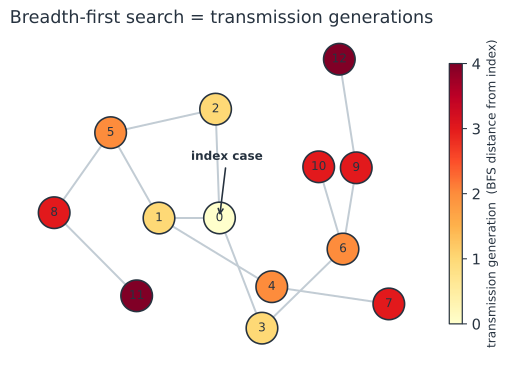
Breadth-first search (BFS) starts at a node and visits the graph in expanding layers: all neighbours first, then their neighbours, and so on. In an unweighted graph BFS finds the shortest path (fewest edges) from the start to every other node — and in an outbreak that shortest path length is exactly the transmission generation.
Depth-First Search: Go Deep#
Depth-first search (DFS) instead follows one path as far as it can before backtracking. It is the tool for cycle detection (is there a feedback loop in this regulatory network?), topological sorting (ordering steps that depend on each other), and exploring tree/graph structure — closely related to the recursion that walks a phylogeny.
Connected Components: Who Is Reachable#
A connected component is a set of nodes all reachable from one another. Finding components (a few BFS/DFS sweeps) answers a genuinely epidemiological question: which cases form one linked cluster, and which outbreaks are actually separate. The same operation identifies isolated subpopulations in a contact network or disconnected contigs in an assembly graph.
import networkx as nx

G = nx.Graph()
G.add_edges_from([("A", "B"), ("A", "C"), ("B", "D"), ("C", "D"),
                  ("D", "E"), ("E", "F"),           # one cluster
                  ("G", "H")])                       # a separate cluster

print("clusters:", [sorted(c) for c in nx.connected_components(G)])
print("generations from A (BFS distance):")
for node, d in sorted(nx.shortest_path_length(G, "A").items()):
    print(f"  {node}: {d}")
clusters: [['A', 'B', 'C', 'D', 'E', 'F'], ['G', 'H']]
generations from A (BFS distance):
  A: 0
  B: 1
  C: 1
  D: 2
  E: 3
  F: 4
Shortest Paths and Centrality#
When edges carry weights — travel time, geographic distance, a transmission cost — plain BFS no longer suffices and you use Dijkstra’s algorithm for the shortest weighted path (or all-pairs methods for every pair). Building on paths, centrality measures rank how important each node is — degree, betweenness (how many shortest paths cross a node), eigenvector centrality — which identify likely superspreaders or keystone species; see centrality.
Where Graph Algorithms Show Up in Biology#
- Transmission and contact networks — reachability bounds a potential outbreak; components are clusters; centrality flags superspreaders.
- Phylogenetic trees — a tree is a special graph, traversed by the same DFS/recursion.
- Genome assembly — de Bruijn and overlap graphs turn read assembly into a path-finding problem.
- Metabolic & gene-regulatory networks — shortest paths, cycles, and reachability describe pathways and feedback.
- Food webs and haplotype networks — connectivity, centrality, and community structure.
Don’t reimplement these — use a battle-tested library:
# R: igraph
library(igraph)
g <- graph_from_edgelist(el, directed = FALSE)
components(g)$membership          # connected components
distances(g, v = "A")            # shortest-path distances
# Julia: Graphs.jl
using Graphs
comps = connected_components(g)
d = gdistances(g, 1)             # BFS distances from node 1
A Short Checklist#
- Model linked data as a graph, and store sparse networks as adjacency lists.
- BFS for shortest unweighted paths and transmission generations; DFS for cycles and ordering.
- Connected components to find outbreak clusters and reachable sets.
- Dijkstra when edges are weighted; centrality to rank important nodes.
- Use a graph library (
igraph,networkx,Graphs.jl) rather than rolling your own.
Related#
- Data Structures & Choosing the Right Container — adjacency lists, and why the representation matters
- Big-O Notation & Computational Complexity — the
O(V+E)cost of traversal - Recursion & Dynamic Programming — DFS and tree traversal
- Networks, Ecological Networks, Network Models, Centrality — the modelling side
- Programming & Computing