Networks in Ecology and Epidemiology
Who eats whom, who pollinates whom, and who contacts whom are all networks, and their structure — not just their averages — shapes ecological stability and how fast a disease spreads. The same graph-theoretic language links keystone species in a food web to superspreaders in an outbreak.
Food webs#
A food web is a directed network of species with trophic links pointing from prey to predator. A basic descriptor of how densely connected it is is the connectance,
the fraction of all possible directed links (including cannibalism) that are actually realized. Connectance and the pattern of who interacts with whom feed directly into stability analysis: the signs and magnitudes of the interactions form the community matrix, whose leading eigenvalue determines whether the equilibrium is stable. Larger, more connected webs are, all else equal, harder to stabilize — the classic complexity–stability tension.
Mutualistic networks#
Plant–pollinator and plant–seed-disperser systems are bipartite: links run only between two disjoint sets (plants and animals), never within a set. These webs are typically nested — specialists interact with proper subsets of the partners that generalists interact with — and modular, organizing into loosely coupled blocks. Nestedness tends to spread the load of mutualistic support and is associated with more species being able to coexist, echoing the conditions studied in competition and coexistence.
Contact and transmission networks#
For disease, the relevant network is who contacts whom. Crucially, the heterogeneity of contacts, not just the mean, governs spread. For a network built by the configuration model with degree distribution , the basic reproduction number scales as
where is the mean degree and is the mean squared degree. Because , any variance in the number of contacts inflates the ratio above the mean, so a few very-high-degree individuals — superspreaders — can push far above what the average contact rate would suggest. This is the network analogue of the branching-process view of early spread, and it is why SIR dynamics on a heterogeneous network differ sharply from the well-mixed model.
The percolation / spectral threshold#
Whether an epidemic can take off is a percolation problem: it corresponds to the emergence of a giant connected component among the edges that actually transmit. For a general contact graph, the epidemic threshold is tied to the largest eigenvalue of the adjacency matrix : spread is possible when the per-contact transmissibility exceeds roughly . Since grows with degree heterogeneity, highly heterogeneous networks have a very low threshold — outbreaks ignite easily. This is also why targeting high-centrality nodes for vaccination or removal, which slashes , is so effective at raising the threshold and halting spread.
Worked example: heterogeneity raises R₀#
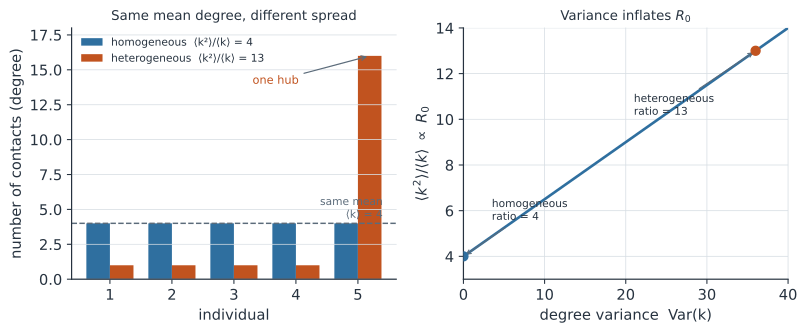
Compare two contact populations with the same mean degree but different variance.
Homogeneous: every one of 5 people has exactly 4 contacts, degrees . Then , , so
Heterogeneous: degrees — four near-isolates and one hub. The mean is still , but , so
The two populations have identical average connectivity, yet the heterogeneous one has a ratio — and hence an — more than three times larger, driven entirely by the single hub (Figure 1). Averages hide superspreading; the second moment reveals it.
In code#
We compute , , and their ratio for the two degree sequences.
R#
homog  <- c(4,4,4,4,4)
hetero <- c(1,1,1,1,16)

ratio <- function(k) mean(k^2) / mean(k)
ratio(homog)     # 4
ratio(hetero)    # 13
Python#
import numpy as np

homog  = np.array([4,4,4,4,4])
hetero = np.array([1,1,1,1,16])

ratio = lambda k: (k**2).mean() / k.mean()
print(ratio(homog))    # 4.0
print(ratio(hetero))   # 13.0
4.0
13.0
Julia#
using Statistics

homog  = [4,4,4,4,4]
hetero = [1,1,1,1,16]

ratio(k) = mean(k.^2) / mean(k)
ratio(homog)     # 4.0
ratio(hetero)    # 13.0
Why it matters#
Ecological and epidemiological outcomes hinge on network structure that averages throw away. In food webs, connectance and interaction pattern feed the community matrix and decide stability; in mutualistic webs, nestedness underpins coexistence; and in contact networks, the ratio shows why degree heterogeneity fuels superspreading and lowers the epidemic threshold. The unifying lesson is that a handful of structurally special nodes — keystones or superspreaders — carry outsized weight, so measuring and targeting them is the highest-leverage move in both conservation and disease control.