Randomness & Random Number Generation
Stochastic simulation is the beating heart of mathematical biology — epidemic models, bootstraps, permutation tests, coalescent genealogies, MCMC. All of it rests on the computer’s ability to produce “random” numbers. But a computer is a deterministic machine, so the numbers are not truly random at all: they are pseudo-random, produced by a formula that generates a stream of numbers with the statistical properties of randomness.
Understanding that one fact — the randomness is a reproducible illusion — is what lets you make your stochastic work both correct and reproducible.
Pseudo-Random, and Why That’s Good#
A pseudo-random number generator (PRNG) starts from a seed and deterministically produces a long stream of numbers that look random. Same seed, same stream — every time, on every machine. Far from a limitation, this is exactly what you want: it makes a stochastic analysis reproducible.
Always set a seed at the top of any script that uses randomness.
set.seed(2026) # R
using Random; Random.seed!(2026) # Julia
import numpy as np
rng = np.random.default_rng(2026)     # Python: make a seeded generator
With the seed fixed, two runs produce identical draws — the foundation of a reproducible result:
a = np.random.default_rng(42)
b = np.random.default_rng(42)
print(a.integers(0, 100, 6))
print(b.integers(0, 100, 6))    # identical stream
[ 8 77 65 43 43 85]
[ 8 77 65 43 43 85]
Use a Modern Generator#
Not all generators are equally good, and the defaults have improved. A few practical rules:
- In Python, use the modern
GeneratorAPI (np.random.default_rng(seed)), not the legacy globalnp.random.seed()/np.random.rand(). The new one uses a better algorithm (PCG64) and avoids a hidden global state that makes bugs hard to trace. - In R and Julia the built-in defaults are solid (
set.seedandRandom.seed!); just set them explicitly. - Create a generator object and pass it around rather than relying on hidden global state — it makes which code touches the random stream explicit.
- Never build your own generator (e.g.
x = (a*x + c) mod m) for real work; homemade PRNGs have subtle correlations that silently bias results.
Drawing From Any Distribution#
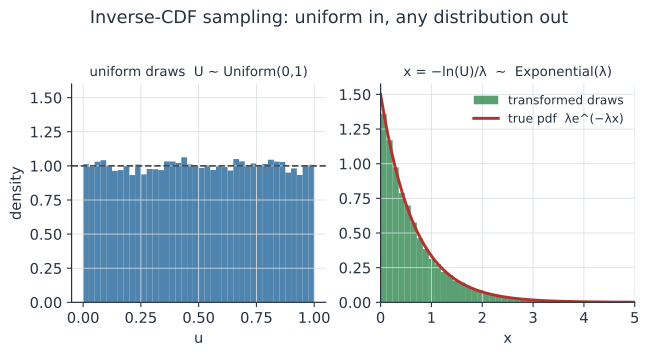
Your generator gives you uniform numbers on . Everything else is built from those. The most fundamental construction is inverse-CDF (inverse-transform) sampling: if , then has the distribution with CDF . For an the inverse CDF is , so a stream of uniforms becomes a stream of exponential waiting times:
rng = np.random.default_rng(0)
u = rng.random(50_000)
x = -np.log(u) / 1.5                 # Exponential(rate = 1.5) by inverse-CDF
print(f"sample mean: {x.mean():.4f}    theory 1/rate: {1/1.5:.4f}")
sample mean: 0.6660 theory 1/rate: 0.6667
In practice you call the library’s named sampler (rexp, randexp, rng.exponential), which uses inverse-CDF or a faster method internally.
When there is no tidy inverse CDF, rejection sampling is the general fallback: propose from an easy distribution and accept a fraction of draws so the survivors follow the target — the same principle underlying MCMC.
# R: named samplers, seeded
set.seed(0)
waits <- rexp(50000, rate = 1.5)     # exponential waiting times
counts <- rpois(50000, lambda = 3)   # Poisson event counts
# Julia
using Random, Distributions
rng = MersenneTwister(0)
waits = rand(rng, Exponential(1 / 1.5), 50_000)
The Parallel-RNG Trap#
This is the mistake that quietly corrupts big simulation studies — and mathematical biologists run big simulation studies.
When you spread replicates across cores or cluster jobs, it is tempting to seed each worker with the same seed, or with seed = worker_id.
Both are wrong: identical seeds make every worker produce the same “random” numbers (so your 1,000 replicates are really one replicate copied 1,000 times), and naively adjacent seeds can produce overlapping or correlated streams.
The right way is to derive independent sub-streams from one parent seed:
# Python: spawn independent child generators from one seed
parent = np.random.SeedSequence(2026)
children = parent.spawn(1000)                 # one per replicate / worker
rngs = [np.random.default_rng(c) for c in children]
# worker i uses rngs[i] -- guaranteed independent, and fully reproducible
# R: L'Ecuyer-CMRG streams are designed for parallel independence
RNGkind("L'Ecuyer-CMRG")
set.seed(2026)
# furrr / future automatically hand each worker an independent stream
# Julia: derive independent per-worker generators from one master seed
using Random
master = Xoshiro(2026)
rngs = [Xoshiro(rand(master, UInt64)) for _ in 1:1000]   # one per replicate
Do give every parallel worker an independent, reproducible stream from a single master seed. Don’t reuse one seed everywhere, and don’t let workers share one global generator.
Where Randomness Drives the Biology#
- Stochastic epidemic models — Gillespie’s algorithm draws the next event’s time (inverse-CDF exponential) and type at every step; small populations need the stochasticity that ODEs smooth away — see the stochastic epidemic and branching process pages.
- Bootstrap and permutation tests — resampling the data to get confidence intervals and null distributions is pure random sampling.
- Population genetics — the coalescent and genetic drift are simulated by random genealogies and allele sampling.
- Bayesian inference — MCMC explores the posterior through random proposals; reproducibility hinges on the seed.
- Monte Carlo experiments — estimating power, coverage, or extinction probability by averaging over many random runs (the law of large numbers at work).
Related#
- A Simulation Toolkit — structuring the simulation studies this feeds
- Reproducibility — seeds as a first-class part of a reproducible result
- Running Jobs on an HPC Cluster (SLURM) — parallel replicates and independent streams
- MCMC and Stochastic Epidemic Models — randomness put to work
- Programming & Computing