Recursion & Dynamic Programming
Two closely related ideas from computer science quietly power a huge fraction of computational biology. Recursion is solving a problem by having it call smaller copies of itself — the natural way to walk a phylogeny or explore a branching process. Dynamic programming (DP) is what you do when those smaller problems overlap: you solve each one once, remember the answer, and reuse it — turning an impossible exponential computation into a fast one.
If you have ever run a sequence alignment, an HMM, or a phylogenetic likelihood, you have used dynamic programming, whether you knew it or not.
Recursion: A Function That Calls Itself#
A recursive function has two parts: a base case that stops the recursion, and a recursive case that reduces the problem to something smaller. The classic (if artificial) example is the Fibonacci numbers:
def fib(n):
    if n < 2:            # base case
        return n
    return fib(n - 1) + fib(n - 2)   # recursive case
Recursion shines when the data is recursive. A phylogenetic tree is defined recursively — a node is either a tip, or an internal node with child subtrees — so the natural way to compute anything on it is a function that calls itself on each child:
# The shape of nearly every tree algorithm in phylogenetics
def postorder(node):
    if node.is_tip():
        return base_value(node)          # base case: a leaf
    results = [postorder(child) for child in node.children]
    return combine(results)              # recursive case: merge children
Why Naive Recursion Can Explode#
The trouble with fib above is that it recomputes the same values enormously many times: fib(50) calls fib(48) twice, fib(47) three times, and so on — an exponential O(2ⁿ) blowup (the worst row of the Big-O chart).
The subproblems overlap, and naive recursion is blind to it.
Count the calls and the explosion is undeniable:
calls = {"naive": 0, "memo": 0}

def fib_naive(n):
    calls["naive"] += 1
    if n < 2:
        return n
    return fib_naive(n - 1) + fib_naive(n - 2)

memo = {}
def fib_memo(n):
    calls["memo"] += 1
    if n < 2:
        return n
    if n not in memo:                       # solve each subproblem once
        memo[n] = fib_memo(n - 1) + fib_memo(n - 2)
    return memo[n]

for n in (10, 20, 30):
    calls["naive"] = calls["memo"] = 0
    memo.clear()
    fib_naive(n); fib_memo(n)
    print(f"fib({n}):  naive = {calls['naive']:>7,} calls   memoized = {calls['memo']:>3} calls")
fib(10):  naive =     177 calls   memoized =  19 calls
fib(20):  naive =  21,891 calls   memoized =  39 calls
fib(30):  naive = 2,692,537 calls   memoized =  59 calls
Dynamic Programming: Solve Each Subproblem Once#
Memoization — caching each subproblem’s answer in a hash map — is the smallest possible fix, and it collapses that exponential cost to linear. That is the whole idea of dynamic programming: when subproblems recur, compute each one only once. DP is usually written one of two ways:
- Top-down (memoized recursion): keep the recursive code, add a cache, as in
fib_memoabove. - Bottom-up (a table): fill a table of subproblem answers in order, each cell built from earlier ones. This is how alignment and HMM algorithms are usually written.
The Canonical Example: Sequence Alignment#
Global alignment (Needleman–Wunsch) is dynamic programming at its most visual. Build a table whose cell holds the best possible score for aligning the first letters of one sequence with the first letters of the other. Each cell is filled once, from the three neighbours it already depends on — diagonal (match/mismatch), up (a gap), or left (a gap):
Once the table is full, the best alignment is recovered by tracing back the path of winning choices from the bottom-right corner to the top-left.
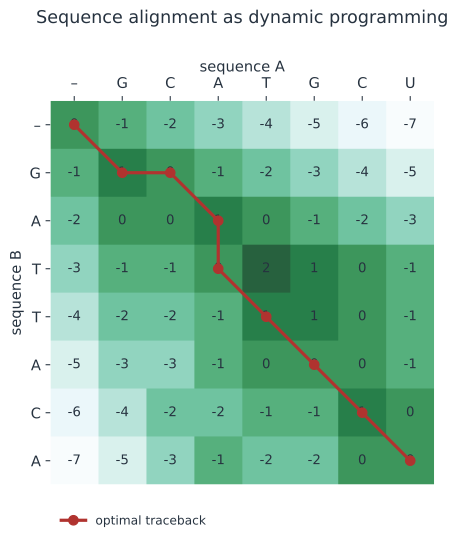
Filling an n × m table costs O(n·m) — quadratic, and entirely tractable — whereas enumerating every possible alignment would be astronomically exponential.
That single change, from “try every alignment” to “fill a table once,” is what makes alignment possible at all.
Dynamic Programming Is Everywhere in Biology#
The same “fill a table of overlapping subproblems, then trace back” pattern recurs across the field:
- Sequence alignment — Needleman–Wunsch (global) and Smith–Waterman (local), the foundation of BLAST-style search.
- Hidden Markov Models — the Viterbi algorithm (most likely hidden path) and the forward algorithm (total probability) fill a states × positions table; used in gene finding, profile HMMs, and base calling.
- Phylogenetics — Felsenstein’s pruning algorithm computes a tree’s likelihood by a post-order recursion that reuses each subtree’s result exactly once, combined with the log-sum-exp trick for stability.
- RNA secondary structure — the Nussinov and Zuker algorithms fold sequences by DP over subsequences.
- Genotype/pedigree likelihoods — peeling algorithms sum over unobserved genotypes with the same reuse-the-subproblem structure.
Recognizing that a problem has overlapping subproblems is the signal to reach for dynamic programming — and it is often the difference between a calculation that finishes and one that never does.
Related#
- Big-O Notation & Computational Complexity — the exponential-to-linear speedup DP delivers
- Data Structures & Choosing the Right Container — the hash map behind memoization; trees for phylogenies
- Floating-Point Arithmetic & Numerical Stability — log-space sums inside the forward and pruning algorithms
- A Simulation Toolkit — recursion for branching processes and genealogies
- Programming & Computing