Scientific Pathways
A research career is, in large part, a sequence of fellowships and grants, often working as an entrepeneur to convince funders that the work you do matters and that you are the right person to do it. If successful, you will be given the money to buy your time and materials to do the science and answer the questions and ask the next question. Being able to get funding to pursue your questions is a major part of being an independent investigator (meaning that you are funded to pursue your research questions). This page maps the major funding mechanisms in the United States and beyond, from graduate fellowships to a first independent research grant, and lays out the basics of writing a competitive application. It is a companion to scientific writing, which covers the craft of the proposal itself.
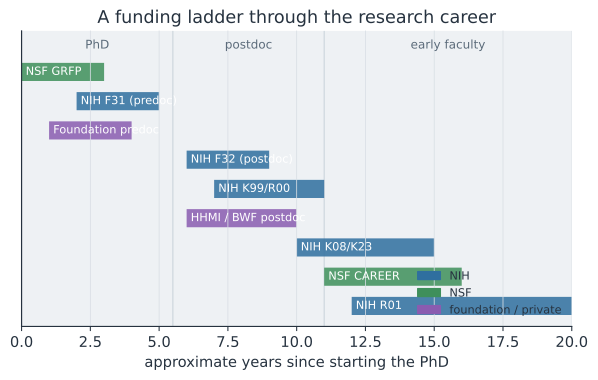
The shape of a research career#
Funding mechanisms are tied to different career stage, and knowing where you sit tells you which doors are open. Note that these are the paradigmatic approaches - you can enter the path from a variety of backgrounds, but this is the most traditional approach.
- Graduate student — predoctoral fellowships that fund your PhD stipend and signal independence.
- Postdoc — postdoctoral fellowships and transition awards that bridge you toward independence.
- Early-career faculty — a first independent research grant, the milestone that establishes a lab.
The ladder is not the only path — many rewarding careers run through industry (i.e., working for a pharmaceutical company or in commercial agriculture), government (e.g., CDC, FDA, USDA, DOD), non-profits, science policy, and teaching-focused institutions — but the mechanisms below are the scaffolding of the academic research track.
NIH: the National Institutes of Health#
The NIH funds biomedical research through institutes (NIAID for infectious disease, NIGMS for basic science, and others), each with its own priorities, and its awards are named by an alphanumeric activity code.
Fellowships and training (the “F” series, NRSA).
- F31 — predoctoral fellowship supporting a PhD student’s dissertation research (a diversity-focused F31 variant also exists).
- F32 — postdoctoral fellowship supporting mentored research and training.
Career-development / transition (“K” series).
- K99/R00 (“Pathway to Independence”) — the flagship transition award: a mentored postdoc phase (K99) that converts to independent faculty funding (R00), designed to carry you across the hardest gap in the career.
- K08 / K23 — mentored career-development awards for clinician-scientists (K08 for lab/translational work, K23 for patient-oriented research).
Independent research (“R” series).
- R01 — the classic independent, renewable research project grant; landing your first R01 is the traditional marker of an established lab.
- R21 — smaller, exploratory/developmental, higher-risk, no preliminary data required.
- R03 — small, short-term projects.
How NIH review works. Applications are evaluated by a study section — a panel of peer scientists — against scored criteria (significance, investigators, innovation, approach, environment, and the overarching factors of rigor and reproducibility). Reviewers give an impact score; competitive applications are discussed and percentiled, and each institute funds down to a payline (a percentile cutoff set by its budget). Most funded grants were resubmissions — a strong revision responding point-by-point to the summary statement is the norm, not a failure.
NSF: the National Science Foundation#
NSF funds fundamental science and education, including the ecological and evolutionary side of infectious-disease research (e.g. through programs on the ecology and evolution of infectious diseases).
- Graduate Research Fellowship Program (GRFP) — a prestigious, portable three-year fellowship for early-stage graduate students, awarded largely on demonstrated potential; apply in the senior undergraduate year or the first/second year of graduate school.
- Standard research grants — investigator-initiated proposals to the relevant program, reviewed on NSF’s two criteria, Intellectual Merit and Broader Impacts.
- CAREER — NSF’s flagship early-faculty award, integrating an ambitious research plan with education and outreach.
- Postdoctoral fellowships — program-specific (e.g. biology postdoctoral research fellowships) supporting independent postdoctoral research.
Beyond federal agencies: foundations and international funders#
Non-governmental funders are a major, and sometimes more flexible, source of support — often prizing bold, investigator-driven ideas and diversifying a funding portfolio.
US foundations and private funders.
- Howard Hughes Medical Institute (HHMI) — the Hanna H. Gray Fellows program (postdoc-to-faculty support for early-career scientists from diverse backgrounds) and the flagship HHMI Investigator program for established scientists.
- Burroughs Wellcome Fund — career-transition and investigator awards, with a notable focus on the interface of disciplines and on infectious disease.
- Damon Runyon Cancer Research Foundation — postdoctoral and early-faculty awards (cancer-focused but broadly relevant to biology).
- Pew, Searle, Sloan, Packard — early-faculty scholar awards supporting independent research with few strings attached.
International and cross-border funders.
- Wellcome Trust (UK) — large fellowships and programs, with major global-health and infectious-disease portfolios.
- EMBO (Europe) — postdoctoral fellowships and installation grants for the life sciences.
- Marie Skłodowska-Curie Actions (EU) — postdoctoral fellowships supporting international mobility.
- Human Frontier Science Program (HFSP) — international, interdisciplinary fellowships and program grants.
Grant-writing basics#
Whatever the funder, competitive proposals share a structure and a discipline.
- Lead with the Specific Aims. For NIH the one-page Specific Aims is the most important page you will write — it frames the problem, the gap, your central hypothesis, the aims, and the payoff. Its anatomy is covered in scientific writing.
- Significance, Innovation, Approach. Say why the problem matters, what is new about your idea, and exactly how you will test it — including pitfalls and alternative strategies, which reviewers read as a sign of a careful mind.
- Rigor and reproducibility. Address experimental design, sample-size justification, blinding, and handling of biological variables explicitly; this is now a scored expectation, not a formality (see experimental design and reproducibility).
- Budget and timeline. Build a realistic budget with justification, and a timeline that shows the aims are feasible in the funded period.
- The biosketch and preliminary data. A well-crafted biosketch (with its personal statement tailored to the proposal) and, where expected, preliminary data that make the aims credible.
- Match the funder. Read the funding-opportunity announcement and recent awards, and — for NIH — talk to a program officer before submitting; aligning to a funder’s mission is half the battle.
- Plan to revise. Treat the first submission as the start of a conversation; the resubmission that answers every reviewer concern is often the one that funds.
Why it matters#
Learning to navigate this landscape — which mechanism fits your stage, how a study section thinks, how a foundation differs from a federal agency — is a core professional skill, as real as any laboratory or statistical technique. Funding is what converts a good question into the time, people, and equipment to answer it, and a scientist who understands the pathways can build a career around the science they most want to do.
Related#
- Scientific Writing — hypotheses, Specific Aims, and papers
- Scientific & Policy Writing — the full hub, including grants and policy briefs
- Experimental Design — rigor and reproducibility in proposals
- Reproducibility — a scored expectation in modern grants
- Causal Inference