Diagnostic Microscopy and Parasitology
Sometimes the fastest, cheapest, and most direct diagnostic is simply to look. Microscopy remains the frontline method for diagnosing malaria and most other parasites, for triaging bacterial infections alongside the Gram stain, and for identifying fungi and crystals. Its power is immediacy and low cost; its limitation is that it depends almost entirely on the skill of the person at the eyepiece.
Brightfield microscopy and diagnostic parasitology#
In brightfield microscopy light passes through a stained specimen and the eye reads contrast from the stains. Diagnostic parasitology is built on it.
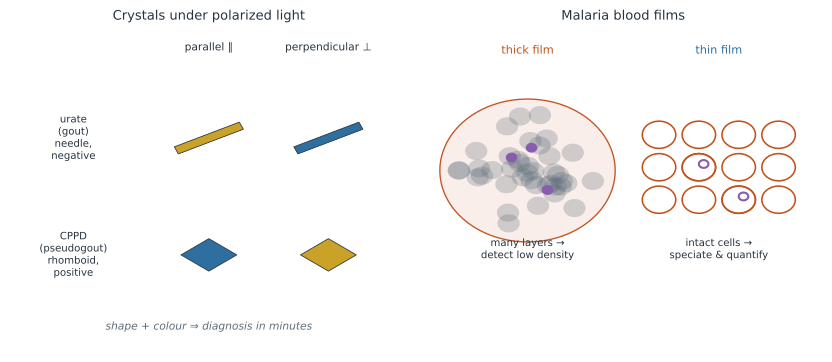
- Blood films for malaria. A drop of blood is spread and stained with Giemsa. The thick film concentrates many layers of blood to detect parasites at low density; the thin film preserves red-cell morphology to speciate (P. falciparum vs vivax and others) and to quantify parasitemia — the percentage of infected red cells, which guides severity assessment. Expert light-microscopy of a Giemsa film is still the reference standard against which malaria rapid tests are measured. The same films reveal Babesia, trypanosomes, and microfilariae.
- Stool ova-and-parasite (O&P) exams. Direct wet mounts and concentration methods reveal helminth eggs and protozoan cysts, identified by their characteristic shapes and sizes.
- Wet mounts. A drop of specimen viewed directly shows motile organisms — Trichomonas, motile bacteria, or fungal elements in a KOH prep that dissolves host cells and leaves fungal hyphae visible.
Special stains and contrast techniques#
Different targets need different tricks to become visible.
- Acid-fast stains (Ziehl–Neelsen, or fluorescent auramine) detect the waxy cell walls of Mycobacterium tuberculosis and related organisms that resist ordinary staining — a cornerstone of TB diagnosis worldwide.
- Darkfield microscopy lights the specimen from the side so objects glow against a black background, making the thin, poorly-staining spirochete of syphilis (Treponema pallidum) visible by its motility.
- Phase-contrast converts differences in refractive index into visible contrast, allowing unstained, living cells to be examined.
- Fluorescence microscopy uses fluorophore-labeled antibodies or dyes (immunofluorescence) to light up specific targets.
Polarized-light and crystal microscopy#
Placing the specimen between crossed polarizing filters reveals birefringent materials — substances that rotate polarized light — which is the basis of diagnostic crystal microscopy. Its classic use is analyzing joint (synovial) fluid.
- Monosodium urate crystals (gout) are needle-shaped and strongly negatively birefringent — yellow when aligned parallel to the compensator’s axis.
- Calcium pyrophosphate crystals (pseudogout, CPPD) are rhomboid and positively birefringent — blue when parallel.
The color-and-shape rule lets a microscopist distinguish two arthritides at the bedside in minutes (Figure 1). Polarized light also identifies other crystalline and foreign materials in tissue.
Trade-offs & resource considerations#
- Sensitivity & specificity. Highly variable and operator-dependent. A skilled microscopist reading a good thick film detects low-density malaria and speciates confidently; a fatigued or undertrained reader misses parasites or misidentifies artifacts. Sensitivity also falls at low organism density (a thick film has a real limit of detection).
- Cost. Low — a light microscope, stains, and slides are inexpensive and durable, which is why microscopy remains dominant in low-resource settings.
- Training & infrastructure. The binding constraint is expertise, not equipment. Producing and retaining microscopists who can reliably read blood films, acid-fast smears, and O&P preparations takes sustained training and quality assurance — a genuine health-system investment.
- Turnaround. Minutes to an hour, at the point of care — one of microscopy’s great advantages.
- Throughput. Low and labor-intensive per sample, which motivates automated digital-microscopy and AI-assisted reading systems now entering the field.
Why it matters#
For the diseases that cause the largest global burden — malaria, tuberculosis, soil-transmitted helminths — microscopy is still the diagnostic that most patients actually receive. Its accuracy is inseparable from the training of the workforce, which is why “strengthening laboratory capacity” so often means, concretely, more and better microscopists.
Related#
- Culture and the Gram Stain
- Rapid Antigen & Lateral-Flow Tests — the malaria RAT alternative
- Electron Microscopy
- Diagnostics & Surveillance