qPCR and RT-qPCR
Quantitative PCR is the reference standard for detecting a pathogen’s nucleic acid. It copies a target DNA sequence through repeated cycles of heating and cooling, and — crucially — measures the amount of product as it accumulates, in real time, using a fluorescent reporter. For RNA viruses a reverse-transcription step (RT-qPCR) first turns RNA into DNA; this is the chemistry behind most molecular tests for SARS-CoV-2, influenza, and HIV viral load.
How amplification is read out#
Each cycle roughly doubles the amount of target, so product grows exponentially until reagents deplete. Fluorescence rises in step with product. The quantification cycle (Ct, also called Cq) is the cycle number at which fluorescence crosses a fixed threshold above background.
More starting template means the threshold is crossed sooner, so Ct is inversely related to the amount of target: a low Ct (say 18) means a lot of template, a high Ct (say 35) means very little. This is why Ct is sometimes used as a rough proxy for viral load, though it is sensitive to sampling and assay details and should be interpreted cautiously.
The standard curve, efficiency, and quantification#
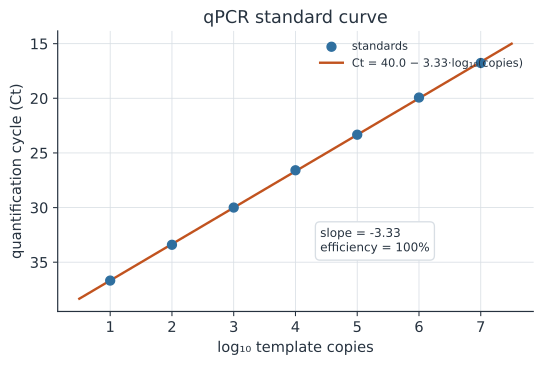
To turn Ct into an absolute quantity you run a dilution series of known concentration and fit a line:
The slope measures amplification efficiency:
A slope of corresponds to perfect doubling every cycle, ; acceptable assays fall roughly between and (90–110%). The intercept sets the assay’s sensitivity, and the lowest concentration reliably detected is the limit of detection (LOD).
Digital PCR (dPCR) sidesteps the standard curve entirely by partitioning the sample into thousands of tiny reactions and counting how many are positive, giving an absolute count without a calibrator — at higher cost.
Controls#
A trustworthy qPCR run carries controls: a no-template control (catches contamination), a positive control (confirms the assay works), and, for RT-qPCR, an internal/extraction control (a host gene or spike-in that confirms the specimen was adequate and not inhibited).
A worked example#
We fit a standard curve to a ten-fold dilution series and read the efficiency off the slope, then quantify an unknown from its Ct.
In code#
R#
log10_copies <- 1:7
ct <- c(36.8, 33.5, 30.1, 26.9, 23.5, 20.2, 16.9)
fit <- lm(ct ~ log10_copies)

slope <- coef(fit)[2]
efficiency <- 10^(-1 / slope) - 1
unknown_ct <- 28.0
unknown_log10 <- (unknown_ct - coef(fit)[1]) / slope

c(efficiency = efficiency, r2 = summary(fit)$r.squared,
  unknown_copies = 10^unknown_log10)
Python#
import numpy as np

log10_copies = np.arange(1, 8)
ct = np.array([36.8, 33.5, 30.1, 26.9, 23.5, 20.2, 16.9])

slope, intercept = np.polyfit(log10_copies, ct, 1)
efficiency = 10 ** (-1 / slope) - 1

# R^2 of the linear fit
pred = intercept + slope * log10_copies
r2 = 1 - np.sum((ct - pred) ** 2) / np.sum((ct - ct.mean()) ** 2)

# quantify an unknown from its Ct
unknown_ct = 28.0
unknown_copies = 10 ** ((unknown_ct - intercept) / slope)

print(f"efficiency = {efficiency*100:.1f}%   R^2 = {r2:.4f}")
print(f"Ct {unknown_ct} -> {unknown_copies:,.0f} copies")
efficiency = 100.2%   R^2 = 1.0000
Ct 28.0 -> 4,480 copies
Julia#
log10_copies = 1:7
ct = [36.8, 33.5, 30.1, 26.9, 23.5, 20.2, 16.9]

X = hcat(ones(length(ct)), collect(log10_copies))
intercept, slope = X \ ct
efficiency = 10^(-1 / slope) - 1
unknown_copies = 10^((28.0 - intercept) / slope)

(efficiency = efficiency, unknown_copies = unknown_copies)
Trade-offs & resource considerations#
- Sensitivity & specificity. qPCR is the benchmark: analytical sensitivity down to a handful of copies and near-perfect specificity when primers and probes are well designed. Its clinical sensitivity is still bounded by sampling — a swab that misses the site of replication, or a test run outside the diagnostic window, yields a false negative despite a flawless assay.
- Cost. Moderate-to-high per test, plus a thermocycler (thousands to tens of thousands of dollars), extraction reagents, and probes; reagent supply chains are a real vulnerability during surges.
- Training & infrastructure. Needs a molecular lab with separated pre- and post-amplification areas to prevent contamination, reliable power, a cold chain for reagents, and technologists trained in extraction and assay setup.
- Turnaround. Hours per run, longer once transport and batching are counted — the main reason point-of-care alternatives like LAMP and rapid antigen tests exist.
- Interpretation. A positive means nucleic acid is present, not that viable, transmissible pathogen is — PCR can stay positive long after infectiousness ends.
Why it matters#
RT-qPCR is the molecular backbone of outbreak response: it defines confirmed cases, drives wastewater surveillance, and supplies the positive samples that feed genomic surveillance. Understanding Ct, efficiency, and the standard curve is what separates “the test was positive” from a defensible, quantitative result.