Balanced Incomplete Block Designs
Blocking sharpens an experiment by grouping similar units, but sometimes a block is too small to hold every treatment. A taster can judge only a few wines before the palate tires; a lab technician can run only three assays in a session; a plot of land fits only a handful of varieties. A balanced incomplete block design (BIBD) chooses which treatments go in each undersized block so that, despite no block containing them all, every pair of treatments appears together equally often — which keeps all the treatment comparisons on an equal footing.
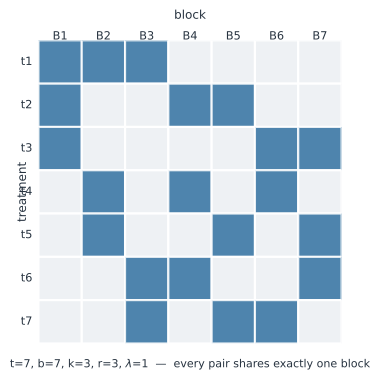
The balance conditions#
A BIBD has five parameters:
- — number of treatments,
- — number of blocks,
- — block size (with , hence incomplete),
- — replications of each treatment,
- — number of blocks in which each pair of treatments appears together.
They are not free; two identities tie them:
The first just counts filled cells two ways. The second is the balance condition: fix a treatment, it shares its blocks with other slots, and those must cover the remaining treatments exactly times each ((1)). Because must be a positive integer, BIBDs exist only for special parameter sets — the smallest non-trivial family being the design shown above, whose blocks are the lines of the Fano plane.
Recovering treatment effects#
Because treatments and blocks are entangled — a treatment’s raw mean is contaminated by which blocks happened to contain it — you cannot just average. The intra-block analysis adjusts each treatment total for the blocks it fell in. With the total for treatment and the sum of totals of the blocks containing it, the adjusted treatment estimate is
The balance ( constant) is exactly what makes every have the same variance and every pairwise difference equally precise — the property that gives the design its name. Equivalently, fit an ordinary linear model with treatment and block factors; the least-squares treatment effects are the adjusted estimates.
A worked example#
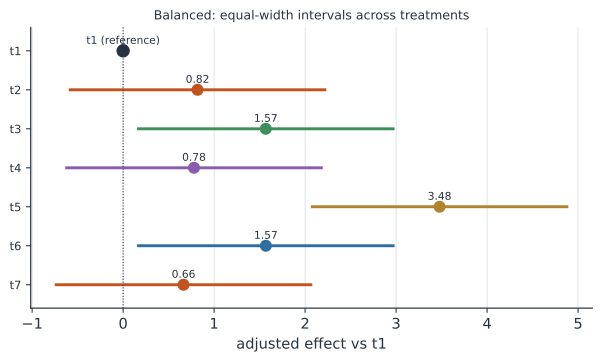
Seven diagnostic panels are compared, but each technician can validate only three per session, so the seven sessions follow the blocks. Each panel is run three times, and each pair of panels shares exactly one session. Simulating a response with genuine panel differences plus session-to-session shifts, and fitting a treatment-plus-block model, recovers the seven adjusted panel effects — each with the same-width interval, the hallmark of balance (Figure 2).
In code#
R#
# blocks are the (7,3,1) Fano lines; fit treatment adjusted for block
fit <- lm(y ~ factor(treatment) + factor(block), data = d)
# The treatment coefficients are the intra-block adjusted effects; because the
# design is balanced, all pairwise treatment contrasts share one variance.
library(agricolae)          # BIB.test() does the balanced analysis directly
Python#
import numpy as np
import pandas as pd
import statsmodels.formula.api as smf

blocks = [(1, 2, 3), (1, 4, 5), (1, 6, 7), (2, 4, 6),
          (2, 5, 7), (3, 4, 7), (3, 5, 6)]          # (7,3,1) Fano lines
rng = np.random.default_rng(2)
tau = {t: e for t, e in zip(range(1, 8), [0, 1, 2, 1, 3, 2, 1])}
rows = []
for blk, treats in enumerate(blocks):
    shift = rng.normal(0, 2.0)                        # block (session) effect
    for t in treats:
        rows.append((t, blk, 10 + tau[t] + shift + rng.normal(0, 0.6)))
d = pd.DataFrame(rows, columns=["treatment", "block", "y"])
fit = smf.ols("y ~ C(treatment) + C(block)", data=d).fit()
adj = fit.params[[f"C(treatment)[T.{t}]" for t in range(2, 8)]]
print({f"t{t}": round(v, 2) for t, v in zip(range(2, 8), adj)})
{'t2': 0.82, 't3': 1.57, 't4': 0.78, 't5': 3.48, 't6': 1.57, 't7': 0.66}
Julia#
using DataFrames, GLM
# treatment adjusted for block gives the intra-block estimates
fit = lm(@formula(y ~ treatment + block), d, contrasts =
         Dict(:treatment => DummyCoding(), :block => DummyCoding()))
Why it matters for statistics#
Incomplete blocks are the rule, not the exception, whenever a natural grouping is small: sensory panels, split field trials, multi-reader diagnostic studies, and any experiment where fatigue, batch size, or logistics caps how many treatments a block can hold. The BIBD’s balance means that shrinking the blocks costs a little efficiency but buys equal, interpretable comparisons among all treatments — no pair is a second-class citizen. It sits alongside the Latin square as a way of removing nuisance variation by structure rather than by brute-force replication, and both are analysed through the same ANOVA partition.