Bifurcations
Ecosystems and epidemics rarely change smoothly forever: push a parameter past a threshold and the entire long-term behavior can flip — a population blinks into existence, a disease starts to invade, a stable state gives way to sustained cycles. These qualitative switches are called bifurcations, and they are where the interesting biology lives.
What is a bifurcation?#
A bifurcation is a qualitative change in the long-term behavior of a dynamical system as a parameter crosses a critical value. Below the threshold the system might have a single stable equilibrium; above it, that equilibrium may vanish, split, change stability, or be replaced by a cycle. The parameter that we vary — a growth rate, a transmission rate, a harvesting effort — is the bifurcation parameter, and the value where the change occurs is the bifurcation point.
Because stability is set by the sign of the real parts of the Jacobian eigenvalues (see equilibria and stability), a bifurcation happens precisely when an eigenvalue’s real part passes through zero as the parameter moves.
Local bifurcations of equilibria#
Saddle-node (fold)#
Two equilibria — one stable, one unstable — approach each other, collide, and annihilate. On one side of the threshold there are two fixed points; on the other side there are none. The normal form is : for there are equilibria at (a stable and an unstable branch), which merge at and disappear for . Folds underlie many ecological tipping points, where a system suddenly collapses because the stable state it was sitting in ceased to exist.
Transcritical#
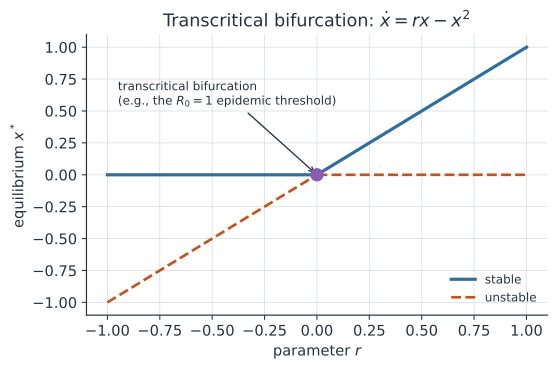
Two equilibria pass through each other and exchange stability; both continue to exist on either side, but which one is stable swaps. The normal form is with equilibria and for all . This is the generic bifurcation at an invasion threshold: the disease-free equilibrium of an epidemic model exchanges stability with the endemic equilibrium exactly as crosses , and the extinction state of a growing population loses stability as the growth rate turns positive.
Pitchfork#
A single equilibrium becomes unstable and gives birth to two new symmetric stable equilibria (supercritical case), as in . Pitchforks require a symmetry in the model and show up in symmetric competition and pattern-formation problems.
Hopf#
Instead of another equilibrium, a limit cycle is born. A stable equilibrium loses stability when a complex-conjugate pair of eigenvalues crosses the imaginary axis ( passes through zero while ), and a small-amplitude oscillation appears around it. Hopf bifurcations are the mathematical origin of sustained cycles in predator-prey systems and in seasonally or demographically forced epidemics.
Bifurcation diagrams and tipping points#
A bifurcation diagram plots the location of equilibria (and the amplitude of any cycles) against the bifurcation parameter, drawing stable branches solid and unstable branches dashed. Reading such a diagram tells you, at a glance, how many attractors exist for each parameter value and where they are created or destroyed.
In ecology these diagrams formalize critical transitions or regime shifts: lakes flipping from clear to turbid, fisheries collapsing, vegetation giving way to desert. When a fold creates a region of bistability, the system can show hysteresis — the parameter value that triggers collapse is not the same as the one needed to recover, so the damage is hard to undo.
A worked example: the transcritical bifurcation#
Take the single-population model where is population size and is the net per-capita growth rate. The equilibria are (extinction) and (a nonzero state).
Linearize with , so .
At : . This is stable when and unstable when .
At : . This is stable when and unstable (or biologically irrelevant, being negative) when .
So as increases through , extinction () hands off its stability to the positive equilibrium : the two branches cross at the origin and swap stability. For the only sensible attractor is extinction; for the population settles at . This is exactly the density-dependent story of a growth rate turning positive, and the same structure controls the disease-free-to-endemic switch handled rigorously by the next-generation matrix.
Simulation#
We sweep the parameter, solve for the stable equilibrium at each value, and plot the resulting bifurcation diagram.
R#
r <- seq(-1, 2, length.out = 300)
stable <- ifelse(r > 0, r, 0)        # stable branch: x* = max(r, 0)
unstable <- ifelse(r > 0, 0, r)      # unstable branch

plot(r, stable, type = "l", lwd = 2, ylab = "equilibrium x*",
     xlab = "r", ylim = c(-1, 2))
lines(r, unstable, lty = 2)          # dashed = unstable
abline(v = 0, col = "grey")          # bifurcation point at r = 0
Python#
import numpy as np
from scipy.optimize import brentq

def equilibria(r):
    return sorted({0.0, r})          # x(r - x) = 0

r = np.linspace(-1, 2, 300)
# stable branch is x* = r for r>0, else x* = 0
stable = np.where(r > 0, r, 0.0)
print(stable[r > 1][0])              # ~1.0: at r just above 1, x* ~ r

# confirm stability via f'(x*) = r - 2x*
for rv in (-0.5, 0.5):
    xs = rv if rv > 0 else 0.0
    print(rv, rv - 2*xs)             # negative -> stable
1.0066889632107023
-0.5 -0.5
0.5 -0.5
Julia#
rs = range(-1, 2; length = 300)
stable = [r > 0 ? r : 0.0 for r in rs]     # stable equilibrium branch
unstable = [r > 0 ? 0.0 : r for r in rs]   # unstable branch

# stability check: f'(x*) = r - 2x*
fprime(r, x) = r - 2x
println(fprime(0.5, 0.5))   # -0.5 < 0: x* = r is stable for r > 0
println(fprime(-0.5, 0.0))  # -0.5 < 0: extinction is stable for r < 0
Why it matters#
Bifurcations tell us where the switches are: the growth rate at which a population escapes extinction, the transmission level () at which a pathogen can invade, the harvesting or nutrient loading at which an ecosystem tips into collapse. Understanding whether a threshold is a gentle transcritical exchange or an abrupt fold with hysteresis is the difference between a warning we can heed and a regime shift we cannot easily reverse. The same thresholds appear in discrete-time models, where increasing growth drives period-doubling cascades into chaos.
Related#
- Equilibria and Linear Stability
- Discrete-Time Models and the Logistic Map
- The Next-Generation Matrix and R₀
- Compartmental Models (SIR)
- Exponential and Logistic Growth
- Critical Transitions and Early-Warning Signals — detecting an approaching fold from the statistical slowing-down that precedes it
- Quantitative Methods