Mendelian Randomization
Mendelian randomization (MR) uses genetic variants as instrumental variables to estimate the causal effect of a modifiable exposure on an outcome. Because alleles are randomly assigned from parents to offspring at conception (Mendel’s law of segregation), they are largely independent of the lifestyle and environmental confounders that plague observational studies — giving MR the flavor of “nature’s randomized trial.”
Genes as instruments#
MR is instrumental-variable analysis in which the instrument is one or more single-nucleotide polymorphisms (SNPs). The three IV assumptions translate into genetic language:
- Relevance. The SNP is robustly associated with the exposure (a genome-wide-significant SNP–exposure association).
- Independence. The SNP is independent of confounders — threatened chiefly by population stratification (systematic ancestry differences correlated with both genotype and outcome).
- Exclusion restriction. The SNP affects the outcome only through the exposure. The main violation is horizontal pleiotropy, where a variant influences the outcome via a separate pathway.
Because random assignment happens at conception, MR is also robust to reverse causation — the outcome cannot alter the genotype one was born with.
The ratio (Wald) estimate#
For a single variant , let be the estimated SNP–exposure association (change in exposure per allele) and the SNP–outcome association (change in outcome per allele). The per-variant causal estimate is the ratio
the outcome-per-allele effect divided by the exposure-per-allele effect — exactly the Wald IV ratio applied to genetic summary statistics.
Inverse-variance-weighted (IVW) estimate#
With many independent variants, the individual ratios are combined by a fixed-effect meta-analysis that weights each by its precision. Using weights ,
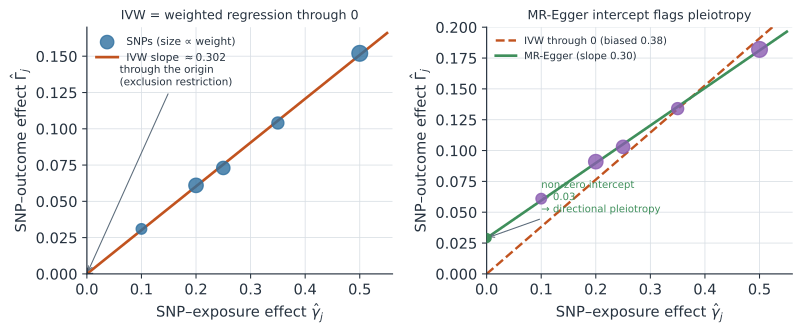
This is algebraically identical to the slope of a weighted linear regression of the SNP–outcome estimates on the SNP–exposure estimates through the origin, with weights (Figure 1). The zero intercept encodes the exclusion restriction: a variant with no effect on the exposure should have no effect on the outcome.
Threats and sensitivity analyses#
The IVW estimate is consistent only if every variant satisfies the exclusion restriction. Because horizontal pleiotropy is common, MR studies report sensitivity analyses that relax this in different ways:
- MR-Egger. Regress on with an intercept. A non-zero intercept flags average directional pleiotropy; the slope stays consistent under the weaker InSIDE assumption.
- Weighted median. Consistent if at least half of the weight comes from valid instruments — robust to a minority of pleiotropic variants.
Agreement across these methods strengthens a causal claim.
Worked example#
Five independent SNPs with summary statistics :
| SNP | ratio | |||
|---|---|---|---|---|
| 1 | 0.20 | 0.061 | 0.020 | 0.305 |
| 2 | 0.35 | 0.104 | 0.025 | 0.297 |
| 3 | 0.10 | 0.031 | 0.030 | 0.310 |
| 4 | 0.50 | 0.152 | 0.018 | 0.304 |
| 5 | 0.25 | 0.073 | 0.022 | 0.292 |
The per-SNP ratios cluster near . The IVW formula (weights ) pools them to a precision-weighted causal estimate of about .
R#
gamma <- c(0.20, 0.35, 0.10, 0.50, 0.25)   # SNP-exposure
Gamma <- c(0.061, 0.104, 0.031, 0.152, 0.073)  # SNP-outcome
se    <- c(0.020, 0.025, 0.030, 0.018, 0.022)   # se of Gamma
w     <- 1 / se^2

# Per-SNP Wald ratios
Gamma / gamma                               # ~ 0.305 0.297 0.310 0.304 0.292

# Manual IVW = weighted regression through the origin
coef(lm(Gamma ~ gamma - 1, weights = w))    # ~ 0.303

# Closed form
sum(gamma * Gamma * w) / sum(gamma^2 * w)   # ~ 0.303

# Package: MendelianRandomization (also see TwoSampleMR)
# library(MendelianRandomization)
# obj <- mr_input(bx = gamma, bxse = rep(0.01, 5), by = Gamma, byse = se)
# mr_ivw(obj)                               # Estimate ~ 0.303
Python#
import numpy as np

gamma = np.array([0.20, 0.35, 0.10, 0.50, 0.25])   # SNP-exposure
Gamma = np.array([0.061, 0.104, 0.031, 0.152, 0.073])  # SNP-outcome
se    = np.array([0.020, 0.025, 0.030, 0.018, 0.022])  # se of Gamma
w = 1.0 / se**2

# Per-SNP Wald ratios
Gamma / gamma                               # ~ [0.305 0.297 0.310 0.304 0.292]

# IVW: weighted regression through origin (closed form)
beta_ivw = np.sum(gamma * Gamma * w) / np.sum(gamma**2 * w)
beta_ivw                                    # ~ 0.303
Julia#
gamma = [0.20, 0.35, 0.10, 0.50, 0.25]        # SNP-exposure
Gamma = [0.061, 0.104, 0.031, 0.152, 0.073]   # SNP-outcome
se    = [0.020, 0.025, 0.030, 0.018, 0.022]   # se of Gamma
w = 1.0 ./ se.^2

# Per-SNP Wald ratios
Gamma ./ gamma                                # ~ 0.305 0.297 0.310 0.304 0.292

# IVW: weighted regression through the origin (closed form)
beta_ivw = sum(gamma .* Gamma .* w) / sum(gamma.^2 .* w)   # ~ 0.303
Why it matters for statistics#
Mendelian randomization brings the logic of instrumental variables to genetic epidemiology, letting researchers probe causal effects of exposures — LDL cholesterol, alcohol, body-mass index — that would be unethical or impractical to randomize. It shows how a purely observational summary dataset can support causal inference when the instrument assumptions hold, and it makes sensitivity analysis (pleiotropy diagnostics) an essential part of the workflow rather than an afterthought.