The Poisson Distribution
The Poisson distribution models the number of rare, independent events that occur in a fixed interval of time or space: new disease cases reported per week, mutations per genome, radioactive decays per second, or calls arriving at a help line. It is the go-to model for count data when events happen at a steady average rate.
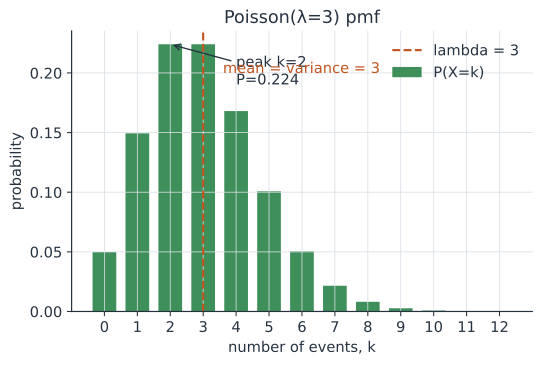
Definition#
Let count events in a fixed window with average rate . Its probability mass function is
- Support: .
- Parameter: rate (the expected number of events in the window).
- Mean: .
- Variance: .
A striking feature is that the mean and variance are equal, both .
Show that the mean and variance both equal
Start from the definition . The term vanishes, and for we can write :
since the shifted sum is just the Taylor series for . For the variance, the same reindexing on gives
Then , so
Mean and variance coincide — the signature of the Poisson.
Real count data with variance much larger than the mean are called overdispersed and signal that a plain Poisson model is too simple.
Limit of the binomial#
The Poisson arises as the limit of a binomial with many trials, each individually unlikely. If and while the product stays fixed, then This is why the Poisson is called the “law of rare events”: it counts many opportunities for an event, each with tiny probability.
When it arises#
The Poisson applies to counts of independent events at a constant rate: epidemiological case counts, incidence of rare diseases, defects per batch, or arrivals in a queue. It connects directly to the exponential distribution: if event counts are Poisson, the waiting times between consecutive events are exponential.
In code#
R#
# pmf, cdf, quantile, and sampling for Poisson(lambda = 4)
dpois(2, lambda = 4)    # P(X = 2)
ppois(2, lambda = 4)    # P(X <= 2)
qpois(0.95, lambda = 4) # 95% quantile

set.seed(123)
x <- rpois(10000, lambda = 4)  # random sample
hist(x, breaks = seq(-0.5, max(x) + 0.5, 1), freq = FALSE)  # histogram
points(0:15, dpois(0:15, 4))                                # overlay the pmf
Python#
import numpy as np
from scipy import stats

lam = 4
stats.poisson.pmf(2, lam)    # P(X = 2)
stats.poisson.cdf(2, lam)    # P(X <= 2)
stats.poisson.ppf(0.95, lam) # 95% quantile

rng = np.random.default_rng(123)
x = rng.poisson(lam, size=10000)  # random sample
# plt.hist(x, bins=range(0, 16), density=True); overlay stats.poisson.pmf(range(16), lam)
Julia#
using Distributions, Random

d = Poisson(4)      # Poisson(lambda)
pdf(d, 2)           # P(X = 2)   (pdf = pmf for discrete)
cdf(d, 2)           # P(X <= 2)
quantile(d, 0.95)   # 95% quantile

Random.seed!(123)
x = rand(d, 10_000) # random sample
# histogram(x, normalize=:pdf); scatter!(0:15, pdf.(d, 0:15)) to overlay the pmf
Simulation#
Many Poisson draws have empirical mean and variance both close to — the signature equality of the distribution.
set.seed(7)
x <- rpois(1e6, lambda = 4)
mean(x)  # ~ 4.00  (theoretical mean = lambda)
var(x)   # ~ 4.00  (theoretical variance = lambda; mean == variance)
Why it matters for statistics#
The Poisson is the foundation of count-data modeling, including Poisson regression for rates (cases per person-year) and the analysis of contingency tables. Recognizing when the mean-equals-variance assumption fails — overdispersion — guides the choice of richer models such as the negative binomial. It links proportions (binomial) and waiting times (exponential) into one coherent picture of event processes.