Nested Within- and Between-Host Models
The evolution of virulence rests on a trade-off between transmission and harm, but that curve is usually drawn by hand rather than derived. A nested model closes the gap: a fast within-host process sets the transmission rate and virulence that a slow between-host SIR model treats as parameters. The trade-off then emerges from viral replication rather than being assumed, and the virulence that maximizes between-host is an output of the coupled system (Mideo, Alizon & Day 2008).
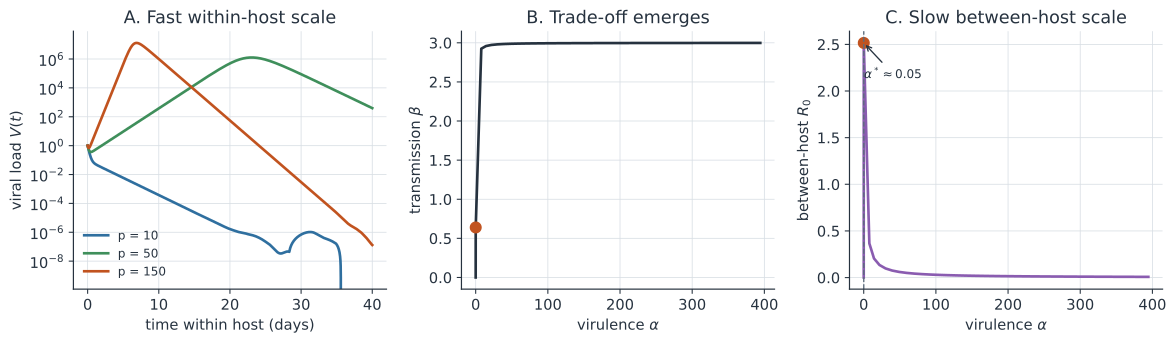
Two coupled scales#
Infection runs on two clocks that differ by orders of magnitude in speed.
Inside one host, virus replicates over hours to days. Take a minimal target-cell model with target cells , infected cells , and free virus :
The single parameter that a pathogen can evolve here is the virion production rate : a faster-replicating strain reaches a higher peak viral load .
Between hosts, the pathogen spreads over days to weeks in an SIR population, where the epidemiological parameters are not free constants but functions of the within-host state.
From viral load to and #
The nesting is the pair of maps that turn a within-host summary into between-host rates. Transmission saturates with viral load, because a host can only shed and contact so many others, so we write an increasing, saturating map
while disease-induced mortality (virulence) climbs with the damage a high load does,
Both increase with , so raising within-host replication raises transmission and virulence together. This shared dependence is what generates the trade-off: and are not independent knobs but two readouts of the same underlying viral load (Gilchrist & Coombs 2006).
The emergent trade-off and its optimum#
Feed the two maps into the between-host reproduction number for an SIR infection,
with recovery rate and background mortality . As sweeps from low to high, plotting against traces out the classic trade-off curve as an output of the nested model, not an input. Because transmission saturates while virulence keeps rising, has an interior maximum at some finite replication rate: an emergent optimal virulence , exactly the singular strategy of the adaptive-dynamics analysis, now derived from mechanism.
Fitness across scales#
The two scales define two different notions of fitness, and they need not agree. Within a host, selection acts on competitive success among viral variants, which favors faster replication and higher peak load. Between hosts, selection acts on , which is maximized at intermediate replication.
When within-host competition pushes replication past the between-host optimum, the pathogen evolves higher virulence than is best for its own spread: short-sighted evolution, where within-host wins cost between-host fitness (Gilchrist & Coombs 2006). The Price equation makes this conflict precise by partitioning selection into within- and between-host components with opposite signs.
Assumptions and caveats#
The nesting buys mechanism, but it hides as much as it reveals (Handel & Rohani 2015). It assumes a clean timescale separation, so the within-host trajectory reaches its summary before between-host dynamics matter. It usually assumes a single infecting strain per host, sidestepping the within-host competition that drives short-sighted evolution. And collapsing an entire viral time course to one scalar discards the shape of the infectiousness profile, which itself shapes transmission. Reading across the scales is a modeling choice, not a free lunch (Mideo, Alizon & Day 2008).
A worked example#
Take the within-host model with , infection rate , infected-cell death , and viral clearance . Sweep the replication rate from 2 to 200 and record each peak load . Map load to rates with , , and , and set . The between-host rises, peaks, and falls; the emergent optimum sits near , reached at a moderate replication rate well short of the fastest strain in the sweep.
In code#
The executed block sweeps replication rate, integrates the within-host model for each, and reports the virulence that maximizes between-host .
Python#
import numpy as np
from scipy.integrate import solve_ivp

# Fast within-host target-cell model: T target cells, I infected, V virus.
T0, b, dI, c = 1e6, 2e-7, 1.0, 5.0

def peak_load(p):
    def rhs(t, y):
        T, I, V = y
        return [-b * T * V, b * T * V - dI * I, p * I - c * V]
    sol = solve_ivp(rhs, [0, 40], [T0, 0.0, 1.0], method="LSODA",
                    rtol=1e-8, atol=1e-6, dense_output=True)
    t = np.linspace(0, 40, 4000)
    return sol.sol(t)[2].max()

# Map peak viral load to between-host transmission and virulence.
beta_max, Kb, a_v, d0 = 3.0, 1e4, 2e-5, 0.2   # d0 = gamma + mu
ps = np.linspace(2, 200, 60)
Vmax = np.array([peak_load(p) for p in ps])
beta = beta_max * Vmax / (Vmax + Kb)
alpha = a_v * Vmax
R0 = beta / (alpha + d0)
i = int(np.argmax(R0))
print(f"emergent optimum: alpha* = {alpha[i]:.3f}, R0 = {R0[i]:.3f}")
print(f"peaks at replication rate p = {ps[i]:.1f} (of {ps.min():.0f}-{ps.max():.0f})")
emergent optimum: alpha* = 0.039, R0 = 2.059
peaks at replication rate p = 32.2 (of 2-200)
R#
library(deSolve)

T0 <- 1e6; b <- 2e-7; dI <- 1; cc <- 5
peak_load <- function(p) {
  rhs <- function(t, y, ...) {
    with(as.list(y), list(c(
      dT = -b * T * V,
      dI = b * T * V - dI * I,
      dV = p * I - cc * V)))
  }
  out <- ode(c(T = T0, I = 0, V = 1), seq(0, 40, 0.01), rhs, parms = NULL)
  max(out[, "V"])
}

beta_max <- 3; Kb <- 1e4; a_v <- 2e-5; d0 <- 0.2
ps <- seq(2, 200, length.out = 60)
Vmax <- sapply(ps, peak_load)
beta <- beta_max * Vmax / (Vmax + Kb)
alpha <- a_v * Vmax
R0 <- beta / (alpha + d0)
alpha[which.max(R0)]      # emergent optimal virulence
Julia#
using DifferentialEquations

T0, b, dI, c = 1e6, 2e-7, 1.0, 5.0
function peak_load(p)
    rhs!(du, y, _, t) = begin
        T, I, V = y
        du[1] = -b * T * V
        du[2] = b * T * V - dI * I
        du[3] = p * I - c * V
    end
    sol = solve(ODEProblem(rhs!, [T0, 0.0, 1.0], (0.0, 40.0)), Rosenbrock23())
    maximum(u[3] for u in sol.u)
end

beta_max, Kb, a_v, d0 = 3.0, 1e4, 2e-5, 0.2
ps = range(2, 200, length = 60)
Vmax = peak_load.(ps)
beta = beta_max .* Vmax ./ (Vmax .+ Kb)
alpha = a_v .* Vmax
R0 = beta ./ (alpha .+ d0)
alpha[argmax(R0)]         # emergent optimal virulence
Why it matters#
Nesting turns the trade-off hypothesis from an assumption into a prediction. Once and both descend from viral load, the intermediate optimal virulence of adaptive dynamics is a theorem about the coupled system rather than a curve chosen to make the argument work. The framing also clarifies when interventions backfire: a therapy that suppresses within-host load moves the pathogen along the emergent trade-off, and a vaccine that blunts virulence without blocking transmission can select for strains that replicate harder (Mideo, Alizon & Day 2008). It is the mechanistic backbone under the population-scale story of pathogen evolution.
Related#
- Within-Host Viral Dynamics
- Within-Host Dynamics and the Immune Response
- Adaptive Dynamics and the Evolution of Virulence
- The Price Equation and Evolutionary Epidemiology
- Antimicrobial Resistance Across Scales — the same nesting applied to drug resistance in malaria
- The Next-Generation Matrix and R₀
- Compartmental Models (SIR)
- Epidemiology