Antimicrobial PK/PD
Antimicrobial PK/PD combines what the body does to the drug with what the drug does to the pathogen, in order to pick a dose and schedule that maximizes killing while suppressing resistance. It joins the concentration–time curve from pharmacokinetics to the concentration–effect curve from pharmacodynamics through a single benchmark: the MIC.
The MIC and free drug#
The minimum inhibitory concentration (MIC) is the lowest drug concentration that prevents visible growth of an organism in vitro. It is a fixed number for a given drug–bug pair, so the concentration–time profile can be scored against it. Only unbound (free) drug is microbiologically active, so the indices below use the free concentration , where is the unbound fraction.
The three PK/PD indices#
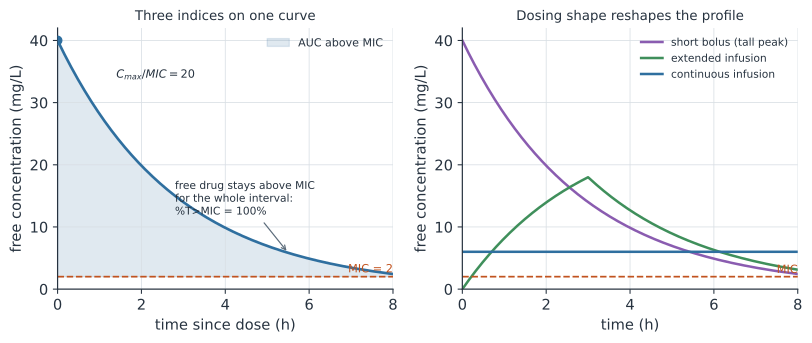
Which feature of the profile predicts efficacy depends on the drug’s kill pattern, giving three indices (Figure 1).
Percent time above MIC#
For time-dependent agents such as β-lactams, killing depends on how long the free concentration stays above the MIC, not how high it climbs:
Typical bacteriostatic-to-maximal targets fall around of the dosing interval .
AUC over MIC#
For agents whose total exposure matters — fluoroquinolones, and vancomycin — the index is the 24-hour free AUC divided by the MIC:
A widely used vancomycin target is .
Peak over MIC#
For concentration-dependent agents such as aminoglycosides, a high peak drives rapid killing:
Dosing strategies#
Each index implies a dosing shape. Because β-lactams are governed by time above MIC, extended or continuous infusions keep the concentration over the MIC for more of the interval than a short bolus of the same total dose. Because aminoglycosides are governed by the peak, once-daily dosing gives a tall peak (large ) while allowing a drug-free trough that limits toxicity and exploits the post-antibiotic effect.
Suppressing resistance#
Above the MIC but below the concentration that blocks resistant mutants (the mutant prevention concentration) lies the mutant selection window, where susceptible cells are killed but pre-existing resistant mutants are selectively amplified. Regimens that push exposure through this window quickly — higher peaks or sustained time above MIC — reduce the chance of selecting resistance.
Worked example#
Take a one-compartment IV bolus with and elimination rate (half-life 2 h), dosed every , against an organism with . Assume the drug is fully unbound () for simplicity, so .
The concentration falls to the MIC when , i.e.
Since exceeds the 8 h interval, the free concentration stays above the MIC for the entire interval, so .
At steady state the AUC over one dosing interval equals the single-dose AUC from to , namely , so the exposure over 24 h (three doses of ) is :
The peak-to-MIC ratio is . So this regimen easily satisfies a time-dependent target but would fall short of a vancomycin-style goal — a concrete illustration of how the target index changes the verdict on the same profile.
In code#
We simulate one dose of , find the time above MIC by root-finding, integrate the single-dose AUC by the trapezoid rule, and use the steady-state identity to report all three indices.
R#
library(pracma)

C0 <- 40; k <- 0.35; tau <- 8; MIC <- 2; n <- 3   # 3 doses/day
Cf <- function(t) C0 * exp(-k * t)

# time above MIC (root of Cf(t) = MIC), capped at tau
tcross <- log(C0 / MIC) / k
tabove <- min(tcross, tau)
pct_T  <- 100 * tabove / tau            # 100% here

t <- seq(0, 48, by = 0.01)              # ~infinite horizon for one dose
auc_single <- trapz(t, Cf(t))           # ~114.3 = C0/k
auc24 <- n * auc_single                 # 342.9 mg*h/L
c(pctT = pct_T, AUC_MIC = auc24 / MIC, Cmax_MIC = C0 / MIC)
# ~ pctT 100, AUC/MIC 171, Cmax/MIC 20
Python#
import numpy as np
from scipy.optimize import brentq

C0, k, tau, MIC, n = 40.0, 0.35, 8.0, 2.0, 3   # 3 doses/day
Cf = lambda t: C0 * np.exp(-k * t)

tcross = brentq(lambda t: Cf(t) - MIC, 0, tau) if Cf(tau) < MIC else tau
tabove = min(tcross, tau)
pct_T = 100 * tabove / tau               # 100.0

t = np.linspace(0, 48, 4801)             # ~infinite horizon for one dose
auc_single = np.trapz(Cf(t), t)          # ~114.3 = C0/k
auc24 = n * auc_single                    # 342.9
print(pct_T, auc24 / MIC, C0 / MIC)      # ~ 100, 171, 20
Julia#
using Roots

C0, k, tau, MIC, n = 40.0, 0.35, 8.0, 2.0, 3   # 3 doses/day
Cf(t) = C0 * exp(-k * t)

tcross = Cf(tau) < MIC ? find_zero(t -> Cf(t) - MIC, (0, tau)) : tau
tabove = min(tcross, tau)
pct_T  = 100 * tabove / tau              # 100.0

t = 0:0.01:48                            # ~infinite horizon for one dose
Cvals = Cf.(t)
auc_single = sum(diff(t) .* (Cvals[1:end-1] .+ Cvals[2:end]) ./ 2)  # ~114.3
auc24 = n * auc_single                   # 342.9
(pct_T, auc24 / MIC, C0 / MIC)           # ~ (100, 171, 20)
Why it matters#
PK/PD indices turn a pile of pharmacology into three actionable numbers that tell you whether a regimen will work and how to reshape it if it will not — infuse longer, dose higher, or extend the interval. Getting these targets right at the population level is also what keeps the transmission of resistant organisms in check, linking bedside dosing to the epidemiology of resistance.
Related#
- Pharmacokinetics: Compartment Models
- Pharmacodynamics: Dose–Response
- Compartmental Models — transmission of resistant strains
- Quantitative Methods