Asynchrony and the Inflationary Effect in Metapopulations
A population, or a pathogen, that cannot sustain itself anywhere can nonetheless thrive everywhere. Two features of patchy, fluctuating landscapes make this possible: variation through time, which can inflate the abundance of an immigration-fed sink far above its deterministic value, and variation through space, whose asynchrony lets a patch at its peak rescue a neighbour that has just crashed. (A source is a patch that more than replaces itself and exports the surplus; a sink is one that cannot replace itself and would dwindle to nothing without immigrants arriving from elsewhere.) The same mathematics governs a beetle in a scatter of habitat fragments and measles in a network of towns, and it carries a sharp warning for disease control: keeping the average reproduction number below one, patch by patch, need not eliminate an infection.
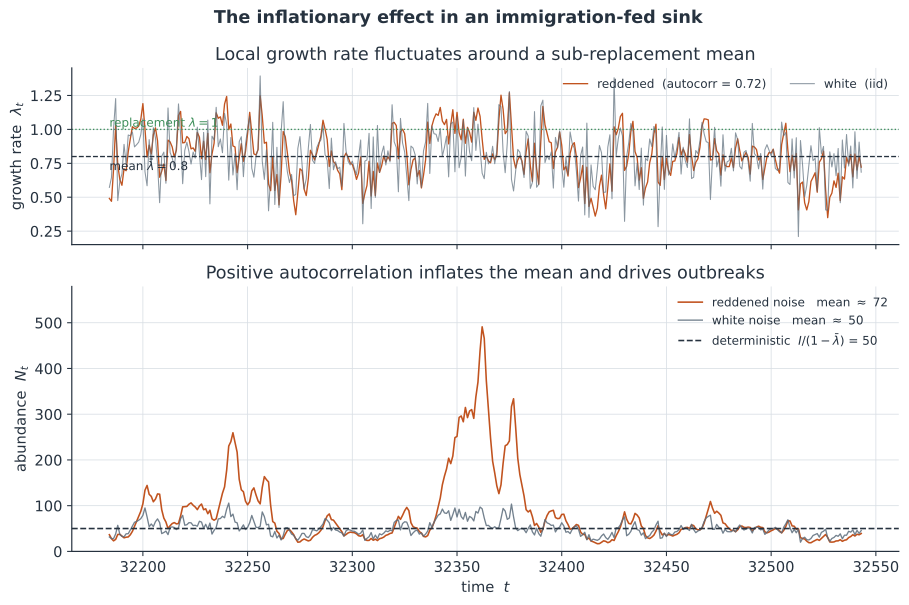
Two faces of spatiotemporal variation#
A metapopulation is a set of local populations on discrete patches, coupled by dispersal. Classical theory à la Levins asks only whether patches are occupied; here we care about how many individuals — or infections — each patch holds, and how that number is shaped by variation.
Call the local per-generation multiplier : a patch with abundance produces locally next generation, plus a steady trickle of immigrants from elsewhere. A patch is a sink when its mean growth rate is sub-replacement, : left alone it dwindles to nothing, and only immigration keeps it populated. In a constant environment the sink settles at the deterministic equilibrium — set and solve.
Real environments are not constant, and the variation comes along two axes that this page treats in turn. Along the time axis, rises and falls from one generation to the next, and whether the good and bad spells cluster — their temporal autocorrelation — turns out to control the mean abundance. Along the space axis, different patches peak and trough at different times, and whether their fluctuations line up — their synchrony — controls regional persistence. The surprise is that these two axes pull in opposite directions: positive autocorrelation in time inflates and stabilises, while positive correlation across space destabilises.
The inflationary effect#
Start with a single sink and ask what temporal variation does to its long-run mean. Iterating the recursion from the infinite past collects every past immigrant, discounted by the string of growth rates it has survived since arriving: Everything hinges on that expected product of growth rates.
White noise does not inflate the mean. If the are independent and identically distributed, the expectation of the product is the product of the expectations, , and the series collapses back to the deterministic value: Independent good and bad years cancel, and the average abundance is exactly what you would have predicted by plugging in the mean growth rate.
Positive autocorrelation does. When good years tend to follow good years — a reddened or positively autocorrelated environment — the growth rates in a product are positively correlated, so because the expectation of a product of positively correlated positive quantities exceeds the product of their means. Every term in the series is inflated, so the long-run mean rises above : This is the inflationary effect of Gonzalez & Holt (2002), extended to networks of coupled sinks by Roy, Holt & Barfield (2005).
The mechanism is Jensen’s inequality wearing temporal clothes. Population growth is multiplicative, and multiplicative accumulation is a convex function of a run of good years: a spell of lets abundance build super-linearly, while a spell of can only take it down to — never below — the floor that immigration keeps propped up. Autocorrelation lengthens those runs, so the convex upside (an outbreak) is amplified far more than the concave downside is deepened. The immigration term is the storage that makes this asymmetry pay: it refills the patch between outbreaks so there is always a base for the next good run to multiply, exactly the role that a seed bank or a refuge plays in the storage effect. The signature, visible in the lead figure, is a reddened outbreak pattern — long quiescent stretches near the immigration floor, punctuated by sharp eruptions when a lucky run of good years compounds.
How big is the inflation?#
The size of the effect grows with the variance of the environment and with the autocorrelation , and it is cleanest to see in an exactly solvable “good year / bad year” model. Let the environment be a symmetric two-state Markov chain: a good state with and a bad state with , each occupied half the time, with probability of staying put each generation. The lag-one autocorrelation of the growth rate is then , tuning smoothly from white noise (, ) to a highly persistent environment (, ). Solving the stationary mean of (a linear system, below) gives the curve of mean abundance against autocorrelation.
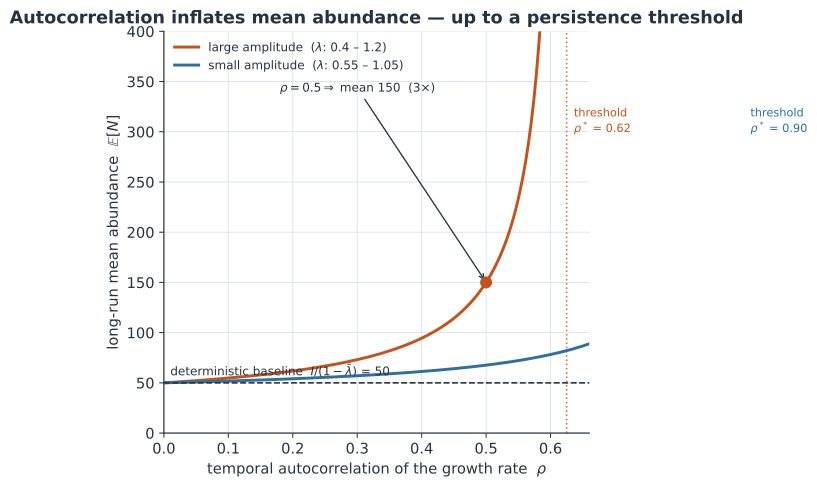
Two things stand out. First, inflation accelerates: with a large-amplitude environment ( swinging between 0.4 and 1.2, mean 0.8) an autocorrelation of only already triples the mean, from 50 to 150. Second, there is a persistence threshold. As rises the mean diverges at a finite (here ): beyond it the runs of good years are long enough that the population sustains itself without immigration, and the whole metapopulation of coupled sinks flips from immigration-dependent to self-perpetuating. This is the Roy, Holt & Barfield (2005) result — temporal autocorrelation, not just variance, can let a network of sinks persist indefinitely on its own.
Inflation is a covariance in time#
The product argument has an exact closed form that names the mechanism outright. Time-averaging the sink recursion (writing the growth rate as and allowing immigration to vary) and rearranging gives the Roy, Holt & Barfield (2005) identity (their eq. 2), where overbars denote time-averages and is the temporal covariance between the growth rate and the abundance in the patch. When the growth rates are independent from one generation to the next, and the mean collapses to the deterministic : in this discrete accounting, uncorrelated variation alone leaves the arithmetic mean untouched. Positive autocorrelation makes the patch densest exactly when it is growing fastest — a positive — and that covariance is the inflation. The proper “sink” condition in discrete time is that the geometric mean of is below one, equivalently the stochastic growth rate ; a patch can have geometric-mean growth below replacement — doomed if closed — yet an arithmetic-mean abundance inflated well above . (In continuous time the counterpart is Gonzalez & Holt’s (2002) harmonic-mean identity: the harmonic mean of a fluctuating sink’s abundance equals its constant-environment equilibrium , so the arithmetic mean is always at least — but in both settings the large inflation, the outbreaks, is carried by positively autocorrelated runs of good years.)
Asynchrony and rescue#
Now hold time fixed and look across space. Suppose each town runs its own recurrent epidemic, and each town on its own is below the critical community size — the population, first estimated by Bartlett (1957) at around 250,000–500,000 for measles, below which the infection troughs to zero cases between epidemics and fades out by chance. Whether the region keeps the pathogen alive depends entirely on how the local epidemics are phased relative to one another.
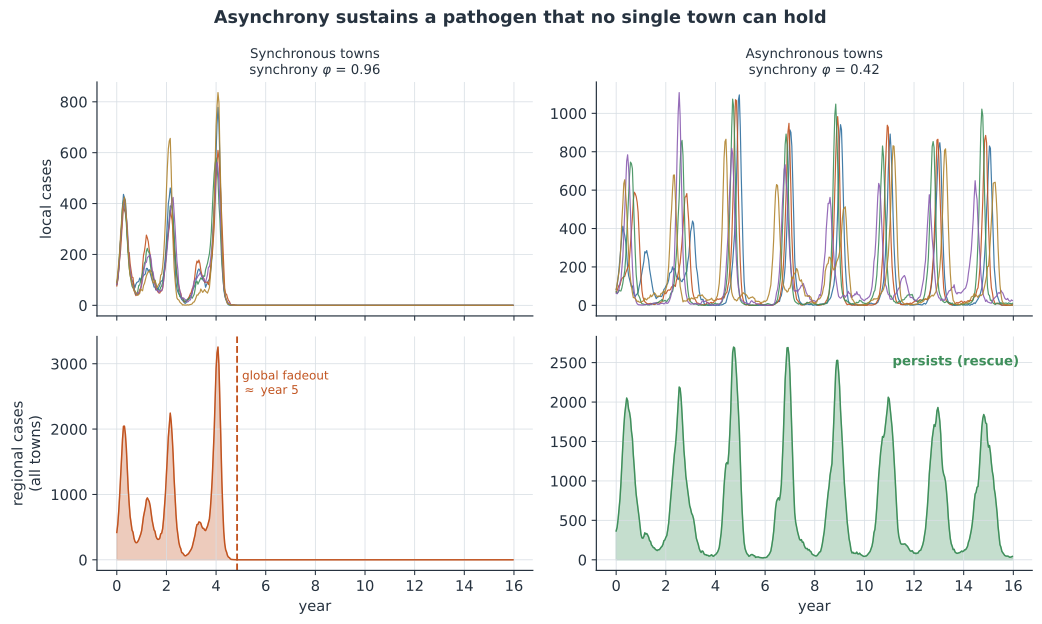
When the towns are synchronous (left), their epidemics crest and crash together. Every few years the whole region passes through a deep collective trough, and because all the local case counts hit zero at the same moment, there is no reservoir left to reignite anyone: the pathogen fades out globally, and the region’s large total population counts for nothing. When the towns are asynchronous (right), the troughs are staggered. At the moment one town’s chain of transmission flickers out, another is at its epidemic peak, and a handful of infected travellers reseed the faded town before its susceptibles have piled up in vain — the rescue effect. The pathogen bounces around the network indefinitely even though no single town could hold it, exactly the “cities and villages” picture of measles persistence from Bolker & Grenfell (1995) and Grenfell & Bolker (1998).
Asynchrony is, in a sense, the spatial twin of the inflationary effect: both let coupling plus variation sustain something that local dynamics alone cannot. But note the reversal of sign. In time, positive autocorrelation (persistence of good spells) helps the population. In space, positive correlation (synchrony of patches) hurts it, because synchrony removes the out-of-phase reservoir that rescue depends on. This is why Earn, Rohani & Grenfell (1998) could argue that anything which synchronises epidemics — strong shared seasonal forcing, or coordinated control — raises the risk of global fadeout, a lever that works for elimination rather than against it. The converse is a genuine trap for control: Bolker & Grenfell (1996) showed that mass vaccination can decorrelate previously synchronised city epidemics, and that this vaccine-induced asynchrony lessens the chance of global extinction — so a programme can lower incidence everywhere yet make the pathogen harder to eradicate by scattering its epidemics out of phase.
Measuring asynchrony#
To turn these pictures into numbers, we need to quantify how out-of-phase a set of local time series is. Three complementary measures do most of the work.
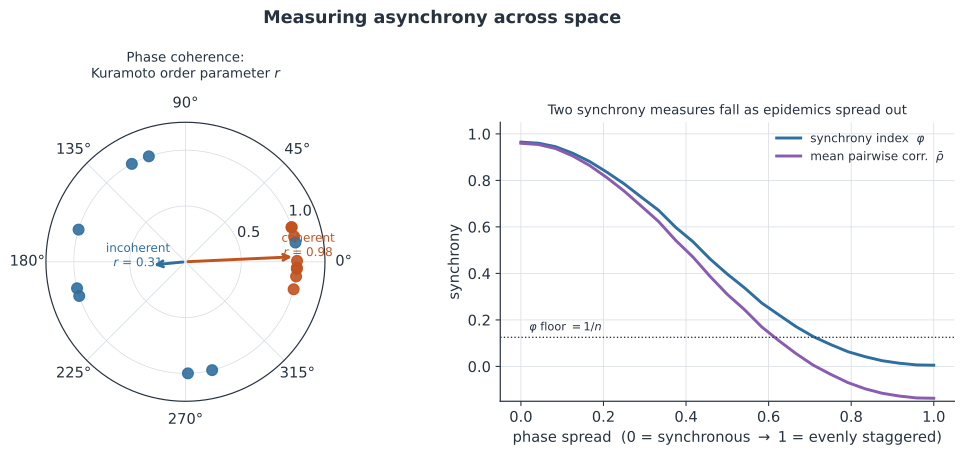
Mean pairwise correlation. The simplest index averages the zero-lag correlation of local incidence over all pairs of patches, . It runs from (synchrony) down toward zero, and can even go slightly negative when epidemics are locked into anti-phase — evenly staggered oscillators of equal amplitude are correlated at exactly .
Community synchrony index. Loreau & de Mazancourt (2008) compare the variance of the aggregate to the variances of the parts: When patches move in lockstep the aggregate fluctuates as violently as the sum of the parts and ; when they are perfectly asynchronous their ups and downs cancel in the sum and (and toward under anti-phase locking). The complement is the statistical-averaging or portfolio effect — the damping of regional fluctuations that spatial asynchrony buys, the same diversification that stabilises a spread-out portfolio.
Phase coherence. For cleanly oscillatory epidemics it is natural to extract each series’ phase — via a Hilbert or wavelet transform — and summarise their alignment with the Kuramoto order parameter Think of each local epidemic as a hand on a clock; is the length of the resultant when you add the hands as unit vectors. All hands together give (perfect coherence); hands scattered around the dial give (incoherence), as in the left panel above.
From to little and to : the disease translation#
Everything above transfers to epidemics by reading the multiplier as a reproduction number. Over one generation an infection multiplies by its effective reproduction number, so , the local abundance becomes prevalence or incidence, and the immigration becomes importation — infected travellers arriving through host movement. A sink patch is one that is locally subcritical, : transmission there cannot sustain a chain on its own, and the patch only carries infection because cases keep being imported.
It pays to keep two “growth” quantities distinct, because they answer different questions. The epidemic growth rate is little (the log per-generation multiplier — see the effective reproduction number). Whether a closed pathogen invades and grows is governed not by the arithmetic-mean reproduction number but by the stochastic growth rate, the geometric-mean rate where the inequality is Jensen’s again: temporal variance in lowers the growth rate that decides invasion, so averaging on its natural scale over-states a fluctuating pathogen’s ability to establish. That is the sense in which “little ” — the log-scale, geometric-mean rate — is the honest currency of growth under variation.
The inflationary effect is the complementary, and initially counter-intuitive, half of the story. It concerns not the growth rate of a closed population but the standing prevalence of an open, subcritical one, and there variance plus positive autocorrelation plus importation push the long-run mean up. A patch can have , and even a negative stochastic growth rate , yet — because seasons of favourable transmission cluster (a reddened ) and because movement keeps reseeding it — carry a substantial, outbreak-prone burden of infection whose time-average dwarfs the naive . Couple several such patches and the collective can cross the persistence threshold: the metapopulation sustains the pathogen with a regional effective reproduction number above one even though every patch is subcritical on average. This is the public-health payload of Kortessis et al. (2025): spatiotemporal heterogeneity and dispersal can hold an infection in a region that no constituent community could hold, and can do so invisibly to any surveillance that only tracks average transmission.
The practical corollary is a warning about thresholds. An elimination programme that drives the mean reproduction number below one in every patch has not necessarily won. If transmission is temporally autocorrelated (seasonality, weather, behavioural waves) and patches are spatially asynchronous and connected by movement, inflation and rescue can keep the pathogen endemic below the naive threshold. To anticipate this you measure three things directly: the local reproduction-number time series (from incidence, via the renewal equation), its temporal autocorrelation — how reddened the spectrum is — and the cross-patch synchrony or coherence . High redness and high asynchrony are the fingerprints of a system that will persist below where mean-field intuition says it should collapse — and, read the other way, synchronising control across patches (so troughs align) is a way to engineer the global fadeout that eliminates it.
Growth-rate inflation as a covariance: watching , space, and time#
Kortessis et al. (2025) fold the temporal and spatial stories into one measurable quantity built directly from local growth rates, and it is worth walking through because it makes “inflation” something you can compute from data rather than assert. Track the per-capita growth rate of each patch, . For an epidemic this is — the log rate of change of cases, little itself — positive while a local outbreak grows and negative once it burns through susceptibles. Let be each patch’s density (here, prevalence) relative to the metapopulation average .
Because movement only shuffles individuals between patches — it conserves the regional total — the growth rate of the whole metapopulation decomposes exactly, by the same algebra as the Price equation of evolutionary theory, into a spatial mean plus a spatial covariance:
The first term is the mean local growth rate across patches; the second — the spatial covariance between a patch’s growth rate and its relative density — is the instantaneous inflation. Whenever individuals are concentrated in the patches that happen to be growing fastest, and the metapopulation grows faster than the average of its patches.
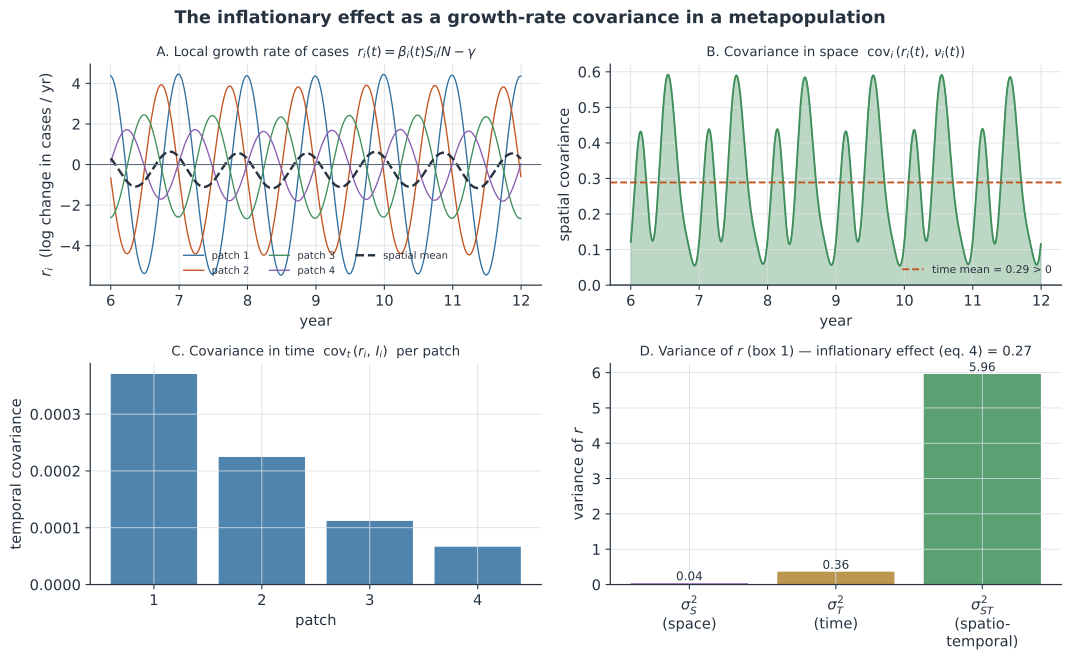
Panel A plots for four seasonally forced, out-of-phase patches; the spatial mean (dashed) hovers near zero, so no single patch is a runaway source. Panel B is the covariance in space, evaluated instant by instant: it pulses but stays positive, because diffusive movement keeps nudging infections toward whichever patch is currently in its growing season, so growth and density stay aligned. Panel C is the covariance in time, , computed patch by patch — the single-sink inflation of Roy et al.’s eq. 2, positive in every patch here because each patch, too, is densest when it is growing. Panel D is the variance budget, and it is the key to why asynchrony matters.
The variance of any factor that varies across space and time splits, ANOVA-style, into three pieces (Kortessis et al. 2025, box 1):
- Pure spatial, : the variance of the time-averaged spatial pattern — how patches differ on average.
- Pure temporal, : the variance of the space-averaged temporal pattern — how the whole landscape moves together.
- Spatiotemporal, : the remainder — the shifting mosaic in which the ranking of good and bad patches itself changes over time.
Asynchrony is : perfectly synchronised patches share one temporal signal and carry , while asynchronous patches carry a large . In the out-of-phase epidemics of the figure almost the entire variance of is spatiotemporal (panel D), and it is exactly this component — not the spatial or temporal main effects — that the inflationary effect feeds on.
Kortessis et al.’s inflationary effect (their eq. 4) is then the time-averaged spatial covariance, measured against a reference environment in which spatiotemporal heterogeneity has been switched off by freezing each patch’s growth rate at its own temporal mean :
where is the relative density the metapopulation would settle into under those frozen growth rates and the same movement. It is positive when dispersal, averaged over the shifting mosaic, leaves individuals in better-than-average locations — which, for symmetric (fitness-independent) movement that is not too fast, it does. Subtracting the frozen-growth reference is what isolates the contribution of : it is the disease analogue of asking how much extra transmission the spatiotemporal shuffle buys the pathogen beyond what its fixed geography already provides.
In code#
We simulate the four-patch seasonally forced SIR metapopulation, then read off the covariance in space, the covariance in time, the space/time/spatiotemporal variance budget, and the inflationary effect of equation (4).
import numpy as np
from scipy.integrate import solve_ivp

n, N, gamma, mu = 4, 1.0, 26.0, 1 / 50.0
R0 = 8.0 * (1 + 0.12 * np.linspace(-1, 1, n)); beta0 = R0 * (gamma + mu)
delta = 0.12 * (1 + 0.5 * np.cos(np.linspace(0, np.pi, n)))   # seasonal amplitude per patch
phases = np.linspace(0, 2 * np.pi, n, endpoint=False)         # staggered seasonal phase
m = 2.0                                                        # movement rate of infectives

def rhs(t, y):
    S, I = y[:n], y[n:2 * n]
    b = beta0 * (1 + delta * np.cos(2 * np.pi * t + phases))
    inf = b * S * I / N
    return np.concatenate([mu * N - inf - mu * S,
                           inf - (gamma + mu) * I + m * (I.mean() - I),   # movement conserves total
                           gamma * I - mu * y[2 * n:]])

S0 = np.full(n, 1 / R0.mean()); I0 = 1e-3 * (1 + 0.2 * np.cos(phases))
sol = solve_ivp(rhs, (0, 60), np.concatenate([S0, I0, N - S0 - I0]),
                t_eval=np.linspace(48, 60, 4000), rtol=1e-9, atol=1e-12, method="LSODA")
t, S, I = sol.t, sol.y[:n], sol.y[n:2 * n]

r = beta0[:, None] * (1 + delta[:, None] * np.cos(2 * np.pi * t[None, :] + phases[:, None])) * S / N - gamma
cov_space = (r * I / I.mean(0)).mean(0) - r.mean(0)             # cov_i(r_i, nu_i) at each time
cov_time = np.array([np.cov(r[i], I[i])[0, 1] for i in range(n)])
varS, varT = r.mean(1).var(), r.mean(0).var(); varST = r.var(0).mean() - varS
Aref = np.diag(r.mean(1)) + (m / n) * (np.ones((n, n)) - n * np.eye(n))   # frozen-growth reference
w, V = np.linalg.eig(Aref); nu_ref = V[:, np.argmax(w.real)].real; nu_ref /= nu_ref.mean()
cov_ref = (r.mean(1) * nu_ref).mean() - r.mean(1).mean()

print("cov in space (time-mean) :", round(float(cov_space.mean()), 3),
      " ranges", round(float(cov_space.min()), 2), "to", round(float(cov_space.max()), 2))
print("cov in time (per patch)  :", np.round(cov_time, 5))
print("var(r): space/time/space-time =", round(varS, 2), "/", round(varT, 2), "/", round(varST, 2))
print("inflationary effect (eq.4)   :", round(float(cov_space.mean() - cov_ref), 3))
cov in space (time-mean) : 0.289  ranges 0.05 to 0.6
cov in time (per patch)  : [3.7e-04 2.3e-04 1.1e-04 7.0e-05]
var(r): space/time/space-time = 0.04 / 0.37 / 5.96
inflationary effect (eq.4)   : 0.27
The covariance in space is positive at all times, the covariance in time is positive in every patch, and the variance of is overwhelmingly spatiotemporal — so the inflationary effect is positive: the shifting mosaic of out-of-phase outbreaks, sampled by movement, systematically concentrates infection where transmission is momentarily strongest.
R#
# Spatial decomposition of a growth-rate matrix r (rows = patches, cols = time)
# and the abundance/relative-density matrix I. Mirrors the Python above.
cov_space <- colMeans(r * (I / rep(colMeans(I), each = nrow(I)))) - colMeans(r)  # cov_i(r_i, nu_i)(t)
cov_time  <- sapply(seq_len(nrow(r)), function(i) cov(r[i, ], I[i, ]))           # Roy et al. eq. 2
varS <- var(rowMeans(r)); varT <- var(colMeans(r))                              # box 1: space, time
varST <- mean(apply(r, 2, var)) - varS                                          # spatiotemporal
c(cov_space = mean(cov_space), varS = varS, varT = varT, varST = varST)
Julia#
using Statistics, LinearAlgebra
# r, I are (patches × time) matrices from an SIR metapopulation solve
nu        = I ./ mean(I; dims = 1)
cov_space = vec(mean(r .* nu; dims = 1)) .- vec(mean(r; dims = 1))   # cov_i(r_i, nu_i)(t)
cov_time  = [cov(r[i, :], I[i, :]) for i in 1:size(r, 1)]           # Roy et al. eq. 2
varS = var(vec(mean(r; dims = 2)))                                  # box 1: pure spatial
varT = var(vec(mean(r; dims = 1)))                                  # pure temporal
varST = mean(var(r; dims = 1)) - varS                               # spatiotemporal
(mean_cov_space = mean(cov_space), varS = varS, varT = varT, varST = varST)
A worked example#
Take a single sink with a good-year growth rate (transmission briefly supercritical) and a bad-year rate , each occurring half the time, so the mean is ; immigration is per generation. The deterministic prediction is .
- No autocorrelation (, good and bad years independent): mean abundance is exactly — variance alone does nothing to the mean here.
- Moderate autocorrelation (): the mean climbs to , a three-fold inflation, purely because good years now cluster.
- Stronger autocorrelation (): the mean reaches , a thirteen-fold inflation, as the environment nears the persistence threshold beyond which the sink no longer needs immigration at all.
Read as an epidemic: a town where the reproduction number averages — comfortably “under control” on paper — can carry three-to-thirteen times the case burden a mean-field calculation predicts, and tip into self-sustaining transmission, once favourable-transmission spells cluster in time.
In code#
The exact two-state inflation calculation, and the community synchrony index, are both a few lines.
Python#
import numpy as np

def mean_abundance(lamH, lamL, p, I=10.0):
    """Long-run mean of N_{t+1} = lambda_{s_t} N_t + I under a symmetric two-state
    (good year / bad year) Markov environment: stay-probability p gives lag-1
    autocorrelation rho = 2p - 1. Solves the 2x2 stationary system for the joint
    means u_H, u_L of abundance-in-each-state; the total mean is their sum."""
    A = np.array([[1 - p * lamH, -(1 - p) * lamL],
                  [-(1 - p) * lamH, 1 - p * lamL]])
    uH, uL = np.linalg.solve(A, [I / 2, I / 2])
    return uH + uL

lamH, lamL = 1.2, 0.4               # good year 1.2 (>1), bad year 0.4; mean 0.8 (a sink)
for rho in [0.0, 0.5, 0.6]:
    p = (rho + 1) / 2
    print(f"rho={rho:>3}: mean abundance = {mean_abundance(lamH, lamL, p):6.1f}")
print("deterministic baseline I/(1-lam_bar) =", round(10 / (1 - 0.8), 1))
rho=0.0: mean abundance =   50.0
rho=0.5: mean abundance =  150.0
rho=0.6: mean abundance =  650.0
deterministic baseline I/(1-lam_bar) = 50.0
import numpy as np

def synchrony_index(x):
    """Loreau & de Mazancourt community synchrony: phi = Var(sum_i x_i) / (sum_i sd_i)^2.
    Rows are time, columns are patches. phi = 1 is lockstep, phi -> 1/n is asynchronous."""
    sd = x.std(axis=0)
    return x.sum(axis=1).var() / sd.sum() ** 2

t = np.arange(0, 20, 0.1)
n = 5
sync = np.stack([1 + np.cos(t) for _ in range(n)], axis=1)                    # identical phase
staggered = np.stack([1 + np.cos(t + 2 * np.pi * i / n) for i in range(n)], axis=1)  # spread phase
print("phi (synchronous)  =", round(float(synchrony_index(sync)), 3))
print("phi (asynchronous) =", round(float(synchrony_index(staggered)), 3))
print("1/n floor          =", round(1 / n, 3))
phi (synchronous)  = 1.0
phi (asynchronous) = 0.0
1/n floor          = 0.2
R#
# Exact two-state inflation: mean of N_{t+1} = lambda_{s_t} N_t + I
mean_abundance <- function(lamH, lamL, p, I = 10) {
  A <- matrix(c(1 - p * lamH, -(1 - p) * lamH,
                -(1 - p) * lamL, 1 - p * lamL), nrow = 2)
  u <- solve(A, c(I / 2, I / 2))
  sum(u)
}
for (rho in c(0, 0.5, 0.6)) {
  p <- (rho + 1) / 2
  cat(sprintf("rho=%.1f  mean = %.1f\n", rho, mean_abundance(1.2, 0.4, p)))
}

# Community synchrony index phi = Var(row sums) / (sum of column SDs)^2
synchrony_index <- function(x) {
  var(rowSums(x)) / sum(apply(x, 2, sd))^2
}
t <- seq(0, 20, by = 0.1); n <- 5
sync      <- sapply(1:n, function(i) 1 + cos(t))
staggered <- sapply(1:n, function(i) 1 + cos(t + 2 * pi * i / n))
c(sync = synchrony_index(sync), async = synchrony_index(staggered), floor = 1 / n)
Julia#
using LinearAlgebra, Statistics

# Exact two-state inflation
function mean_abundance(lamH, lamL, p; I = 10.0)
    A = [1 - p*lamH   -(1 - p)*lamL;
         -(1 - p)*lamH  1 - p*lamL]
    u = A \ [I/2, I/2]
    sum(u)
end
for rho in (0.0, 0.5, 0.6)
    p = (rho + 1) / 2
    println("rho=$rho  mean = ", round(mean_abundance(1.2, 0.4, p), digits = 1))
end

# Community synchrony index
synchrony_index(x) = var(vec(sum(x, dims = 2))) / sum(std(x, dims = 1))^2
t = 0:0.1:20; n = 5
sync      = hcat([1 .+ cos.(t)               for _ in 1:n]...)
staggered = hcat([1 .+ cos.(t .+ 2π*i/n)     for i in 1:n]...)
(sync = synchrony_index(sync), async = synchrony_index(staggered), floor = 1/n)
Why it matters#
The inflationary effect and spatial asynchrony are the two ways that variation, filtered through dispersal, breaks the mean-field intuition that a population or pathogen persists only where it can locally replace itself. Temporal autocorrelation inflates the standing abundance of an immigration-fed sink and can render a network of sinks self-sustaining; spatial asynchrony lets peaking patches rescue crashing ones and keeps a pathogen alive across a region of individually-too-small communities. For ecology this reframes conservation and pest control around the correlation structure of the environment, not just its mean and variance. For epidemiology it means that elimination is a property of a connected, fluctuating landscape rather than of any single community’s average reproduction number: an infection can persist with everywhere, and — turning the same physics into a tool — deliberately synchronising control across patches can precipitate the global fadeout that ends it. And because the effect reduces to covariances of the local growth rate — in space, in time, and in their spatiotemporal interaction — it is not just a cautionary story but something you can estimate from surveillance data and watch move.
Related#
- Metapopulations and the Levins Model
- Jensen’s Inequality and Nonlinear Averaging
- The Effective Reproduction Number and Forecasting
- Stochastic Epidemics and the Gillespie Algorithm
- Spatial Moment Equations
- Discrete-Time Models and the Logistic Map
- Compartmental Models (SIR)
- Markov Chains
- Spatial Synchrony and the Moran Effect — how shared environmental forcing and dispersal synchronize populations across space, the mechanism whose failure enables rescue
- Quantitative Methods