Metapopulations and the Levins Model
Real landscapes are patchy: a species survives not as one continuous population but as a scatter of local populations that wink out and are recolonized. The Levins model captures this “population of populations” with a single equation, and it turns out to be mathematically identical to a simple epidemic — patches play the role of hosts, and occupancy plays the role of infection.
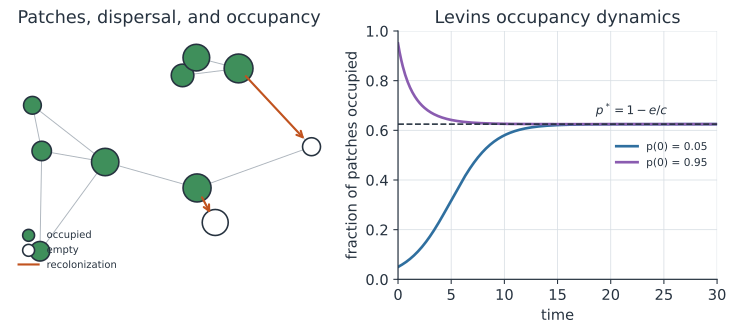
The metapopulation idea#
A metapopulation is a set of local populations occupying discrete habitat patches, linked by dispersal. Individual patches may go extinct, but colonization from occupied patches can rescue the whole system, so the metapopulation persists even as its parts blink on and off. Rather than track numbers within each patch, the classic Levins model tracks only the fraction of patches occupied, .
The Levins model#
Occupancy changes through two opposing processes. Empty patches (a fraction ) are colonized by propagules from occupied patches (a fraction ) at rate , while occupied patches go extinct at rate : The colonization term has exactly the shape of logistic growth — it needs occupied patches to send colonists and empty patches to receive them — while removes occupied patches at a constant per-patch rate.
Equilibrium occupancy#
Setting and factoring gives , so there are two equilibria. The trivial one, (regional extinction), and the interior one This is positive — the metapopulation persists — only if i.e. colonization must outpace extinction. Linearizing shows that when the extinction state is unstable and the interior equilibrium is stable; when the only nonnegative equilibrium is , and the metapopulation is doomed.
Habitat destruction and the extinction threshold#
Suppose a fraction of patches is permanently destroyed, so they can never be occupied. Only a fraction of patches remain available for colonization, and the equilibrium occupancy drops to Persistence now requires , giving an extinction threshold: the metapopulation collapses once Strikingly, the amount of habitat that can be destroyed before collapse equals the pre-destruction occupancy — species that already occupy few patches are the most vulnerable to habitat loss.
Parallel to an SIS epidemic#
The Levins equation is structurally the same as a simple SIS epidemic model. Reinterpret occupied patches as infected hosts and empty patches as susceptible hosts: colonization is transmission (rate , requiring contact between infected and susceptible) and patch extinction is recovery (rate ). The persistence condition is precisely the epidemic threshold , and equilibrium occupancy is the endemic prevalence . Habitat destruction that raises the extinction threshold is the direct analogue of vaccinating a fraction of the population to push below one.
A worked example#
Let and per unit time. The colonization–extinction ratio is (the analogue of ), so the metapopulation persists. Equilibrium occupancy is : three-quarters of patches are occupied at steady state. Now destroy of the patches: occupancy falls to . The system tips to extinction once — destroying more than three-quarters of the habitat wipes the species out even though colonists still exist.
In code#
We solve the Levins ODE and compare the numerical steady state to the formula .
R#
library(deSolve)

levins <- function(t, p, par) list(par$c * p * (1 - p) - par$e * p)
par <- list(c = 0.4, e = 0.1)
out <- ode(y = c(p = 0.05), times = seq(0, 100, 1), func = levins, parms = par)

tail(out[, "p"], 1)   # ~0.75
1 - par$e / par$c     # 0.75  (analytic equilibrium)
Python#
import numpy as np
from scipy.integrate import solve_ivp

c, e = 0.4, 0.1
f = lambda t, p: c * p * (1 - p) - e * p
sol = solve_ivp(f, (0, 100), [0.05], t_eval=[100], rtol=1e-8)

print(sol.y[0, -1])   # ~0.75
print(1 - e / c)      # 0.75

D = 0.5               # habitat destruction
print(1 - D - e / c)  # 0.25 occupancy after destroying half the patches
0.7499997354809338
0.75
0.25
Julia#
using DifferentialEquations

c, e = 0.4, 0.1
f(p, par, t) = c * p * (1 - p) - e * p
prob = ODEProblem(f, 0.05, (0.0, 100.0))
sol = solve(prob, Tsit5())

sol.u[end]        # ~0.75
1 - e / c         # 0.75 analytic equilibrium
Why it matters#
The Levins model shows that a species can persist regionally while every local population is doomed, reframing conservation around colonization, extinction, and the connectivity of patches rather than any single site. Its extinction threshold quantifies how much habitat loss a metapopulation can absorb, and its exact parallel to the SIS epidemic threshold means the same mathematics predicts both when a species survives a fragmenting landscape and when a pathogen invades a host population.
Related#
- Exponential and Logistic Growth
- Equilibria and Stability
- Spatial Moment Equations
- Compartmental Models (SIR)
- Source–Sink Dynamics — when dispersal from productive patches sustains populations in patches that cannot replace themselves
- Metapopulation Networks and the Invasion Threshold — extending the Levins occupancy model to explicit patch networks with heterogeneous connectivity
- Critical Community Size and Epidemic Fade-Out — the disease analogue of patch extinction, where small communities lose an infection between epidemics
- Quantitative Methods