Random-Graph Models
Real contact networks and food webs are messy, so we need generative models that explain how their structure could arise and that serve as null models — the baseline you compare data against to decide what is surprising. The choice of model shapes everything downstream, because degree heterogeneity governs whether a pathogen fizzles or explodes.
The Erdős–Rényi random graph#
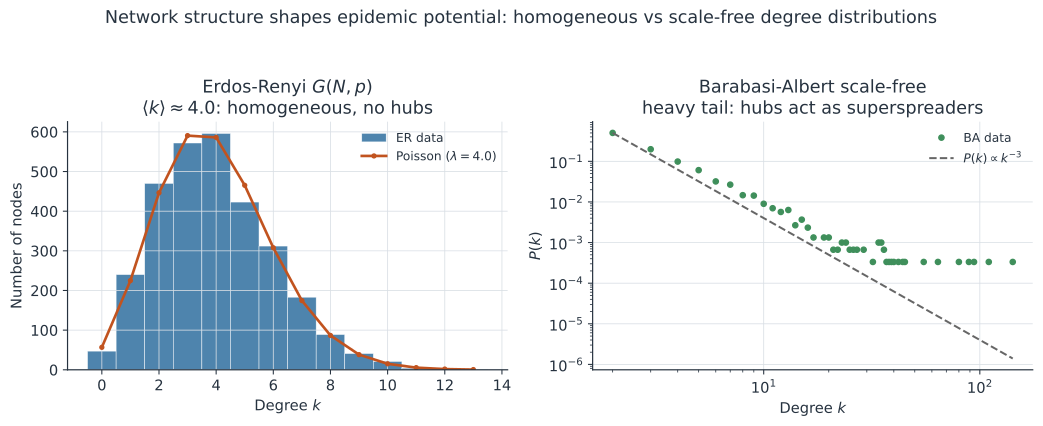
The simplest model is the Erdős–Rényi random graph : start with nodes and connect each of the possible pairs independently with probability . Because every node has potential partners each realised with probability , the degree of a node is a sum of independent Bernoulli trials, so it follows a binomial distribution with mean For large and small with fixed, this binomial converges to a Poisson distribution, which is sharply peaked about its mean: the network is homogeneous, with almost every node having a similar number of contacts and hubs essentially absent.
A defining feature of is a sharp giant-component threshold. When the mean degree crosses , the largest connected component abruptly jumps from tiny ( nodes) to giant (a finite fraction of the whole network). For an epidemic, this phase transition is the difference between a few isolated cases and a population-wide outbreak.
Configuration model and scale-free networks#
The Erdős–Rényi model produces one specific degree distribution, but often we want to fix the degrees and randomise everything else. The configuration model does exactly this: it takes a prescribed degree sequence, gives each node that many half-edges (“stubs”), and then wires the stubs together in random pairs. It is the standard null model for asking whether a network property is explained by its degree distribution alone or requires something more.
Many real networks are far from homogeneous: their degree distribution is a power law, typically with exponent . Such scale-free networks have a heavy tail — a small number of enormously connected hubs coexist with many low-degree nodes. One mechanism that generates them is Barabási–Albert preferential attachment: nodes are added one at a time and preferentially link to nodes that are already well connected, a “rich get richer” rule that concentrates edges onto early, popular nodes. A hallmark of the heavy tail is that the second moment can be very large — even diverging as when — even though the mean stays finite.
Small-world networks#
A third stylised fact is that many networks are small-world: they have high local clustering (like a regular lattice) yet short average path lengths (like a random graph). The Watts–Strogatz model reproduces this by starting from a ring lattice and randomly rewiring a small fraction of edges; those few long-range shortcuts collapse path lengths dramatically while leaving most of the local triangles intact.
Why degree heterogeneity matters#
The contrast between a Poisson network and a scale-free one is not academic. Hubs act as super-spreaders: in an epidemic on a scale-free contact network, the epidemic threshold is pushed down (and, in the idealised limit , can vanish entirely), so diseases invade at transmission rates that a homogeneous network would suppress. The same heterogeneity governs robustness: scale-free networks tolerate random node failures gracefully but collapse quickly when their hubs are removed — which is exactly why targeting highly connected individuals (high centrality) for vaccination or removal is so effective.
Simulation: comparing degree distributions#
We generate an Erdős–Rényi graph and a Barabási–Albert graph with the same size and compare their degree distributions: the first is tightly peaked, the second is heavy-tailed with clear hubs.
R#
library(igraph)
set.seed(1)

er <- sample_gnp(n = 1000, p = 4 / 999)   # <k> ~ 4, Poisson-like
ba <- sample_pa(n = 1000, m = 2, directed = FALSE)  # power law

mean(degree(er)); max(degree(er))   # ~4    ;  ~11  (thin tail)
mean(degree(ba)); max(degree(ba))   # ~4    ;  ~90+ (a few hubs)
Python#
import networkx as nx
import numpy as np
rng = np.random.default_rng(1)

er = nx.gnp_random_graph(1000, 4 / 999, seed=1)
ba = nx.barabasi_albert_graph(1000, 2, seed=1)

er_deg = [d for _, d in er.degree()]
ba_deg = [d for _, d in ba.degree()]
print(np.mean(er_deg), max(er_deg))  # ~4,  ~12   (Poisson: thin tail)
print(np.mean(ba_deg), max(ba_deg))  # ~4,  ~90+  (scale-free: hubs)
3.984 11
3.992 87
Julia#
using Graphs, Statistics, Random
Random.seed!(1)

er = erdos_renyi(1000, 4 / 999)
ba = barabasi_albert(1000, 2)

println((mean(degree(er)), maximum(degree(er))))  # (~4, ~12)  thin tail
println((mean(degree(ba)), maximum(degree(ba))))  # (~4, ~90+) hubs
Both graphs share a mean degree near , but the Barabási–Albert graph’s maximum degree is many times larger — the visible signature of hubs and a heavy tail.
Why it matters#
Random-graph models supply the null hypotheses of network science: to claim a food web is unusually clustered or a contact network unusually hub-dominated, you compare it against Erdős–Rényi or configuration-model ensembles with matched size and degrees. They also make the mechanistic point that microscopic wiring rules — independent edges, preferential attachment, or local rewiring — produce macroscopically different worlds for spreading and stability. Above all, they show why degree heterogeneity is decisive: the same average number of contacts can hide super-spreading hubs that shift epidemic thresholds and reshape which interventions work on an ecological network or a population.