Optimal Experimental Design
When the design region is constrained or irregular — so classical factorials and central composite designs don’t fit — optimal design picks run locations to make a model’s parameter estimates as precise as possible. In a pharmacokinetics or dose–response study, for instance, it chooses which concentrations to test or when to draw blood samples so the model parameters are pinned down most precisely for the fewest, most expensive assays. It is model-based: you specify the model, then choose points that optimize a criterion on the information matrix.
The information matrix#
For a linear model with , the least-squares estimator has covariance
The matrix is the information matrix: larger information means smaller variance. Optimal design chooses the rows of the model matrix (the runs) to make “big” in a chosen sense. These criteria are named by letters — hence “alphabetic” optimality.
Alphabetic optimality criteria#
- D-optimality — maximize . This minimizes the volume of the joint confidence ellipsoid for , since that volume is proportional to . The most widely used criterion.
- A-optimality — minimize , the sum (average) of the parameter variances.
- I-optimality (a.k.a. IV) — minimize the average prediction variance over the design region.
- G-optimality — minimize the maximum prediction variance over the region.
The prediction variance at a point is , which links the I/G criteria to .
Exchange algorithms#
For all but tiny problems, searching over subsets of a candidate set is combinatorial. Exchange algorithms — the classic one is Fedorov’s — start from an initial design and repeatedly swap a design point for a candidate point whenever the swap improves the criterion (e.g. increases ), stopping at a local optimum. Modified Fedorov and coordinate-exchange variants scale this to many candidates.
Worked example: endpoints are D-optimal for a line#
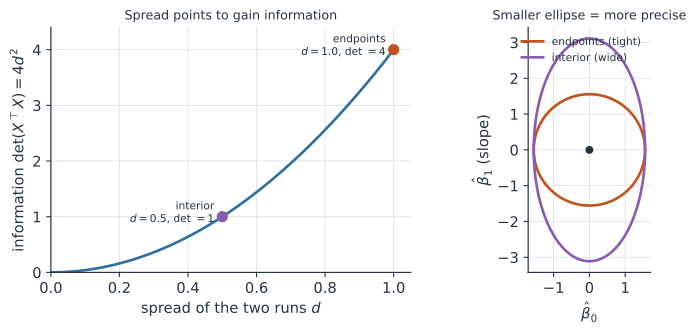
Fit a straight line on the region with two runs at (with ). The model matrix and information matrix are
Then
which increases in and is maximized at . Compare two candidate designs:
- Endpoints : .
- Interior points : .
The endpoint design has four times the determinant, so it estimates the slope far more precisely — spreading points as far apart as the region allows is D-optimal for a line (Figure 1).
In code#
R#
library(AlgDesign)
set.seed(1)
# Candidate set on [-1, 1]; find best 2-point D-optimal design for a line
cand <- data.frame(x = seq(-1, 1, by = 0.1))
res <- optFederov(~ x, data = cand, nTrials = 2, criterion = "D")
res$design
#     x
#   -1
#    1        <- endpoints, as expected
Python#
import numpy as np
from itertools import combinations

# Candidate points on [-1, 1]; greedily/exhaustively maximize det(X'X)
cand = np.linspace(-1, 1, 21)
best_det, best = -np.inf, None
for combo in combinations(range(len(cand)), 2):
    x = cand[list(combo)]
    X = np.column_stack([np.ones_like(x), x])   # model: 1, x
    d = np.linalg.det(X.T @ X)
    if d > best_det:
        best_det, best = d, x
print(best, best_det)
# [-1.  1.] 4.0   -> endpoints are D-optimal
[-1. 1.] 4.0
Julia#
using LinearAlgebra, Combinatorics

cand = collect(range(-1, 1, length = 21))
best_det, best = -Inf, Float64[]
for combo in combinations(1:length(cand), 2)
    x = cand[combo]
    X = hcat(ones(length(x)), x)        # model matrix: [1  x]
    d = det(X' * X)
    if d > best_det
        best_det, best = d, x
    end
end
println(best, "  det = ", best_det)
# [-1.0, 1.0]  det = 4.0   -> endpoints
Why it matters for statistics#
Real experiments rarely live on a tidy cube: budgets cap runs, some factor combinations are infeasible, and the region can be an odd polytope. Optimal design gives a principled, criterion-driven way to place runs anywhere in such regions, tailored to the model you intend to fit. It also unifies classical designs — for many standard settings the D-optimal design is the familiar factorial — and quantifies exactly what “precise estimation” means through .