Population Dynamics of Resistance
Antimicrobial resistance plays out on two scales. Within a single infection, mutation and selection change the makeup of a bacterial population, which is the story told in The Evolution of Resistance. Across a host population, drug-sensitive and drug-resistant strains circulate as competing transmission chains, and treatment tilts the competition toward whichever strain the drug cannot clear. This page is about that second, epidemiological scale, following the two-strain transmission models of Lipsitch, Bonhoeffer, and colleagues.
Two strains competing for hosts#
Picture a population of hosts, each either susceptible or infected by one of two strains. The sensitive strain transmits at rate and is cleared both naturally and by treatment. The resistant strain transmits at rate , where is the fitness cost of resistance, and treatment does nothing to it. Writing , , and for the fractions of hosts in each state, an SIS model with treatment rate reads
Here is the natural clearance rate and cleared hosts return to , so this is an SIS rather than an SIR system. The two strains share the same susceptible pool, so they are in direct competition for hosts to infect.
Treatment is selection at the population scale#
Each strain has an effective reproduction number, the average number of new infections one case produces given the current clearance pressure. For the sensitive strain treatment adds to clearance, while the resistant strain is untouched:
Whichever strain has the larger reproduction number at a shared susceptible level outcompetes the other. Treatment is the selection pressure: raising shrinks but leaves alone.
The fitness cost sets the tipping point#
The two strains are equally fit when , which happens at a threshold treatment rate
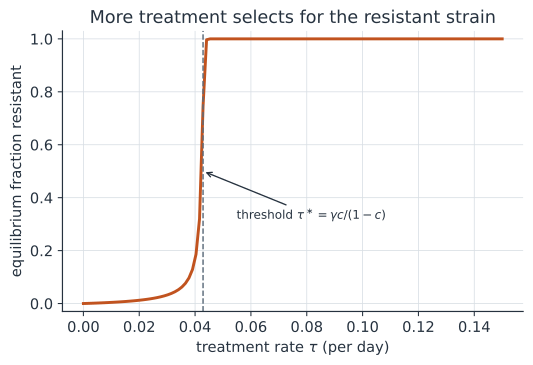
Below the sensitive strain wins because it transmits faster and treatment is too rare to matter. Above the drug clears sensitive infections quickly enough that the slower resistant strain, immune to the drug, takes over. A larger fitness cost pushes higher, so a costly resistance mutation is held in check until drug use climbs. This is why the cost of resistance is the quantity clinicians and modelers most want to measure.
Coexistence and slow reversal#
In the bare model the switch at is abrupt, an instance of competitive exclusion. Two features soften it into the S-curve in the figure. Real populations continually generate resistance de novo when treatment converts a sensitive infection into a resistant one, which seeds a low resistant fraction even below . Host heterogeneity, where some people are treated far more than others, lets each strain dominate its own niche so the strains coexist over a range of treatment rates rather than at a single knife-edge.
The same competition explains why resistance is slow to reverse. Once the resistant strain is established and the susceptible pool has shifted, cutting drug use back below does not immediately restore the sensitive strain, because reversal is limited by the small fitness cost acting over many transmission generations. If the cost is near zero, resistance can persist almost indefinitely after the selective pressure is gone.
A worked example#
Take , natural clearance (a ten-day infection), and a fitness cost . The threshold treatment rate is
At a low treatment rate we have against , so the sensitive strain dominates. Doubling treatment to makes , and the resistant strain wins. Adding a small de novo resistance rate during treatment turns the abrupt switch into the smooth rise plotted above, so the equilibrium resistant fraction climbs steadily with .
In code#
We integrate the two-strain SIS model to steady state, adding a small rate at which treated sensitive infections become resistant, and read off the resistant fraction for a few treatment rates.
R#
library(deSolve)

beta <- 0.30; gamma <- 0.10; cost <- 0.30; rho <- 0.01

rhs <- function(t, y, p) {
  S <- y[1]; Is <- y[2]; Ir <- y[3]; tau <- p$tau
  new_s <- beta * S * Is
  new_r <- beta * (1 - cost) * S * Ir
  dIs <- new_s - gamma * Is - tau * Is
  dIr <- new_r - gamma * Ir + rho * tau * Is
  dS  <- gamma * Is + gamma * Ir + (1 - rho) * tau * Is - new_s - new_r
  list(c(dS, dIs, dIr))
}

frac <- function(tau) {
  out <- ode(c(0.98, 0.01, 0.01), seq(0, 5000, 10), rhs, list(tau = tau))
  last <- out[nrow(out), ]
  last["3"] / (last["2"] + last["3"])       # Ir / (Is + Ir)
}
sapply(c(0.02, 0.04, 0.06), frac)            # ~ 0.01, 0.17, 1.00
Python#
import numpy as np
from scipy.integrate import solve_ivp

beta, gamma, cost, rho = 0.30, 0.10, 0.30, 0.01


def rhs(t, y, tau):
    S, Is, Ir = y
    new_s = beta * S * Is
    new_r = beta * (1 - cost) * S * Ir
    dIs = new_s - gamma * Is - tau * Is
    dIr = new_r - gamma * Ir + rho * tau * Is
    dS = gamma * Is + gamma * Ir + (1 - rho) * tau * Is - new_s - new_r
    return [dS, dIs, dIr]


def resistant_fraction(tau):
    sol = solve_ivp(rhs, [0, 5000], [0.98, 0.01, 0.01],
                    args=(tau,), rtol=1e-9, atol=1e-11)
    S, Is, Ir = sol.y[:, -1]
    return Ir / (Is + Ir)


for tau in (0.02, 0.04, 0.06):
    print(f"tau={tau:.2f}/day  resistant fraction={resistant_fraction(tau):.3f}")
tau=0.02/day  resistant fraction=0.012
tau=0.04/day  resistant fraction=0.167
tau=0.06/day  resistant fraction=1.000
Julia#
using DifferentialEquations

beta, gamma, cost, rho = 0.30, 0.10, 0.30, 0.01

function rhs!(du, u, tau, t)
    S, Is, Ir = u
    new_s = beta * S * Is
    new_r = beta * (1 - cost) * S * Ir
    du[1] = gamma*Is + gamma*Ir + (1-rho)*tau*Is - new_s - new_r
    du[2] = new_s - gamma*Is - tau*Is
    du[3] = new_r - gamma*Ir + rho*tau*Is
end

function frac(tau)
    prob = ODEProblem(rhs!, [0.98, 0.01, 0.01], (0.0, 5000.0), tau)
    u = solve(prob, Tsit5(); reltol = 1e-9).u[end]
    u[3] / (u[2] + u[3])
end
frac.((0.02, 0.04, 0.06))                    # ~ (0.01, 0.17, 1.00)
Why it matters#
The population dynamics of resistance say that how much a drug is used, not just how it is used in one patient, determines how common resistance becomes. That reframes stewardship as managing a shared resource: the community-wide treatment rate sets the selection pressure, and the fitness cost sets how hard resistance is to reverse once it spreads. The same transmission machinery that gives an epidemic its basic reproduction number governs which strain circulates, so slowing resistance is as much an epidemiological problem as a pharmacological one.
Related#
- Compartmental Models — the SIS and SIR transmission machinery
- The Evolution of Resistance — the within-host selection scale
- Antimicrobial Resistance Across Scales — joins this population model to within-host competitive release and a nested malaria model
- Antimicrobial PK/PD — dosing that suppresses resistance in the individual
- The Next-Generation Matrix and R₀ — reproduction numbers for competing strains
- PK/PD Target Attainment — the sibling dosing view
- Quantitative Methods