Testing & Verification for Scientific Code
Analysis code has a dangerous property: it almost always produces an answer, and a wrong answer looks exactly like a right one. A model still runs, a plot still renders, a number still prints — even when a sign is flipped or an index is off by one. Testing is how you catch those silent errors before they reach a manuscript, by writing code that checks your code.
For scientific work the goal is not “100% coverage.” It is a small set of tests that would fail loudly if the results were wrong, so that when you refactor, add a feature, or update a package, you find out immediately instead of six months later.
The Unit Test: Check a Known Answer#
The basic building block is the unit test: call a function with an input whose correct output you already know, and assert you get it. The best inputs are the ones you can work out by hand or from theory.
# pytest: a function and the tests that pin down its behaviour
def prevalence(positives, n):
    return positives / n

def test_prevalence_basic():
    assert prevalence(20, 100) == 0.2

def test_prevalence_all_positive():
    assert prevalence(50, 50) == 1.0
The same idea in each language’s standard framework:
# R: testthat
test_that("prevalence is computed correctly", {
  expect_equal(prevalence(20, 100), 0.2)
  expect_equal(prevalence(50, 50), 1.0)
})
# Julia: the built-in Test standard library
using Test
@testset "prevalence" begin
    @test prevalence(20, 100) == 0.2
    @test prevalence(50, 50) == 1.0
end
Because floating-point results are approximate, compare numbers with a tolerance, never ==: expect_equal (R), ≈/isapprox (Julia), and pytest.approx / np.isclose (Python) all exist for exactly this.
Test the Edges, and the Bugs You Fix#
The inputs that break code are rarely the typical ones. Deliberately test the edge cases: an empty dataset, a single observation, a zero, a negative number, a missing value, the largest realistic input.
And every time you find a bug, write a test that reproduces it first, then fix it. That “regression test” is a tripwire ensuring the bug can never silently return — a habit that pairs naturally with debugging and the reprex.
Property & Invariant Tests#
Often you do not know the exact output, but you know something that must always be true — a property or invariant. Asserting those catches a huge class of errors without a reference answer:
- A simulated SIR/SEIR trajectory must conserve the population:
S + I + Rstays constant. - A vector of probabilities must be non-negative and sum to 1.
- A distance matrix must be symmetric with a zero diagonal.
- Sorting, then sorting again, changes nothing (idempotence).
- An estimator run on data simulated from known parameters should recover those parameters (on average).
An invariant test needs no oracle — just the law the code must obey:
import numpy as np

def sir_step(S, I, R, beta, gamma, dt):
    dS, dI = -beta * S * I, beta * S * I - gamma * I
    return S + dS*dt, I + dI*dt, R + gamma*I*dt

S, I, R = 0.99, 0.01, 0.0
total_start = S + I + R
for _ in range(500):
    S, I, R = sir_step(S, I, R, 0.4, 0.1, 0.1)

print("population conserved:", np.isclose(S + I + R, total_start))
print("compartments non-negative:", min(S, I, R) >= 0)
population conserved: True
compartments non-negative: True
Property-based testing tools (hypothesis in Python, quickcheck/hedgehog in R, and Julia’s macros) push this further: they generate hundreds of random inputs and check the property holds for all of them, automatically hunting for the one that breaks it.
Testing Code That Is Random#
Stochastic code — simulations, samplers, bootstraps — seems untestable: it gives a different number every run. There are two complementary answers.
Fix the seed for exact tests. With the seed pinned, a stochastic function becomes deterministic, so you can assert on exact values or shapes — a regression test that catches any unintended change.
Assert statistical properties for the randomness itself. You cannot claim one run equals a fixed number, but you can simulate data from a known truth many times and check that the distribution of estimates is centred on that truth within a tolerance. Any single run scatters; the average lands on the right answer.
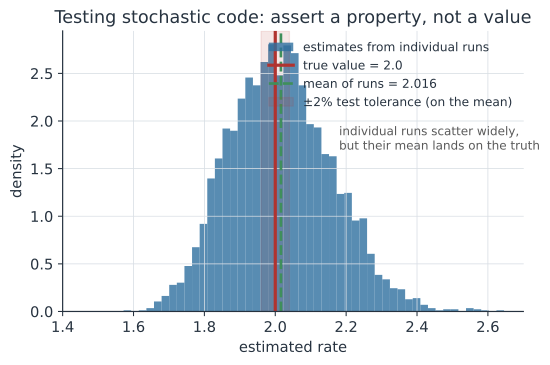
rng = np.random.default_rng(1)
true_rate = 2.0
ests = np.array([
    1.0 / rng.exponential(1 / true_rate, size=200).mean()   # estimate the rate
    for _ in range(2000)
])

print(f"mean estimate: {ests.mean():.3f}   (true value {true_rate})")
print("recovers truth within 2%:", abs(ests.mean() - true_rate) < 0.02 * true_rate)
mean estimate: 2.017   (true value 2.0)
recovers truth within 2%: True
This is the everyday logic of a simulation study turned into a pass/fail check — see A Simulation Toolkit.
What to Test, in Practice#
You do not need to test everything. For a typical analysis, aim these tests at the parts most likely to be silently wrong:
- Your own core functions — the custom likelihood, the transmission step, the summary statistic. Not the libraries; they are already tested.
- Data-cleaning steps — filters, joins, and recodes, where an off-by-one or a bad join quietly drops or duplicates rows.
- Anything numerically delicate — log-space calculations, ODE integration, optimization.
- Every bug you fix — as a regression test.
Wire the tests into your project workflow so they run with one command, and — ideally — automatically on each commit, so a broken result can never quietly ship.
Related#
- Debugging and Troubleshooting — finding the bug a test just caught
- A Simulation Toolkit — simulate-from-known-truth is also how you test estimators
- Randomness & Random Number Generation — seeds make stochastic tests reproducible
- Floating-Point Arithmetic & Numerical Stability — why tests compare with a tolerance
- Reproducibility and Project Workflow — running tests as part of the pipeline
- Programming & Computing