Epidemiological Intervals and Delays
Transmission is a sequence of events strung out in time: a person is infected, becomes infectious, perhaps develops symptoms, and infects others, who repeat the cycle. The intervals between these events — incubation, latent, infectious, serial, and generation — are the clocks of an epidemic. They set how fast cases accumulate, how much warning symptoms give before spread, and how we translate an epidemic growth rate into a reproduction number.
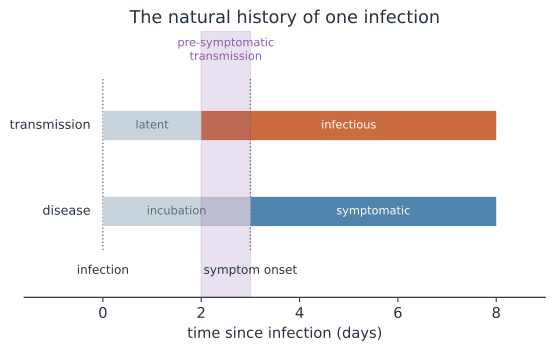
The natural history of one infection#
Set the clock to zero at the moment of infection (exposure). Two independent processes then unfold, and it is essential to keep them separate.
The disease clock governs symptoms. The incubation period is the time from infection to symptom onset.
The transmission clock governs infectiousness. The latent period is the time from infection to the onset of infectiousness, and the infectious period is how long infectiousness then lasts.
The latent period and the incubation period are not the same thing, and their ordering matters enormously for control.
- When infectiousness begins after symptoms (latent period longer than incubation), sick people can be identified and isolated before they transmit. This was the situation with SARS-CoV-1 in 2003, which is a large part of why it was containable.
- When infectiousness begins before symptoms (latent period shorter than incubation), there is a pre-symptomatic transmission window in which apparently healthy people spread the pathogen. This was a defining, and dangerous, feature of SARS-CoV-2.
Asymptomatic infections take this to its limit: infectious individuals who never develop symptoms at all, and so are invisible to any surveillance system that relies on people feeling ill.
Serial interval and generation interval#
To describe transmission between people we need intervals that span an infector–infectee pair.
The generation interval (or generation time) is the time between the infection of an infector and the infection of the person they infect. It is the quantity that actually governs epidemic dynamics, but it is rarely observable directly — we almost never see the moment of infection.
The serial interval is the time between symptom onset in the infector and symptom onset in the infectee. Onsets are usually observable, so the serial interval is what we typically measure and use as a proxy for the generation interval.
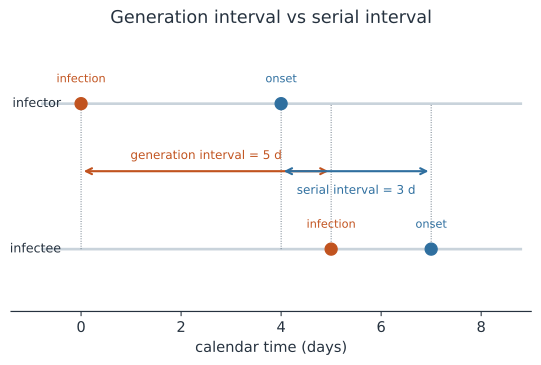
The two intervals are linked through the incubation periods of the two people:
where and are the two incubation periods. Two consequences follow.
- If incubation periods are independent and identically distributed across people, the serial and generation intervals have the same mean, so the serial interval is an unbiased estimator of the mean generation time.
- The serial interval has larger variance (it adds the variability of two incubation periods) and can be negative: if the infectee happens to have a much shorter incubation period than the infector, they can show symptoms first. Negative serial intervals were repeatedly observed for SARS-CoV-2 and are a direct signature of substantial pre-symptomatic transmission.
Why the generation interval controls #
The generation interval distribution is the bridge between the two things we can most easily measure about an epidemic — its growth rate and its reproduction number . The renewal (Euler–Lotka) equation ties them together:
For a given growth rate , a shorter generation interval implies a reproduction number closer to 1, because each generation of transmission is turned over faster. This is why estimating well matters: plug in the wrong generation interval and you get the wrong , and the wrong sense of how hard the epidemic is to stop. See the effective reproduction number for how is estimated from incidence using .
A gallery of biological examples#
Intervals vary enormously across pathogens, and that variation shapes both dynamics and control.
| Pathogen | Incubation (mean) | Serial interval (mean) | Note |
|---|---|---|---|
| Influenza A | ~2 days | ~2–3 days | short intervals → fast, hard-to-outrun epidemics |
| SARS-CoV-2 (ancestral) | ~5 days | ~5 days | serial interval sometimes < incubation → pre-symptomatic spread |
| SARS-CoV-1 | ~5 days | ~8–10 days | infectiousness peaks after symptoms → containable |
| Measles | ~10–14 days | ~12 days | very high (12–18) despite moderate intervals |
| Ebola virus | ~8–10 days | ~15 days | long intervals give contact tracing time to work |
| Smallpox | ~12 days | ~17 days | long, symptom-first transmission enabled eradication |
For vector-borne diseases there is an extra clock inside the vector. The extrinsic incubation period (EIP) is the time from a mosquito taking an infectious blood meal to becoming able to transmit. For Plasmodium (malaria) the EIP is roughly 10–14 days but is strongly temperature-dependent — warmer temperatures shorten it, which is one mechanism by which climate shifts transmission intensity (see vector-borne models).
Delays from onset to observation#
Surveillance sees events even later than onset, through a chain of reporting delays: onset-to-testing, onset-to-hospitalization, onset-to-death, and onset-to-report. These delays are why the most recent days of any epidemic curve are always incomplete, and correcting for them is the job of nowcasting.
A worked example#
Suppose the generation interval is Gamma-distributed with mean 5 days and standard deviation 2 days, and each person’s incubation period is Gamma-distributed with mean 5 days and standard deviation 3 days, all independent. The serial interval then has the same mean as the generation interval, 5 days, but a larger standard deviation of days, and a non-trivial fraction of infector–infectee pairs will have negative serial intervals.
In code#
We simulate infector–infectee pairs to confirm that the serial interval shares the generation interval’s mean, spreads wider, and goes negative.
R#
set.seed(1)
n  <- 200000
gi <- rgamma(n, shape = 6.25, scale = 0.8)          # mean 5, sd 2
Ia <- rgamma(n, shape = 2.78, scale = 1.8)          # infector incubation: mean 5, sd 3
Ib <- rgamma(n, shape = 2.78, scale = 1.8)          # infectee incubation
si <- gi + (Ib - Ia)                                # serial interval

c(gen_mean = mean(gi), si_mean = mean(si),
  si_sd = sd(si), frac_negative = mean(si < 0))
Python#
We use Polars to hold and summarize the simulated pairs.
import numpy as np
import polars as pl

rng = np.random.default_rng(1)
n = 200_000
gi = rng.gamma(shape=6.25, scale=0.8, size=n)       # generation interval: mean 5, sd 2
Ia = rng.gamma(shape=2.78, scale=1.8, size=n)       # infector incubation: mean 5, sd 3
Ib = rng.gamma(shape=2.78, scale=1.8, size=n)       # infectee incubation
si = gi + (Ib - Ia)                                 # serial interval

pairs = pl.DataFrame({"generation": gi, "serial": si})
summary = pairs.select(
    gen_mean=pl.col("generation").mean(),
    si_mean=pl.col("serial").mean(),
    si_sd=pl.col("serial").std(),
    frac_negative=(pl.col("serial") < 0).mean(),
)
print(summary)
shape: (1, 4)
┌──────────┬──────────┬──────────┬───────────────┐
│ gen_mean ┆ si_mean  ┆ si_sd    ┆ frac_negative │
│ ---      ┆ ---      ┆ ---      ┆ ---           │
│ f64      ┆ f64      ┆ f64      ┆ f64           │
╞══════════╪══════════╪══════════╪═══════════════╡
│ 4.989681 ┆ 4.989542 ┆ 4.689407 ┆ 0.130155      │
└──────────┴──────────┴──────────┴───────────────┘
The generation and serial means agree near 5 days, the serial standard deviation is about 4.7, and a noticeable fraction of serial intervals come out negative — exactly the pre-symptomatic-transmission signature.
Julia#
using Distributions, Statistics, Random
Random.seed!(1)

n  = 200_000
gi = rand(Gamma(6.25, 0.8), n)                      # mean 5, sd 2
Ia = rand(Gamma(2.78, 1.8), n)                      # mean 5, sd 3
Ib = rand(Gamma(2.78, 1.8), n)
si = gi .+ (Ib .- Ia)

(gen_mean = mean(gi), si_mean = mean(si),
 si_sd = std(si), frac_negative = mean(si .< 0))
Why it matters#
Intervals are where biology meets dynamics. The gap between the latent and incubation periods decides whether symptom-based control can ever work; the generation interval decides how a measured growth rate maps to a reproduction number; and the serial interval is the observable stand-in we actually estimate, complete with its awkward tendency to go negative. Getting these distributions right — and estimating them correctly from messy, real-time data — is the subject of the next page.
Related#
- Fitting Delay Distributions: Truncation and Censoring
- The Effective Reproduction Number and Forecasting
- Compartmental Models (SIR)
- SEIR and Compartmental Extensions
- Vector-Borne Disease Models
- Survival Analysis
- The Euler–Lotka Equation and the r–R₀ Relationship — the renewal equation that turns a growth rate into a reproduction number through the generation interval
- Within-Host Viral Dynamics and Infectiousness — how the viral-load trajectory generates the infectiousness profile underlying the generation interval
- The Speed and Strength of Epidemic Control — how the generation interval sets the pace an intervention must beat
- Epidemiology