Exponential and Logistic Growth
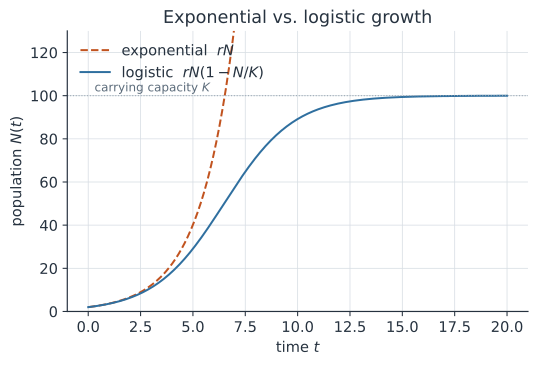
Every population, from a bacterial colony to an outbreak’s infected class, starts by growing in proportion to its own size. In the case of bacterial growth undergoing binary fission, each generation begets two offspring, continuing. Exponential and logistic growth are the two baseline models that describe this — the first for unlimited resources (rarely if ever the case in reality, but realistic in early growth periods), the second for the density dependence that eventually reins growth in due to limited resources driven by the resources or competition for the resources.
Exponential growth#
When each individual reproduces at a constant per-capita rate and nothing limits them, the population obeys where is the intrinsic growth rate (births minus deaths per individual per unit time). This is the simplest ordinary differential equation in ecology: the rate of change is proportional to the current size. Separating variables and integrating gives the closed-form solution where is the initial size. Deriving this solution is a standard application of integration and the exponential function.
When the population grows without bound; when it decays toward zero; when it stays put.
Doubling time#
A useful summary of exponential growth is the doubling time , the time for the population to double. Setting gives , so The same formula (with the epidemic growth rate) gives the early doubling time of cases in an outbreak.
Logistic growth#
Unlimited growth is unrealistic: crowding reduces per-capita reproduction as resources run short. The logistic model makes the per-capita rate decline linearly with density, where is the carrying capacity — the population size the environment can sustain. When is small the bracket is near and growth is nearly exponential; as the bracket goes to and growth stops.
The solution is the sigmoid (S-shaped) curve It rises slowly at first, accelerates, then levels off at .
Show how the sigmoid solution is obtained
Separate variables in :
Split the left side with partial fractions, , and integrate both sides:
where . Fixing from the initial value gives , and solving for yields the sigmoid
Where growth is fastest#
The absolute growth rate is a downward parabola in , maximized where its derivative with respect to vanishes: , i.e. at At the inflection point the population is adding individuals fastest, at rate .
Equilibria and stability#
Setting gives two equilibria: and . Linearizing gives . At , , so the origin is unstable — a few individuals grow away from extinction. At , , so the carrying capacity is stable — perturbations decay back to .
A worked example#
Take , , and . The doubling time during early (near-exponential) growth is years. Growth is fastest when , at rate individuals per year. Using the closed form at years: the factor , and , so The population has climbed from 10 to about 600 and is now just past its fastest-growth point.
In code#
We solve the logistic ODE numerically and overlay the exact sigmoid to confirm they agree.
R#
library(deSolve)

logistic <- function(t, N, p) list(p$r * N * (1 - N / p$K))
p <- list(r = 0.5, K = 1000)
times <- seq(0, 20, by = 0.1)
out <- ode(y = c(N = 10), times = times, func = logistic, parms = p)

# closed form
N0 <- 10
exact <- p$K / (1 + ((p$K - N0) / N0) * exp(-p$r * times))
max(abs(out[, "N"] - exact))   # ~1e-4: numerical and exact agree
Python#
import numpy as np
from scipy.integrate import solve_ivp

r, K, N0 = 0.5, 1000.0, 10.
f = lambda t, N: r * N * (1 - N / K)
t = np.linspace(0, 20, 201)
sol = solve_ivp(f, (0, 20), [N0], t_eval=t, rtol=1e-8)

exact = K / (1 + ((K - N0) / N0) * np.exp(-r * t))
print(np.max(np.abs(sol.y[0] - exact)))  # ~1e-6: they match
print(exact[t == 10.0])                  # ~600 at t = 10
4.199852662623016e-05
[599.85960181]
Julia#
using DifferentialEquations

r, K, N0 = 0.5, 1000.0, 10.0
f(N, p, t) = r * N * (1 - N / K)
prob = ODEProblem(f, N0, (0.0, 20.0))
sol = solve(prob, Tsit5(); saveat = 0.1)

t = sol.t
exact = @. K / (1 + ((K - N0) / N0) * exp(-r * t))
maximum(abs.(sol.u .- exact))   # tiny: numerical solution matches the sigmoid
Why it matters#
Exponential growth is the null model of population change and the engine of early epidemic spread, where case counts double every time units. The logistic adds the single most important biological correction — density dependence — which is exactly the mechanism that makes an epidemic’s susceptible pool deplete and turns unlimited growth into a saturating curve. Understanding these two models, their equilibria, and their stability is the foundation on which structured, discrete, and compartmental models are built.