Permutation Tests
Permutation tests let epidemiologists test for a group difference without assuming a particular distribution—useful for small samples or odd-shaped data where a -test’s assumptions are shaky. They build the null distribution directly from the data by shuffling.
The idea#
Under a null hypothesis of no effect / exchangeability, the group labels carry no information: any assignment of observations to groups is equally likely. So we can:
- Compute a test statistic on the real data (e.g., the difference in group means, ).
- Repeatedly shuffle the labels, recomputing the statistic each time to trace out its distribution under .
- Compute the p-value as the fraction of permutations giving a statistic at least as extreme as the observed one.
where is the number of permutations. Adding 1 to numerator and denominator (counting the observed data itself) keeps the test valid and avoids a p-value of exactly zero.
Worked example#
Two groups: treated and control . Observed statistic:
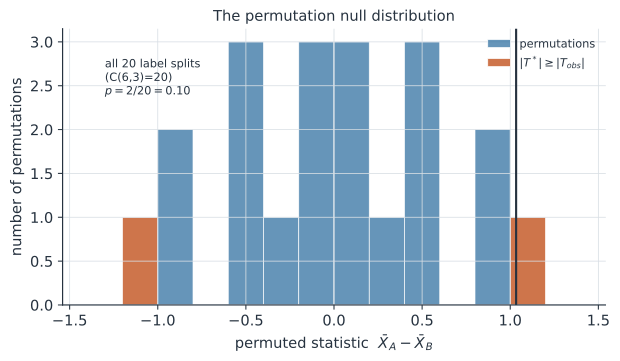
There are ways to split the six pooled values into two groups of three. We recompute for each split and count how many give (Figure 1). That count over 20 (with the continuity adjustment) is the two-sided permutation p-value. With small the smallest attainable p-value is bounded below by .
In code#
R#
set.seed(1)
a <- c(5.1, 6.3, 5.8); b <- c(4.2, 4.9, 5.0)
obs <- mean(a) - mean(b)
pool <- c(a, b); n <- length(a)
perm <- replicate(10000, {
  idx <- sample(length(pool), n)          # shuffle labels
  mean(pool[idx]) - mean(pool[-idx])
})
(sum(abs(perm) >= abs(obs)) + 1) / (length(perm) + 1)   # two-sided p
Python#
import numpy as np
rng = np.random.default_rng(1)
a = np.array([5.1, 6.3, 5.8]); b = np.array([4.2, 4.9, 5.0])
obs = a.mean() - b.mean()
pool = np.concatenate([a, b]); n = len(a)
perm = np.empty(10000)
for i in range(perm.size):
    p = rng.permutation(pool)              # shuffle labels
    perm[i] = p[:n].mean() - p[n:].mean()
print((np.sum(np.abs(perm) >= abs(obs)) + 1) / (perm.size + 1))
0.0978902109789021
Julia#
using Random, Statistics
Random.seed!(1)
a = [5.1, 6.3, 5.8]; b = [4.2, 4.9, 5.0]
obs = mean(a) - mean(b)
pool = vcat(a, b); n = length(a)
perm = map(1:10_000) do _
    p = shuffle(pool)                      # shuffle labels
    mean(p[1:n]) - mean(p[n+1:end])
end
println((count(x -> abs(x) >= abs(obs), perm) + 1) / (length(perm) + 1))
Why it matters for statistics#
Permutation tests give exact or nearly exact p-values under minimal assumptions, relying only on exchangeability rather than normality or large samples. They are a robust, transparent alternative to parametric tests and generalize to almost any statistic you can compute.