Confidence Intervals
A confidence interval reports a range of plausible values for a parameter—a mean incubation time, a prevalence—together with an estimate’s uncertainty. It shifts attention from a single point estimate to the precision behind it.
The idea#
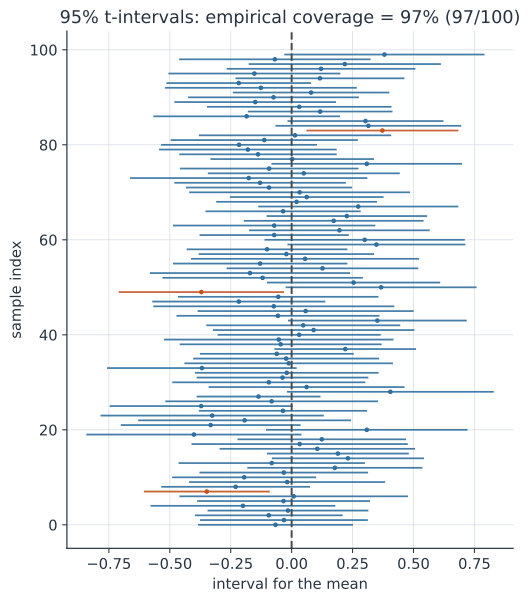
A confidence interval (CI) is an interval, computed from data, designed so that the procedure captures the true parameter a specified fraction of the time (the confidence level, e.g. 95%) across repeated samples.
For a population mean with unknown variance, the standard CI is
where is the sample mean, the sample standard deviation, the sample size, and the upper- critical value of the -distribution with degrees of freedom. The term is the standard error.
Correct interpretation#
The frequentist statement is about the procedure, not a fixed interval:
If we repeated the sampling many times and built a 95% CI each time, about 95% of those intervals would contain the true parameter.
For one particular observed interval, the parameter either is or is not inside it—so it is incorrect to say for that fixed interval. The 95% describes long-run coverage of the method (see sampling distributions).
Worked example#
For , , , a 95% CI for the mean uses :
giving . Because the reference value lies inside, this agrees with a two-sided -test at that does not reject .
In code#
R#
set.seed(42)
x <- rnorm(10, mean = 5.8, sd = 1.2)
t.test(x, mu = 5)$conf.int      # 95% CI for the mean
Python#
import numpy as np
from scipy import stats
rng = np.random.default_rng(42)
x = rng.normal(5.8, 1.2, size=10)
print(stats.t.interval(0.95, df=len(x)-1,
                       loc=x.mean(), scale=stats.sem(x)))
(np.float64(4.595976442189666), np.float64(6.198652417636242))
Julia#
using HypothesisTests, Random, Distributions
Random.seed!(42)
x = rand(Normal(5.8, 1.2), 10)
println(confint(OneSampleTTest(x)))   # 95% CI
Simulation: coverage#
Build many 95% CIs from a known population and count how many cover the true mean—about 95% should.
set.seed(1)
mu <- 5
covered <- replicate(10000, {
  x  <- rnorm(20, mean = mu, sd = 2)
  ci <- t.test(x)$conf.int
  ci[1] <= mu && mu <= ci[2]
})
mean(covered)   # ~0.95
Why it matters for statistics#
Confidence intervals communicate both the estimate and its uncertainty on the natural scale of the parameter, making results easier to judge than a bare p-value. Their coverage guarantee is the interval-based counterpart to hypothesis testing and is central to reporting effect sizes in epidemiology.