Fitting Dynamic Models to Data
A mechanistic model like an SIR system of differential equations describes how an epidemic could unfold, but its parameters are unknown until we confront it with data. Model calibration is the process of tuning those parameters so the model’s output matches observed counts, turning a qualitative story into quantitative estimates like the basic reproduction number.
From model to data#
Start with a mechanistic model whose trajectory depends on parameters , for instance the transmission rate and recovery rate of an SIR model. Solving the equations for a candidate produces a predicted curve, such as daily new infections . Calibration asks: which makes that predicted curve line up best with the observed incidence ? Answering it requires a way to score the mismatch and a way to search over .
The objective function#
The simplest score is least squares, or trajectory matching, which sums the squared gaps between model and data: For count data a likelihood is more natural, because it models the noise explicitly. If observed cases are Poisson around the model’s expected incidence, , the negative log-likelihood to minimize is and a negative-binomial version adds a dispersion parameter to handle overdispersed surveillance data. Minimizing this objective is exactly maximum likelihood estimation of the model parameters.
Optimization#
Because the model has no closed-form solution, we find the best-fit by numerical optimization: repeatedly evaluate the objective, adjust , and iterate until it stops improving. Derivative-free routines like Nelder–Mead, or gradient-based methods, both work well for low-dimensional epidemic models. The output is a point estimate , from which we derive quantities of interest such as the basic reproduction number .
Identifiability and uncertainty#
Not every parameter can be pinned down from incidence alone. If we only observe a fraction of true cases, then and can trade off: a higher transmission rate with lower reporting can produce nearly the same observed curve, so the two are only jointly identifiable with extra information. Even for well-identified parameters, the point estimate is not the whole story. Confidence intervals (from the curvature of the log-likelihood) or Bayesian credible intervals (from Bayesian inference) quantify how tightly the data constrain each parameter, and hypothesis tests can compare nested model variants.
Worked example: recovering R0#
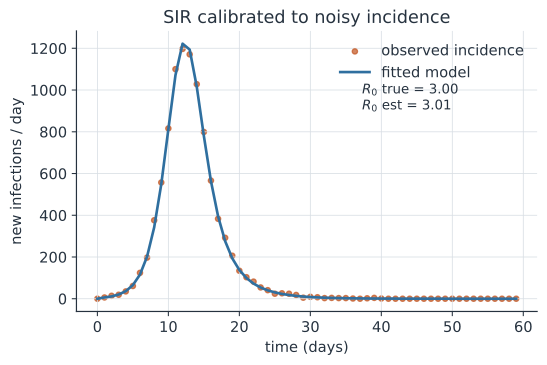
Simulate an SIR epidemic with known and , then generate a noisy observed incidence series by drawing Poisson counts around the model’s daily new infections. Fit and by minimizing the Poisson negative log-likelihood with a numerical optimizer, starting from a rough guess. The fitted values land close to the truth, and the recovered matches the value used to generate the data.
In code#
Python#
import numpy as np
from scipy.integrate import solve_ivp
from scipy.optimize import minimize

rng = np.random.default_rng(3)
N, days = 10000.0, np.arange(0, 60)
beta_true, gamma_true = 0.9, 0.3           # R0 = 3

def incidence(beta, gamma):
    def sir(t, y):
        S, I, R = y
        inf = beta * S * I / N
        return [-inf, inf - gamma * I, gamma * I]
    sol = solve_ivp(sir, [0, days[-1]], [N - 5, 5, 0],
                    t_eval=days, rtol=1e-8, atol=1e-8)
    return np.clip(-np.diff(sol.y[0], prepend=N - 5), 1e-6, None)

obs = rng.poisson(incidence(beta_true, gamma_true))    # noisy data

def nll(theta):
    b, g = theta
    if b <= 0 or g <= 0:
        return 1e12
    lam = incidence(b, g)
    return np.sum(lam - obs * np.log(lam))             # Poisson -log L

res = minimize(nll, [0.5, 0.5], method="Nelder-Mead")
b_hat, g_hat = res.x
print(round(b_hat, 3), round(g_hat, 3))                # ~0.90, ~0.30
print(round(beta_true / gamma_true, 3))                # true R0 = 3.0
print(round(b_hat / g_hat, 3))                         # est  R0 ~ 3.0
0.896 0.298
3.0
3.006
R#
library(deSolve)
set.seed(3)
N <- 10000; days <- 0:59
sir <- function(t, y, p) {
  inf <- p["beta"] * y["S"] * y["I"] / N
  list(c(S = -inf, I = inf - p["gamma"] * y["I"], R = p["gamma"] * y["I"]))
}
incidence <- function(beta, gamma) {
  out <- ode(c(S = N - 5, I = 5, R = 0), days, sir,
             c(beta = beta, gamma = gamma))
  pmax(-diff(c(N - 5, out[, "S"])), 1e-6)
}
obs <- rpois(length(days), incidence(0.9, 0.3))     # R0 = 3
nll <- function(p) { lam <- incidence(p[1], p[2]); sum(lam - obs * log(lam)) }
fit <- optim(c(0.5, 0.5), nll)
fit$par                 # ~0.9, ~0.3
fit$par[1] / fit$par[2] # estimated R0 ~ 3
Bayesian fit with NumPyro#
The optimizer above returns a single best-fit point.
A Bayesian fit instead returns the whole posterior over , , and , so the uncertainty and any parameter trade-offs are explicit (see MCMC and Bayesian inference).
NumPyro expresses the model in JAX and samples it with the NUTS Hamiltonian Monte Carlo sampler; here the epidemic is integrated with a small fixed Euler step inside lax.scan, so the whole model is differentiable and reproduces the same daily incidence as the ODE that made the data.
import jax, jax.numpy as jnp
from jax import random
import numpyro, numpyro.distributions as dist
from numpyro.infer import MCMC, NUTS

N = 10000.0
n_days = obs.shape[0]                       # `obs` = the noisy incidence from above
sub = 20                                    # Euler sub-steps per day -> matches the ODE
dt = 1.0 / sub

def sir_model(obs=None):
    beta = numpyro.sample("beta", dist.LogNormal(jnp.log(0.5), 0.5))   # priors
    gamma = numpyro.sample("gamma", dist.LogNormal(jnp.log(0.5), 0.5))

    def day(state, _):                      # advance one day in `sub` small steps
        S, I, R = state
        new = 0.0
        for _ in range(sub):
            inf = beta * S * I / N * dt      # new infections this sub-step
            rec = gamma * I * dt
            S, I, R = S - inf, I + inf - rec, R + rec
            new = new + inf
        return (S, I, R), new

    _, incidence = jax.lax.scan(day, (N - 5.0, 5.0, 0.0), None, length=n_days)
    incidence = jnp.concatenate([jnp.zeros(1), incidence[:-1]])        # align with obs day 0
    numpyro.deterministic("R0", beta / gamma)
    numpyro.sample("obs", dist.Poisson(jnp.clip(incidence, 1e-6, None)), obs=obs)

mcmc = MCMC(NUTS(sir_model), num_warmup=500, num_samples=1000, progress_bar=False)
mcmc.run(random.PRNGKey(0), obs=jnp.asarray(obs, float))
mcmc.print_summary(exclude_deterministic=False)   # posterior mean, 90% CI, and R-hat
                mean       std    median      5.0%     95.0%     n_eff     r_hat
        R0      2.95      0.10      2.95      2.80      3.12    176.42      1.00
      beta      0.91      0.01      0.91      0.89      0.93    167.80      1.00
     gamma      0.31      0.01      0.31      0.28      0.33    167.41      1.00

Number of divergences: 0
Instead of a single , you get a posterior distribution for it — the honest, uncertainty-aware version of the same calibration.
Why it matters#
Calibration is how mechanistic models earn their keep in public health: fitting an SIR or SEIR model to surveillance data yields real-time estimates of transmissibility, reporting, and that guide response. Understanding the objective, the optimizer, and the limits set by identifiability keeps those estimates honest and their uncertainty visible.