Transformers and Attention
The deep-learning overview introduced attention in a sentence; it deserves a page, because the transformer is the single most consequential neural architecture of the last decade and the engine under every foundation model. Its core idea is self-attention: rather than processing a sequence step by step like an LSTM, let every element look directly at every other and decide, for itself, what to pay attention to. That one operation — parallelizable and able to reach across an entire sequence at once — is what let models train on internet-scale data, and it powers genomic language models, protein-structure prediction, and clinical-text understanding as readily as it powers chatbots.
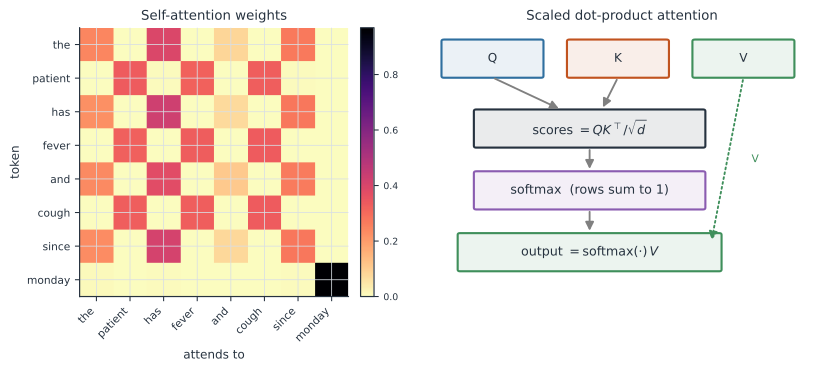
Self-attention#
Each element of the input is first turned into three vectors by learned linear maps: a query (what am I looking for?), a key (what do I offer?), and a value (what do I carry?). A token’s query is compared against every token’s key by a dot product, the scores are scaled and softmaxed into weights that sum to one, and the output is the weighted average of the values. Stacking the per-token vectors into matrices , , , the whole operation is one expression: where is the key dimension and the scaling keeps the dot products from growing large and saturating the softmax. The softmaxed matrix is exactly the heatmap on the left of the figure: row says how much token draws from each other token, and because it is a genuine average over all positions, a token can pull information from the far end of the sequence in a single step — the long-range reach an LSTM struggles for.
Multi-head attention and positional encoding#
One attention operation captures one kind of relationship; a transformer runs several in parallel. Multi-head attention projects the input into independent sets of queries, keys, and values, applies attention (1) in each head, and concatenates the results, so different heads can specialize — one tracking syntax, another long-range dependencies, another, in a genomic model, base-pairing. Attention has one blind spot: it is permutation-invariant, treating the input as a set, so on its own it cannot tell “cough since Monday” from “Monday since cough”. The fix is positional encoding — adding to each element a vector that encodes its position (classically a bank of sines and cosines of different frequencies) — so order is restored as information the attention can use.
The transformer block#
A transformer stacks identical blocks, each pairing a multi-head self-attention layer with a small position-wise feedforward network, and wrapping both in two tricks that make deep stacks trainable: a residual connection (add the input back to the output) and layer normalization. Two structural variants matter. An encoder uses unmasked self-attention so every token sees the whole sequence — right for understanding tasks (classify a clinical note, embed a genome). A decoder uses causal masking so a token sees only earlier positions — right for generation, where the model predicts the next token from the past, the mechanism behind large language models. Cross-attention, where queries come from one sequence and keys/values from another, links the two in translation-style tasks.
Why it took over#
The transformer displaced recurrent networks for three reasons. It is parallel: every position is processed at once, not one step at a time, so it trains far faster on modern hardware. It has a short path between any two positions — one attention hop — so gradients and information travel across long sequences without the vanishing-gradient decay that plagues RNNs. And it scales: performance keeps improving predictably with more data, parameters, and compute, which is what made foundation models possible. The cost is that attention is in the sequence length — every token attends to every other — which is why long-sequence variants (sparse, linear, and windowed attention) are an active field, especially for genomics, where sequences are enormous.
A worked example#
Take three tokens with . Form the matrix of scaled dot products ; softmax each row so its three weights sum to one; then multiply by to blend the value vectors by those weights. If token 1’s query aligns most with token 2’s key, row 1 of the softmax puts the most weight on token 2, so token 1’s output is dominated by token 2’s value — token 1 has “attended to” token 2. Running this in every head and every block, over billions of tokens, is the whole of a transformer.
In code#
Python#
Positional encodings and a full transformer encoder block are a few lines with PyTorch — here we build the sinusoidal positions and run one encoder layer over a short sequence:
import numpy as np, torch, torch.nn as nn
torch.manual_seed(0)

def positional_encoding(seq_len, d):            # sinusoidal position vectors
    pos = np.arange(seq_len)[:, None]
    i = np.arange(d)[None, :]
    angle = pos / (10000 ** (2 * (i // 2) / d))
    return np.where(i % 2 == 0, np.sin(angle), np.cos(angle))

pe = positional_encoding(seq_len=6, d=16)
layer = nn.TransformerEncoderLayer(d_model=16, nhead=4, dim_feedforward=32,
                                   batch_first=True)               # one block
x = torch.randn(1, 6, 16) + torch.tensor(pe, dtype=torch.float32)  # tokens + positions
out = layer(x)                                    # self-attention + FFN + residuals
print("positional encoding shape:", pe.shape)
print("encoder output shape:", tuple(out.shape))
print("block parameters:", sum(p.numel() for p in layer.parameters()))
positional encoding shape: (6, 16)
encoder output shape: (1, 6, 16)
block parameters: 2224
In practice you rarely build one from scratch — you load a pretrained transformer for your domain (illustrative — HuggingFace fetches weights over the network, so shown, not run):
# no-run
from transformers import AutoModel, AutoTokenizer

# a genomic language model: a transformer pretrained on DNA sequences
tok = AutoTokenizer.from_pretrained("InstaDeepAI/nucleotide-transformer-500m-human-ref")
model = AutoModel.from_pretrained("InstaDeepAI/nucleotide-transformer-500m-human-ref")
emb = model(**tok("ACGTACGTACGT", return_tensors="pt")).last_hidden_state
R#
# torch for R exposes nn_transformer_encoder_layer; text/keras3 for NLP pipelines.
library(torch)
layer <- nn_transformer_encoder_layer(d_model = 16, nhead = 4,
                                      dim_feedforward = 32, batch_first = TRUE)
out <- layer(torch_randn(1, 6, 16))
Julia#
# Transformers.jl implements attention, multi-head blocks, and pretrained models.
using Transformers, Transformers.Layers
block = TransformerBlock(4, 16, 32)     # heads, model dim, feedforward dim
y = block(randn(Float32, 16, 6))        # (features, sequence length)
Why it matters#
Transformers are not just for language. In genomics, DNA and protein language models (the Nucleotide Transformer, DNABERT, ESM) pretrain on sequence and transfer to variant-effect prediction, regulatory-element detection, and function annotation; AlphaFold uses attention over residues to predict protein structure, reshaping structural biology. In clinical data, transformers read unstructured notes to extract diagnoses and outcomes, and structured-EHR transformers model a patient’s timeline as a sequence of events. The same cautions from the foundation-model and overfitting pages apply with force — these models are enormous pattern-matchers that must be validated, calibrated, and watched for the biases in their training data — but the architecture itself is now the default whenever the data are a sequence and the relationships are long-range.