Diagnostic Testing and Screening
A diagnostic test never returns the truth—it returns a noisy signal that we must interpret in light of how common the disease is. The same test that looks excellent in the lab can be nearly useless for screening a healthy population, and understanding why is one of the most practically important applications of Bayes’ theorem.
Sensitivity and specificity#
Two conditional probabilities describe how a test behaves on people whose true status we already know. Sensitivity is the true-positive rate, : the chance a truly diseased person tests positive. Specificity is the true-negative rate, : the chance a truly healthy person tests negative. These are properties of the test itself and, unlike the quantities below, do not depend on how common the disease is.
Prevalence and the question that matters#
Prevalence is the probability that a randomly chosen person from the tested population actually has the disease. A clinician holding a positive result does not want sensitivity; they want the reverse conditional, . Getting from one to the other requires prevalence, and this is where intuition often fails.
Bayes’ theorem: predictive values#
The positive predictive value is the probability that a person who tests positive truly has the disease. Bayes’ theorem gives
The denominator is just the total probability of a positive test: true positives plus false positives. The negative predictive value is the mirror image, the chance a negative test is correct:
Unlike sensitivity and specificity, both predictive values depend on prevalence.
The base-rate effect#
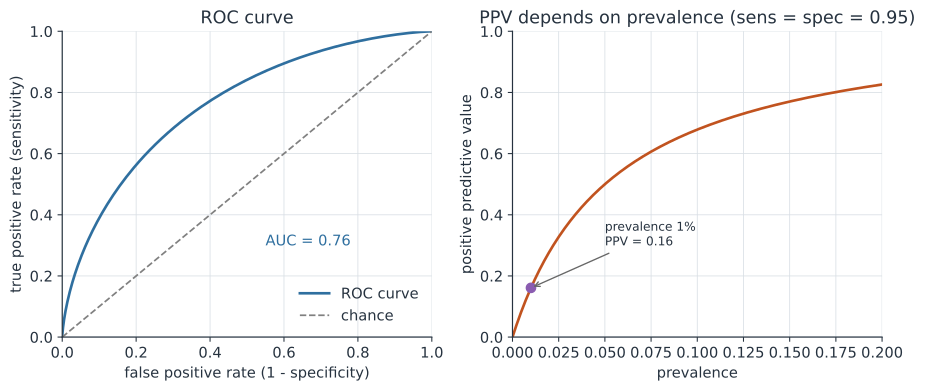
Consider a genuinely good test with and , used to screen a population where the disease has prevalence . Out of people, about are diseased and of them test positive. But among the healthy people, —about —also test positive. So of positive tests, only are real, giving . A positive result still means the disease is unlikely, purely because the disease was rare to begin with. This base-rate effect is why screening for rare conditions demands very high specificity, and why positive screening results are confirmed with a second, independent test.
Likelihood ratios#
Likelihood ratios repackage the same information in a way that combines cleanly with prior odds. The positive likelihood ratio is
and the negative likelihood ratio is . The appeal is that posterior odds equal prior odds times the likelihood ratio: . For our example , so a positive test multiplies the prior odds of disease by .
ROC curves and AUC#
Most tests report a continuous score, and we choose a threshold above which we call the result positive. Lowering the threshold catches more true cases (higher sensitivity) but also flags more healthy people (lower specificity), so there is always a trade-off. The receiver operating characteristic (ROC) curve plots the true-positive rate against the false-positive rate as the threshold sweeps across every possible value. The area under the curve (AUC) summarizes the whole curve in one number: it equals the probability that a randomly chosen diseased person scores higher than a randomly chosen healthy one. An AUC of is the diagonal chance line and is a perfect test; the figure’s test, with diseased scores and healthy , gives .
In code#
R#
ppv <- function(sens, spec, prev)
  (sens * prev) / (sens * prev + (1 - spec) * (1 - prev))
npv <- function(sens, spec, prev)
  (spec * (1 - prev)) / (spec * (1 - prev) + (1 - sens) * prev)

ppv(0.95, 0.95, 0.01)   # ~0.161
npv(0.95, 0.95, 0.01)   # ~0.999
Python#
def ppv(sens, spec, prev):
    return (sens * prev) / (sens * prev + (1 - spec) * (1 - prev))

def npv(sens, spec, prev):
    return (spec * (1 - prev)) / (spec * (1 - prev) + (1 - sens) * prev)

sens, spec = 0.95, 0.95
for prev in (0.01, 0.10):
    print(prev, round(ppv(sens, spec, prev), 3), round(npv(sens, spec, prev), 4))
# 0.01 0.161 0.9995
# 0.1 0.679 0.9942

print("LR+ =", sens / (1 - spec))   # LR+ = 19.0
0.01 0.161 0.9995
0.1 0.679 0.9942
LR+ = 18.999999999999982
Julia#
ppv(sens, spec, prev) = (sens*prev) / (sens*prev + (1-spec)*(1-prev))
npv(sens, spec, prev) = (spec*(1-prev)) / (spec*(1-prev) + (1-sens)*prev)

println(ppv(0.95, 0.95, 0.01))   # ~0.161
println(npv(0.95, 0.95, 0.01))   # ~0.999
Why it matters#
Predictive values, not sensitivity and specificity, are what a patient and clinician actually experience, and they hinge on prevalence in a way that surprises even trained professionals. The base-rate effect explains why mass screening for rare diseases produces mostly false alarms, why confirmatory testing is essential, and why the same test can be superb in a clinic yet misleading in the general public.