Hypothesis Testing
Hypothesis testing is the formal machinery epidemiologists use to decide whether an observed effect—a difference in infection rates, a shift in mean exposure—is more than noise. It frames a question as a decision between two competing claims about the world.
The two hypotheses#
The classical hypothesis framework is that of Pearson in a frequentist framework.
- The null hypothesis states “no effect” or “no difference” (e.g., the mean equals a reference value).
- The alternative hypothesis is what we entertain if the data are incompatible with (e.g., the mean differs).
We summarize the data with a test statistic—a single number whose distribution under is known.
What’s important to consider and cannot be said enough– a hypothesis is either supported or rejected given some threshold in the frequentist framework. There are Bayesian alternatives and other frequentist frameworks, but the Pearson hypothesis testing approach is most common so we’ll cover it here.
The logic#
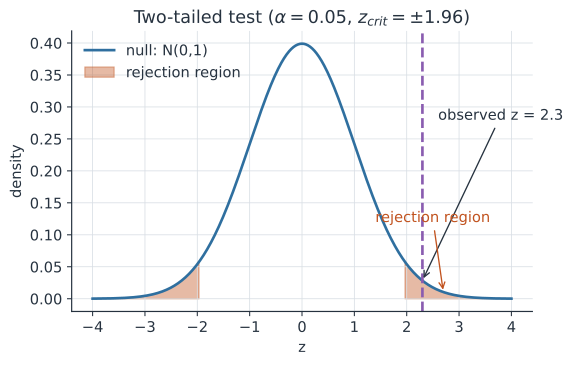
The reasoning is a proof by contradiction under uncertainty: assume is true, then ask how surprising the observed data are. If data at least as extreme as ours would almost never occur when holds, we reject in favor of . The measure of surprise is the p-value.
Errors and significance level#
Because we decide under uncertainty, two mistakes are possible:
| true | false | |
|---|---|---|
| Reject | Type I error (prob. ) | correct |
| Fail to reject | correct | Type II error (prob. ) |
The significance level (often ) is the Type I error rate we are willing to tolerate; we reject when the p-value is below . Power is .
Choosing a test by data type#
There is a common cookbook approach to choosing a test statistic. These are just general heuristics, and really, many of the test statistics are related through distributional assumptions. The common tests based on the support (i.e., what values a given data generating process can take on) determine the test statistic along with the values that are generated.
| Data | Question | Typical test |
|---|---|---|
| Continuous | mean vs. value / two means | z-test (known ), -test |
| Proportions | success rate vs. value / two rates | binomial test, prop.test |
| Counts / categories | association in a table | chi-square, Fisher’s exact |
Again, these are simple approaches and there are many more test statistics that can be considered. The linear model for instance is highly flexible (and related to most of these tests).
Worked example: one-sample -test#
Suppose we measure incubation times (days) for cases and want to test against . We observe and . The test statistic is
compared to a -distribution with degrees of freedom. The two-sided p-value is about , so at we would not reject .
In code#
R#
set.seed(42)
x <- rnorm(10, mean = 5.8, sd = 1.2)
t.test(x, mu = 5)                      # continuous: one-sample t-test
prop.test(x = 18, n = 40, p = 0.5)     # proportion vs. 0.5
Python#
import numpy as np
from scipy import stats
rng = np.random.default_rng(42)
x = rng.normal(5.8, 1.2, size=10)
print(stats.ttest_1samp(x, popmean=5))          # continuous
print(stats.binomtest(18, 40, p=0.5))           # proportion
TtestResult(statistic=np.float64(1.1216087309978322), pvalue=np.float64(0.2910612434086062), df=np.int64(9))
BinomTestResult(k=18, n=40, alternative='two-sided', statistic=0.45, pvalue=0.6358280026288412)
Julia#
using HypothesisTests, Random, Distributions
Random.seed!(42)
x = rand(Normal(5.8, 1.2), 10)
println(OneSampleTTest(x, 5.0))          # continuous
println(BinomialTest(18, 40, 0.5))       # proportion
Why it matters for statistics#
Hypothesis testing gives a disciplined, reproducible rule for turning data into decisions while controlling the rate of false alarms. It is the foundation for evaluating treatment effects, screening associations, and reporting findings in nearly every quantitative study.